Fastener Surface Treatment and Corrosion Protection: How to Choose the Right Finish
Fastener surface treatment and corrosion protection is not just about appearance—it determines service life, installation consistency, and the total cost of ownership. The same bolt in a dry indoor plant and on a coastal bridge will face completely different corrosion risks. Choosing the right coating or plating can prevent red rust, reduce galling, stabilize torque-tension performance, and meet customer standards such as ISO, ASTM, or OEM specifications. This guide explains the most common anti-corrosion processes for screws, bolts, nuts, and washers, and how to select the best option for your environment.
Why Surface Treatment Matters for Fasteners
Fasteners are often the first components to show corrosion because they are exposed edges on an assembly. Even when the base metal is strong, corrosion can reduce cross-section, weaken threads, and create seizure during maintenance. That is why buyers frequently search for “best coating for bolts,” “anti corrosion coating for screws,” and “salt spray test hours” when selecting parts for outdoor projects.
Beyond corrosion resistance, surface finish impacts friction. Friction affects tightening torque, clamp load, and loosening risk. A coating choice can change installation behavior as much as it changes rust performance, especially for high-strength fasteners and automated assembly lines.
Common Fastener Finishes and What They Are Good For
There is no “one best” finish. Each option has tradeoffs in corrosion resistance, cost, thickness, appearance, and environmental compliance.
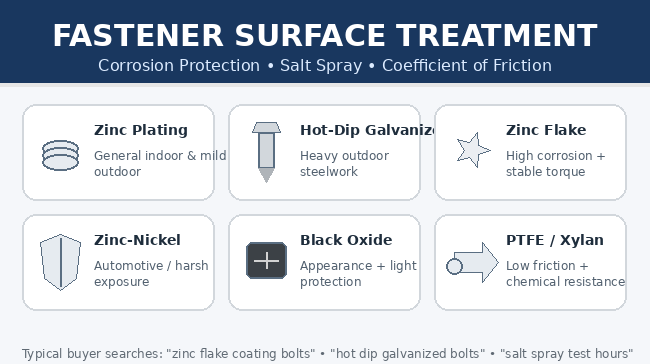
- Zinc plating (electro zinc): A widely used, cost-effective option for general indoor and mild outdoor use. Often paired with blue/clear, yellow, or black passivation. Popular searches include “zinc plated screws rust” because performance depends heavily on passivation quality and exposure conditions.
- Hot-dip galvanizing (HDG): Thick zinc coating for outdoor steel structures, power transmission, and heavy construction. HDG provides strong long-term protection but can affect thread fit due to coating thickness. “Hot dip galvanized bolts and nuts” is a common procurement keyword for infrastructure projects.
- Zinc-nickel plating: Higher corrosion performance than standard zinc plating, often used in automotive and demanding industrial environments. It can provide excellent salt spray performance with proper topcoats. Buyers often search “zinc nickel vs zinc plating” when upgrading corrosion specs.
- Mechanical galvanizing: A non-electro process that avoids hydrogen embrittlement risk compared with some electroplating processes, making it attractive for high-strength fasteners.
- Zinc flake coatings (Dacromet/Geomet-like): High corrosion resistance and widely used for automotive and wind power applications. These systems often deliver strong salt spray performance and stable friction when paired with a topcoat. Search phrases like “zinc flake coating bolts” and “Geomet coating” are popular because many OEMs specify them.
- Black oxide: Mainly for appearance and mild corrosion protection when used with oil; best for indoor, controlled environments. Often searched as “black oxide screws” for tooling and machinery aesthetics.
- Phosphate coating: Common as a base for lubrication, improving installation and reducing galling in some applications, but it is not a high-corrosion solution by itself.
- PTFE / Xylan / fluoropolymer topcoats: Used when low friction, chemical resistance, and anti-galling performance are critical. Often seen in chemical processing, offshore, and high-performance assemblies.
Fastener Surface Treatment and Corrosion Protection: How to Match Finish to Environment
Selecting the right finish starts with the environment and the expected service life. Consider these common scenarios:
- Indoor general machinery: Zinc plating or black oxide may be sufficient if humidity is controlled.
- Outdoor general use (non-coastal): Thicker zinc systems, zinc-nickel, or zinc flake coatings are often safer than basic electro zinc, depending on exposure.
- Coastal / marine / de-icing salt: Zinc flake with topcoat, specialized topcoats, or stainless solutions may be required. Buyers frequently search “marine corrosion resistant bolts” for this reason.
- High-temperature or chemical splash: Coating chemistry matters—some finishes degrade or discolor. Fluoropolymer systems may be considered for chemical resistance.
When comparing options, salt spray hours can be a useful reference, but it should not be the only decision factor. Real-world performance depends on UV exposure, wet/dry cycles, crevices, and contact materials.
Hydrogen Embrittlement: The Critical Risk for High-Strength Fasteners
If you use high-strength grades (such as 10.9 or 12.9), surface treatment must consider hydrogen embrittlement risk. Some electroplating processes can introduce hydrogen, which can lead to delayed brittle failure if baking and process control are insufficient. That is why many engineers search “hydrogen embrittlement in fasteners” and specify mechanical galvanizing or zinc flake systems for critical high-strength applications.
For safety-critical joints, ask your supplier about process control, baking procedures, and test methods used to mitigate risk.
Torque-Tension Consistency: Why Topcoats and Lubrication Matter
Modern assemblies often require predictable clamp load. Coatings with controlled friction (or paired topcoats) help stabilize torque-tension behavior. This is especially important in automated tightening where variance can create under-clamp or over-clamp conditions. Common searches include “torque tension relationship coating” and “coefficient of friction fastener coating.”
If your project relies on a defined friction window, specify it explicitly and confirm that the coating system can meet it.
What to Include in Your Coating Specification
To avoid miscommunication, a good specification includes:
- Base material and fastener standard (bolt, screw, nut, washer)
- Coating type and system (plating + passivation + topcoat if applicable)
- Required corrosion performance (test method and target, if defined)
- Thickness range and any thread fit requirements
- Friction requirement (if torque-tension is critical)
- Compliance needs (RoHS/REACH or customer-specific restrictions)
Partnering with a Supplier Who Can Support Multiple Finishes
For global sourcing, you often need options—zinc plating for general use, HDG for construction, zinc flake for high corrosion targets, and specialty topcoats for chemical environments. At Flybear Fastener, we support a wide range of surface treatments and corrosion protection systems for screws, bolts, nuts, and washers, helping buyers match finishes to real service conditions and project standards.
Conclusion
Fastener surface treatment and corrosion protection is a technical decision that balances environment, service life, assembly behavior, and compliance. By choosing the right coating system—zinc, HDG, zinc-nickel, zinc flake, or specialty topcoats—you can extend service life, reduce maintenance, and improve installation consistency. The best approach is to define the environment clearly, specify performance requirements, and work with a supplier that can control process quality and documentation.
Follow Me!