How to Prevent Screws from Loosening: Pre-Applied Patch, Liquid Threadlocker, or Nylon Patch—and Why They Fail
how to prevent screws from loosening is a top Google query for buyers and engineers because vibration, thermal cycling, and joint relaxation can defeat even “tight” fasteners over time. Whether you build machines, electronics, HVAC equipment, automotive components, or outdoor assemblies, loosening is rarely caused by one single factor. It’s usually a combination of reduced clamp load (from embedding, creep, or thermal effects) plus vibration that gradually rotates the fastener loose.
When people search “best threadlocker for screws,” “pre-applied threadlocker patch,” or “nylon patch screws vs threadlocker,” they want a clear, practical answer: which anti-loosening method fits my production line, my environment, and my service requirements—and what are the most common failure causes to avoid? This guide compares three mainstream options—pre-applied patch, liquid threadlocker, and nylon patch—then explains typical failure modes and prevention steps.
Why Screws Loosen: The Real Root Cause
Before picking a locking method, it helps to understand the mechanism. Most self-loosening happens when clamp load drops and micro-movement starts at the joint interface. Once friction at the interfaces decreases, vibration can cause small rotational movement. That’s why fixing loosening often means improving both:
- Retention: preventing rotation under vibration
- Clamp load stability: keeping preload from fading over time
Locking features work best when the joint design, torque method, and surface conditions are controlled.
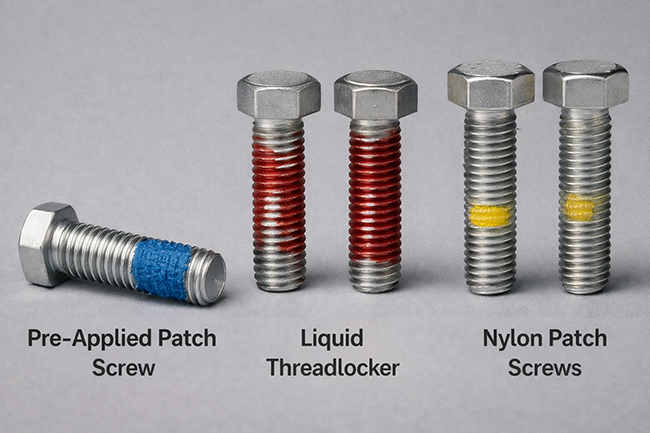
Option 1: Pre-Applied Threadlocker Patch (Dry Patch-Coated Screws)
Pre-applied patch-coated screws have a factory-applied locking patch on the threads. The patch provides controlled prevailing torque and/or adhesive locking during assembly. This approach is popular in automated production because it eliminates manual liquid application and reduces mess.
Advantages:
- Clean, fast installation for high-volume assembly
- Consistent application when the coating is tightly controlled
- Good for production lines that want predictable process flow
Limitations:
- Performance depends on patch position, thickness, and shelf life
- Can increase torque scatter if mating threads vary or are contaminated
- Reuse is limited and depends on patch chemistry
Option 2: Liquid Threadlocker (Anaerobic Adhesive)
Liquid threadlocker (often searched as “best threadlocker for screws”) cures in the absence of oxygen between metal surfaces. It can provide strong locking and sealing when applied correctly. However, consistency depends heavily on correct dispensing amount, clean threads, and correct cure time.
Advantages:
- Strong locking strength and good vibration resistance
- Many grades available (low/medium/high strength; removable vs permanent)
- Can also help seal threads in some applications
Limitations:
- Over/under-application causes inconsistent results
- Oil, plating residues, or passive surfaces can slow or reduce cure
- Cure time and temperature affect final performance
Option 3: Nylon Patch Screws (Prevailing Torque by Friction)
Nylon patch screws use a nylon pellet or strip on the threads to create friction against the mating thread. This is why “nylon patch screws vs threadlocker” is a common comparison—nylon patch is primarily a friction-based solution, while threadlocker can provide adhesive bonding as well.
Advantages:
- Simple, clean locking approach without curing time
- Good for controlled reuse in some service situations
- Useful when liquid adhesives are not preferred
Limitations:
- Locking depends on thread fit and temperature exposure
- May not seal against fluids unless combined with other sealing methods
- Torque can rise if the patch is oversized or threads are rough
Pre-Applied Patch vs Liquid Threadlocker vs Nylon Patch: Quick Selection Guide
- High-volume assembly, automation friendly: pre-applied patch
- Maximum locking strength and sealing options: liquid threadlocker
- Friction-based locking, no curing: nylon patch
In practice, the “best” method depends on whether your priority is production speed, field serviceability, sealing, chemical resistance, or torque consistency.
Common Failure Reasons (And How to Prevent Them)
Even the right locking method can fail if basic conditions are not controlled. Here are the most common failure causes across all three solutions:
- Contaminated threads: oil, coolant, dust, or plating residues reduce friction control and can prevent adhesive bonding. Cleanliness is a top driver of real-world performance.
- Wrong torque strategy: torque alone is sensitive to friction changes. For critical joints, consider torque-angle methods, controlled lubrication policies, and validation testing.
- Clamp load loss over time: embedding of rough surfaces, gasket compression, plastic creep, or thermal cycling reduces preload. Locking features cannot fully compensate for a joint that relaxes heavily.
- Mismatched thread fit: incorrect pitch/TPI or poor tolerance increases damage, galling, or early loosening.
- Shelf life and storage issues: pre-applied patches can change properties with heat/humidity; liquid threadlocker can degrade if stored improperly.
- Temperature and chemicals: heat can weaken nylon patches or change friction; chemicals can attack polymers or affect adhesive cure and durability.
Many teams search “why do screws loosen” after field failures. The root issue is often not the locking product—it’s assembly variability, contamination, or preload loss. A complete anti-loosening solution includes joint design, process control, and correct specification.
Best Practices to Prevent Screws from Loosening in Production
- Specify measurable requirements: prevailing torque window, breakaway torque targets, and vibration test criteria for your joint.
- Validate on real materials: test using actual female threads, plating, and surface conditions—not just lab coupons.
- Control storage and handling: FIFO inventory, sealed packaging, and retesting aged patch-coated screws.
- Standardize cleanliness: define allowable oil levels and protect mating threads from debris.
- Consider joint stability: use washers, better bearing surfaces, or spring elements when relaxation is expected.
How Flybear Fastener Supports Anti-Loosening Fastener Programs
Choosing the right anti-loosening method is a system decision: fastener design, locking feature, mating thread quality, and assembly process must work together. At Flybear Fastener, we support customers with pre-applied patch screws, nylon patch screws, and application guidance for liquid threadlocker programs—helping you define torque targets, patch positions, packaging, and verification plans for stable production performance.
Conclusion
How to prevent screws from loosening depends on your production needs and service conditions. Pre-applied patches offer clean, fast assembly; liquid threadlocker offers strong bonding and sealing options; nylon patches provide friction-based locking without cure time. Most failures come from contamination, torque variability, preload loss, or environmental mismatch. With clear specifications and real-joint validation, you can achieve reliable vibration resistance and reduce loosening-related failures.
Follow Me!