How to Choose Bolt Strength Grade and Material Grade: A Practical Guide for Engineers and Buyers
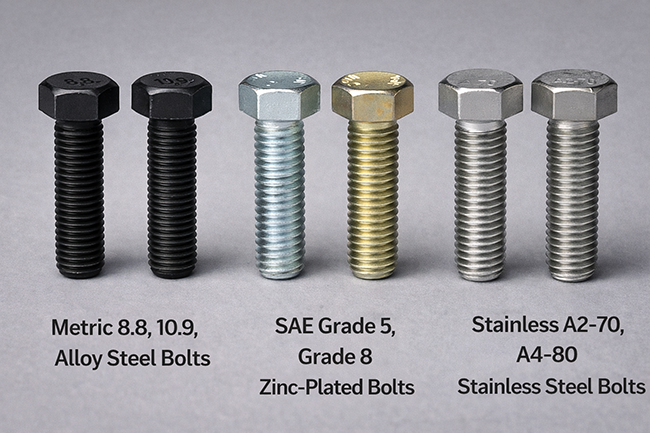
how to choose bolt strength grade is a common question because “grade” can mean different things across standards and materials. A metric bolt marked 8.8 is not the same grading system as an SAE Grade 8 bolt, and stainless grades like A2-70 or A4-80 follow yet another convention. If you choose the wrong strength grade or material grade, you can end up with joint loosening, bolt fracture, thread stripping, stress corrosion risks, or unnecessary cost.
Buyers often search for “bolt grades explained,” “8.8 vs 10.9 vs 12.9,” “Grade 5 vs Grade 8 bolt,” “A2-70 vs A4-80,” and “stainless vs alloy steel bolts.” This guide explains how to select fastener grades based on load, environment, and assembly constraints—without over-specifying.
Strength Grade vs Material Grade: What’s the Difference?
Strength grade describes mechanical performance—typically tensile strength and yield strength. Examples include metric property classes (8.8, 10.9, 12.9) and SAE grades (Grade 2, 5, 8). Material grade describes the base material family and chemistry—such as carbon steel, alloy steel, stainless 304/316, duplex stainless, brass, titanium, or PEEK.
In real sourcing decisions, you must match both: a bolt can be high strength but poor in corrosion, or corrosion resistant but not strong enough for the clamping load you need.
Start With the Application: Load, Joint Type, and Safety Factor
Before comparing “8.8 vs 10.9 vs 12.9,” define:
- Working load: static load, cyclic load, impact, or vibration
- Joint type: metal-to-metal, gasketed joint, plastic, or multi-material stack
- Failure mode risk: bolt fracture vs thread stripping vs joint slip
- Assembly method: torque control, torque-angle, or tensioning
A higher grade is not always safer. If the female thread is weak (thin sheet metal, soft aluminum), a very high-grade bolt can strip threads before reaching the needed clamp load.
Metric Property Classes: 8.8 vs 10.9 vs 12.9 (Bolts and Cap Screws)
Metric fasteners commonly use property classes:
- 8.8: a widely used general-purpose high-strength option for machinery
- 10.9: higher strength for more demanding joints, common in automotive and industrial equipment
- 12.9: very high strength often used for socket head cap screws and critical compact joints
Higher classes can provide higher clamp load for a given diameter, but they may increase sensitivity to hydrogen embrittlement and require tighter process control for coatings. This is why searches like “12.9 bolt hydrogen embrittlement” and “zinc plating high strength bolts” often appear in quality discussions.
SAE Grades: Grade 5 vs Grade 8 (Inch-Series Bolts)
In North America, inch-series bolts often use SAE grades, and “Grade 5 vs Grade 8 bolt” is a frequent search. As a simple selection concept:
- Grade 5: medium strength for many general mechanical applications
- Grade 8: higher strength for more demanding joints
Do not assume direct 1:1 equivalency between SAE grades and metric property classes. If your project crosses suppliers and standards, specify the exact standard (ISO/DIN/ASTM/ASME) and verify markings.
Stainless Grades: A2-70 vs A4-80 (Corrosion vs Strength Trade-Off)
Stainless fasteners use both material designation and strength class. “A2-70 vs A4-80” is a popular query because it captures the most common decision point:
- A2 (often 304): good general corrosion resistance for indoor and mild outdoor environments
- A4 (often 316): better corrosion resistance in chloride exposure (coastal air, de-icing salt, washdown)
- 70 / 80: strength class within the stainless system (higher number indicates higher minimum tensile strength class)
If corrosion is the main risk, A4 may outperform higher-strength carbon/alloy steel fasteners that rust quickly in real service. For outdoor hardware, marine equipment, and chemical environments, material grade can be more important than a small difference in tensile strength.
How to Choose Bolt Strength Grade: A Simple Decision Framework
How to choose bolt strength grade becomes easier if you follow a structured checklist:
- Step 1 — Define the environment: indoor dry, outdoor wet, coastal salt, chemical splash, high temperature.
- Step 2 — Define the joint requirement: is clamp load critical, is vibration present, is sealing needed?
- Step 3 — Match material grade: stainless (304/316), alloy steel, duplex, brass, titanium, or polymer.
- Step 4 — Select strength grade within the material: 8.8/10.9/12.9 or A2-70/A4-80.
- Step 5 — Confirm coating/finish: zinc, zinc-nickel, zinc flake, black oxide, passivation, or specialized coatings.
- Step 6 — Validate with real assembly testing: torque-to-tension behavior, stripping margin, vibration tests.
Common Buyer Mistakes (And How to Avoid Them)
- Over-specifying strength: choosing 12.9 when 8.8 is sufficient can increase cost and risk without improving performance.
- Ignoring corrosion: high strength does not help if the bolt rusts and seizes in one season.
- Not matching mating material: high-grade bolt into weak threads leads to stripping; consider inserts, larger diameter, or different joint design.
- Coating without process control: high-strength bolts need careful finishing to reduce embrittlement risk and maintain consistent friction.
- Mixing standards: markings and grade systems vary; always specify the standard and verify head markings.
Material + Coating Choices That Buyers Search Most Often
High-intent searches often combine grade and finish, for example: “8.8 zinc plated bolts,” “10.9 zinc flake coated,” “A4-80 stainless bolts,” and “zinc nickel plated fasteners.” In practice:
- Indoor general machinery: 8.8 with zinc plating is common
- Higher load + corrosion demand: 10.9 with zinc-nickel or zinc flake systems
- Coastal / washdown: A4 (316) stainless, often with passivation
Always align the selection with your environment and verify performance requirements rather than relying on a generic “best grade.”
How Flybear Fastener Helps Customers Select the Right Grades
Choosing the correct grade is a balance between mechanical safety and environmental durability. At Flybear Fastener, we support customers by matching fastener strength grade and material grade to the real application—considering load, vibration, corrosion exposure, and assembly method. We also help define clear RFQ specifications so you can avoid mismatched standards and reduce quality risk in production.
Conclusion
How to choose bolt strength grade and material grade starts with understanding your joint and environment. Use metric property classes (8.8/10.9/12.9) or SAE grades (Grade 5/8) for mechanical requirements, and select material grades (stainless A2/A4, alloy steel, duplex, etc.) for corrosion and temperature needs. With correct specification and real-joint validation, you can achieve reliable clamp load, avoid stripping and fracture, and control total cost.
Follow Me!