Titanium Screws: Types, Grades and Characteristics for Industrial Use
Titanium screws are advanced fastening components widely utilized in aerospace, automotive, medical, and high-performance industrial applications. Titanium offers a unique combination of high strength, low density, corrosion resistance, and biocompatibility. Selecting the appropriate titanium screw requires understanding alloy types, grades, and mechanical properties to ensure long-term reliability.

At Flybear Fastener, we supply a broad range of titanium screws to meet demanding engineering specifications across global industries.
Types of Titanium Screws
Titanium screws are available in several types depending on their head design, thread style, and intended application:
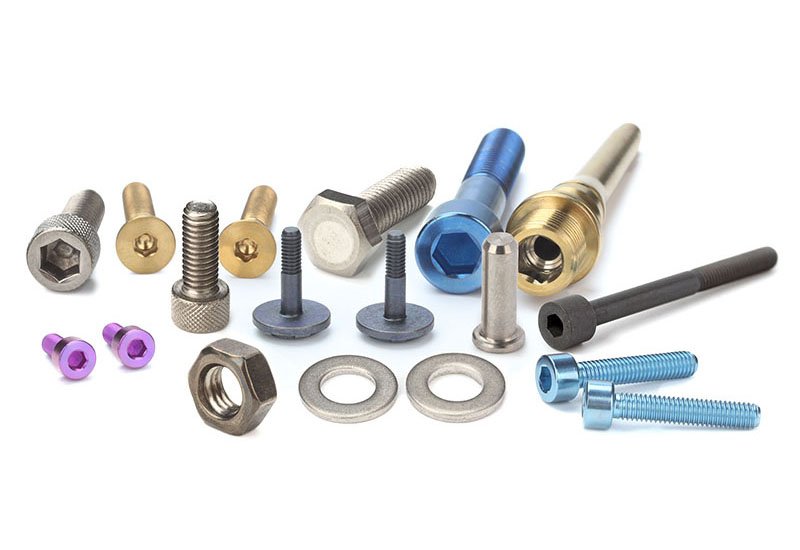
- Socket Head Cap Screws – Commonly used in precision machinery and aerospace assemblies due to their high strength and compact head design.
- Countersunk Head Screws – Ideal for flush mounting in structures requiring smooth surfaces.
- Button Head Screws – Offer a low-profile aesthetic while maintaining robust fastening performance.
- Fully Threaded and Partially Threaded Screws – Adaptable for structural and mechanical load applications.
Grades and Alloy Types
Titanium screws are classified by alloy type and mechanical grade. The most common international grades include:
- Grade 2 (Commercially Pure, CP-Ti) – Excellent corrosion resistance, moderate strength, used in chemical, marine, and medical applications.
- Grade 5 (Ti-6Al-4V) – Also known as TC4 or Ti 6Al4V, offers high tensile strength, lightweight characteristics, and superior fatigue resistance; widely used in aerospace and automotive industries.
- Grade 23 (Ti-6Al-4V ELI) – Extra low interstitial variant of Grade 5; optimized for medical implants and critical aerospace components.
Mechanical Properties and Advantages
Titanium screws provide a combination of properties that make them superior in high-performance applications:
- High strength-to-weight ratio
- Excellent corrosion and oxidation resistance
- Good fatigue resistance under cyclic loading
- Biocompatibility for medical devices
- Non-magnetic and electrically conductive properties in specific alloys
These features allow titanium screws to outperform conventional stainless steel or alloy steel fasteners in critical environments.
Surface Treatments and Finishes
Titanium screws can be enhanced with several surface treatments to improve wear, friction, and corrosion properties:
- Anodizing – Increases hardness, wear resistance, and can provide color coding.
- Passivation – Enhances corrosion resistance for chemical or marine exposure.
- Electropolishing – Produces smooth surfaces for medical or cleanroom applications.
Applications of Titanium Screws
Titanium screws are used in diverse high-performance sectors:
- Aerospace – Airframes, engines, and structural components
- Medical – Implants, surgical instruments, and prosthetics
- Marine – Saltwater-exposed structures and equipment
- Automotive – High-performance engines and lightweight assemblies
- Industrial Machinery – Robotics, precision machines, and chemical equipment
Selection Guide for Titanium Screws
When selecting a titanium screw, consider:
- Alloy grade (CP-Ti, Ti-6Al-4V, Ti-6Al-4V ELI)
- Mechanical load and tensile requirements
- Environmental exposure (corrosion, temperature, chemical)
- Thread size, pitch, and head type
- Surface treatment for wear, friction, or medical standards
Proper selection ensures performance, durability, and safety in demanding applications.
Conclusion
Titanium screws offer unmatched performance for industries requiring high strength, corrosion resistance, and low weight. By understanding types, grades, and material characteristics, engineers and procurement specialists can optimize assembly reliability and longevity. High-quality screws from Flybear Fastener guarantee compliance with international standards and superior engineering performance.
Follow Me!