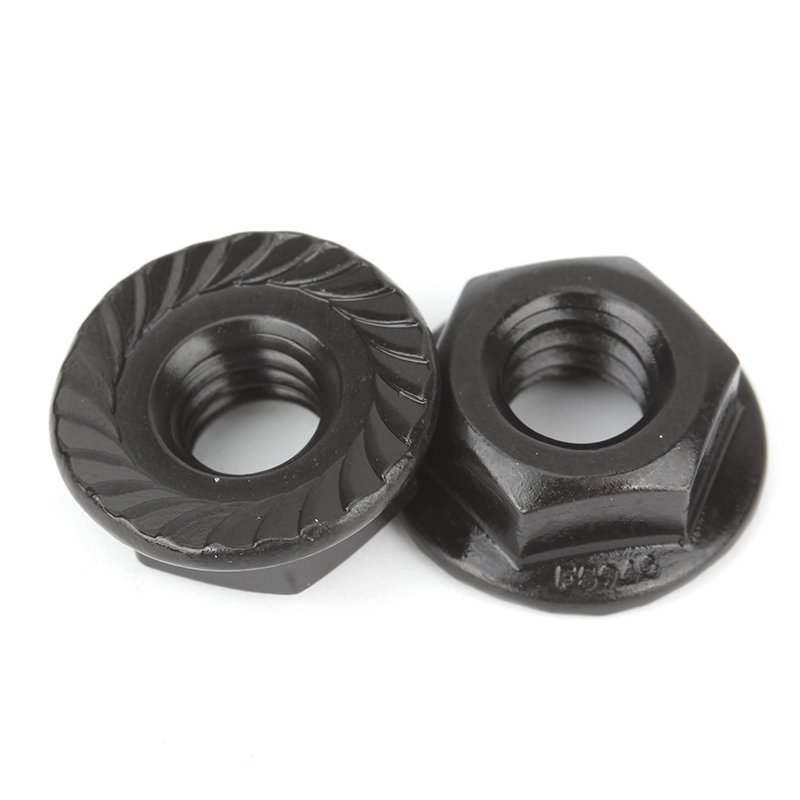
Flybear 304 black oxide flange nuts combine a stainless steel body, an integrated serrated flange, and a black surface finish. Designed for inch-series threaded assemblies, they provide a wider bearing footprint and a dark appearance that complements machinery frames, equipment housings, brackets, and mounting hardware.
The one-piece flange simplifies component handling, while the serrations engage the mating surface as the nut is tightened. This configuration suits assemblies where bearing support, resistance to rotation, and coordinated hardware appearance are practical design priorities.
Key Features of 304 Black Oxide Flange Nuts
- 304 stainless steel: Provides corrosion resistance for many indoor and mild outdoor service environments.
- Integrated flange: Extends the bearing footprint beyond the hex body and can reduce the need for a separate washer where the joint design permits.
- Serrated bearing face: Engages the mating surface under clamp load to help resist nut rotation.
- Black oxide finish: Matches dark equipment components and reduces the visual contrast of exposed hardware.
- External hex drive: Allows installation using a correctly sized wrench or socket.
Product Specifications
| Specification | Description |
|---|---|
| Product Type | Serrated hex flange nut |
| Material | 304 stainless steel |
| Surface Treatment | Black oxide finish |
| Body Configuration | External hexagon with an integral circular flange |
| Bearing Face | Serrated |
| Thread System | Inch series; diameter, threads per inch, and thread fit as specified |
| Dimensional Reference | IFI 145 historical dimensional reference; final dimensions per approved drawing |
| Mechanical Requirements | According to the agreed stainless steel nut specification |
| Inspection and Documentation | According to purchase order requirements |
IFI 145 addresses inch-series hex flange nuts and large hex flange nuts. Because it is a withdrawn standard, orders referencing IFI 145 should identify the required edition, nut configuration, and dimensional requirements. Material properties and load capacity should be specified separately.
304 Stainless Steel Body
304 is an austenitic chromium-nickel stainless steel commonly selected for industrial fasteners. Its protective passive surface film provides corrosion resistance in many ordinary atmospheric conditions, making it useful for equipment hardware exposed to humidity and occasional moisture.
For outdoor installations, assess chloride exposure, drainage, cleaning chemicals, and areas where moisture may collect. Marine environments and aggressive process conditions can require a different material selection.
The material designation does not establish a finished nut strength grade. Required proof load, mating bolt strength, and thread engagement should be evaluated together when selecting the nut for a load-bearing connection.
Integrated Flange for a Wider Bearing Footprint
The circular flange extends beyond the hexagonal body, providing a broader support footprint than a comparable plain hex nut. This helps distribute the clamping force across a larger region of the connected component, subject to the actual bearing contact and joint geometry.
Combining the nut and flange in one component can simplify handling during assembly. Where the joint has been designed for direct flange contact, it may also eliminate a separate washer from the bill of materials.
Flange diameter, hole size, edge distance, and component thickness should be considered together. Thin sheet, soft materials, and slotted holes may still need additional bearing support.
Serrated Face for Resistance to Rotation
The underside of the flange incorporates teeth that engage the mating surface as clamp load develops. This engagement increases resistance to rotation at the bearing interface and can help resist loosening in suitable assemblies.
Performance depends on the hardness and condition of the mating material, the applied preload, and the service loads. Serrations can mark the contact surface or disrupt paint and other coatings, so the joint should allow this contact.
For connections exposed to substantial vibration or repeated movement, validate the fastening arrangement under representative conditions. The presence of serrations alone does not establish a vibration-performance rating.
Black Oxide Finish for Dark Hardware Assemblies
The black oxide surface gives the nut a dark appearance that coordinates with black brackets, housings, and equipment frames. This is particularly useful when fasteners remain visible in the finished product.
Stainless steel blackening requires suitable surface preparation and a compatible finishing process. Shade, gloss, cleanliness, and handling characteristics depend on the process and any protective post-treatment. An approved appearance sample can help define expectations for repeat orders.
Corrosion performance should be evaluated for the finished part and its intended environment. Black color alone does not establish a salt spray rating. Where coating performance or residue limits matter, include the test method and acceptance criteria in the purchase specification.
Typical Applications
- Industrial machinery: Brackets, guards, covers, and accessory mounting points with suitable bearing surfaces.
- Automation equipment: Sensor supports, equipment frames, and mounting assemblies using inch-series hardware.
- Equipment enclosures: Mechanical connections where a black fastener finish complements the housing.
- Instrument supports: Mounts and brackets requiring compact hex tooling access and an integrated flange.
- General OEM assemblies: Connections where reducing loose assembly components supports an efficient installation process.
Explore Flybear’s stainless steel nuts and locking nuts for related configurations.
Installation and Inspection
Match the nut to the bolt’s exact inch diameter and thread pitch. Start the nut squarely by hand, then tighten with the serrated flange facing the intended bearing surface. Confirm that the flange seats properly without interference from an adjacent edge or raised feature.
Stainless steel threads can gall during tightening. Controlled installation speed and an appropriate, approved lubricant can help manage this risk. Lubrication, blackening post-treatment, and bearing-surface condition all influence friction, so tightening torque should be established for the actual assembly.
Relevant inspection items include material identification, thread gauging, flange diameter, nut height, width across flats, serration condition, and finish appearance. Mechanical testing and traceability documents should be included where required by the order. Review Flybear’s fastener quality inspection capabilities when defining your acceptance plan.
Frequently Asked Questions
Does a serrated flange nut need a washer?
The integral flange can provide the required bearing support in a suitable joint. Adding a washer changes the contact interface and prevents the serrations from engaging the component directly. Follow the approved assembly design when deciding whether a washer is required.
Can these nuts replace metric flange nuts?
IFI 145 is an inch-series dimensional reference. Metric and inch threads are not interchangeable. Confirm diameter, pitch, nut height, and flange clearance before selecting a replacement.
Does black oxide make the nut stronger?
Black oxide is a surface treatment. It does not establish a higher nut strength grade. Mechanical performance must be defined by the finished product specification and verified through the required testing.
Request a Quote for Your Application
Send Flybear the required thread designation, quantity, dimensional drawing or IFI 145 reference edition, and black finish requirements. Include the mating material, operating environment, and any proof-load, inspection, or documentation requirements.
Contact Flybear for a quotation on 304 stainless steel black oxide serrated hex flange nuts matched to your assembly requirements.
Follow Me!