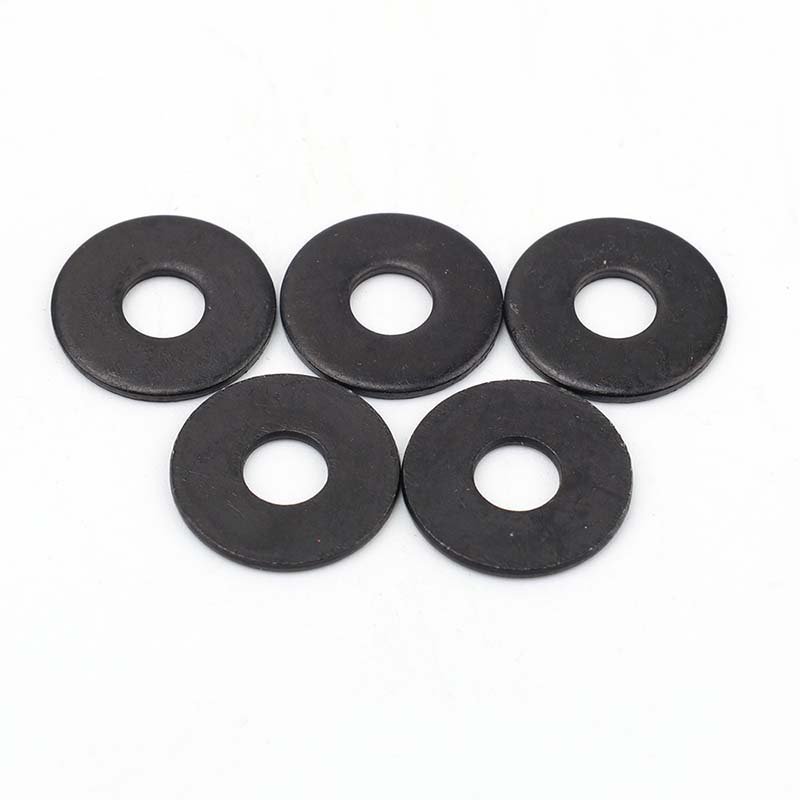
Flybear DIN 9021 black oxide washers combine a large outside diameter with a 304 stainless steel body and a blackened surface. The broad bearing footprint helps distribute clamping force across the connected component, making these washers useful for equipment panels, mounting brackets, covers, and assemblies requiring greater support around a clearance hole.
The black finish coordinates with dark bolts, nuts, frames, and housings. For visible connections, it provides a consistent hardware appearance while retaining the material characteristics of the stainless steel washer body.
Key Features of DIN 9021 Black Oxide Washers
- Large outside diameter: Provides a wider bearing footprint beneath a bolt head or nut.
- 304 stainless steel: Offers corrosion resistance for many indoor and mild outdoor environments.
- Black oxide finish: Complements black equipment surfaces and matching fasteners.
- Flat washer construction: Supports straightforward installation in conventional bolted assemblies.
- Metric size selection: Allows matching to the required bolt size, clearance hole, and available mounting space.
Product Specifications
| Item | Description |
|---|---|
| Product Type | Large outside diameter flat washer |
| Material | 304 stainless steel |
| Surface Treatment | Black oxide |
| Dimensional Reference | DIN 9021, according to the specified edition or approved drawing |
| Size System | Metric |
| Shape | Circular flat washer with a central clearance hole |
| Key Dimensions | Inside diameter, outside diameter, and thickness |
| Hardness Requirements | To be specified and verified where required by the application |
| Inspection and Documentation | According to the agreed purchase specification |
Large Bearing Area for Better Load Distribution
The defining feature of a DIN 9021 washer is its enlarged outside diameter, broadly associated with approximately three times the nominal thread diameter. Exact dimensions must come from the applicable dimensional table rather than this approximate relationship.
When adequately supported, the wider washer spreads the clamping force over a larger area of the connected component. This can reduce average bearing pressure and help limit local indentation compared with a smaller washer carrying the same load.
This benefit is particularly relevant to sheet-metal components, mounting plates, and materials sensitive to concentrated pressure. Washer thickness, hardness, and the strength of the underlying material remain important: a large diameter alone does not establish load capacity.
304 Stainless Steel for Industrial Hardware
304 is an austenitic chromium-nickel stainless steel widely used in industrial fastening components. Its protective passive film provides corrosion resistance in many ordinary atmospheric environments, including indoor equipment and suitable outdoor installations.
Material selection should reflect the actual exposure. Chloride deposits, seawater, aggressive cleaning chemicals, and moisture trapped beneath the washer can increase the risk of localized corrosion. Consider drainage and cleaning access when designing the connection.
The designation “304” identifies the material, but does not establish a washer hardness class. Where a joint requires a particular hardness or resistance to permanent deformation, include that requirement in the order specification.
Black Oxide Finish for Coordinated Assemblies
The blackened surface helps the washer blend with dark equipment housings, brackets, and matching fasteners. This is useful when the washer remains visible around the bolt head or nut and appearance forms part of the finished product specification.
Stainless steel blackening requires a suitable finishing process. Surface preparation and protective post-treatment influence the final shade, gloss, cleanliness, and handling characteristics. For appearance-sensitive projects, an approved sample helps define acceptable production consistency.
Black oxide does not establish a higher mechanical grade or a guaranteed corrosion-test result. If the project requires a specific salt spray performance, residue limit, or surface appearance, define the test method and acceptance criteria separately.
DIN 9021 and ISO 7093 Selection
DIN 9021 remains a familiar purchasing reference for large flat washers. The withdrawn DIN standard was replaced by DIN EN ISO 7093-1 and DIN EN ISO 7093-2, covering product grades A and C respectively.
For a new drawing or a replacement part, identify the required standard and part number explicitly. Check inside diameter, outside diameter, thickness, tolerances, and applicable hardness requirements before approving an alternative. A shared bolt size does not automatically establish complete interchangeability.
The washer hole must provide suitable clearance for the mating fastener. Its outside diameter must also fit within nearby walls, recesses, and adjacent components without preventing proper seating.
Typical Applications
- Equipment panels and covers: Wider bearing support around fastening points in sheet-metal assemblies.
- Machinery brackets: Load distribution beneath bolt heads and nuts on mounting plates and supports.
- Automation equipment: Connections for frames, guards, sensor brackets, and auxiliary components.
- Instrument housings: Visible fastening points where black washers complement the enclosure finish.
- Soft-material assemblies: Connections involving wood or selected plastics where bearing pressure and long-term deformation have been evaluated.
For related configurations, explore Flybear’s stainless steel washers and retaining rings.
Installation and Joint Design Considerations
Position the washer beneath the bolt head or nut at the location specified by the assembly drawing. Confirm that it seats flat, clears the fastener’s underhead radius, and bears on a sufficiently supported surface.
For oversized holes or slots, assess the unsupported span and the washer’s resistance to bending. Covering the opening is only one part of the selection process; some joints require a thicker washer or a dedicated backing plate.
Use a tightening procedure appropriate to the complete fastener assembly. Surface finish, lubrication, and the material beneath the washer affect friction and joint behavior. For plastics or other materials that creep under sustained load, account for possible clamp-load relaxation during service.
Quality Checks for Procurement
A clear inspection plan helps ensure that the washer fits and performs as intended. Relevant checks include:
- Material identification and agreed batch traceability.
- Inside diameter, outside diameter, and thickness.
- Flatness and edge condition, including unacceptable burrs.
- Black finish appearance and cleanliness.
- Hardness testing where specified by the order.
Review Flybear’s fastener quality inspection capabilities and confirm any required reports or acceptance criteria before production.
Frequently Asked Questions
How does a large washer differ from a normal-series flat washer?
Its larger outside diameter provides a wider bearing footprint for the associated fastener size. This can improve load distribution where the washer is sufficiently stiff and properly supported.
Does this washer prevent vibration loosening?
Its primary function is bearing support and load distribution. A plain washer does not provide a dedicated locking mechanism. Connections requiring vibration resistance need an appropriate, validated fastening arrangement.
Can it be used with high-strength bolts?
Check the washer’s specified hardness, thickness, and bearing performance against the joint requirements. The 304 material designation alone does not confirm suitability for every high-strength bolt assembly.
Request a Quote for DIN 9021 Washers
Send Flybear the required nominal bolt size, washer dimensions, quantity, and black finish requirements. Include the governing standard or drawing, any hardness requirement, the mating materials, and the operating environment.
Contact Flybear for a quotation on DIN 9021 304 stainless steel black oxide large flat washers for your equipment or OEM assembly.
Follow Me!