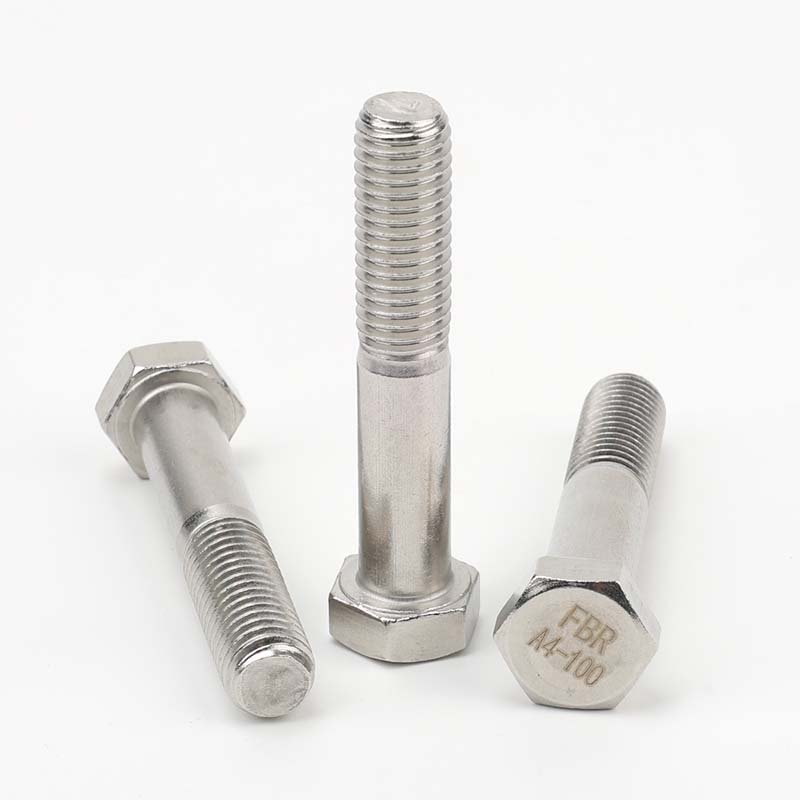
A4-100 stainless steel hex bolts combine the corrosion resistance of 316 stainless steel with a high mechanical property class. Featuring a DIN 931 partially threaded configuration, these bolts provide an unthreaded shank and a threaded end for industrial connections that require both material durability and substantial mechanical strength.
This combination is valuable for equipment operating around moisture, compatible process chemicals or coastal atmospheric exposure, particularly when standard stainless steel bolts do not provide the required strength. Typical applications include pump mounting, water-treatment machinery, process equipment supports and loaded connections in stainless steel machine frames.
Key Features of A4-100 Stainless Steel Hex Bolts
- 316 Stainless Steel: Molybdenum-bearing material offers improved resistance to localized corrosion compared with 304 in many chloride-containing environments.
- A4-100 Strength Class: Provides a higher specified mechanical strength level than A4-70 and A4-80 bolts.
- Partially Threaded Shank: Allows the smooth shank to be positioned within the clamped components where the joint design requires it.
- External Hexagonal Head: Supports installation and removal with conventional sockets and spanners.
- Industrial Connection Versatility: Suitable for evaluation across equipment mounting, brackets, frames and other mechanically loaded assemblies.
Product Specifications
| Item | Specification |
|---|---|
| Product type | Partially threaded hexagon head bolt |
| Dimensional reference | DIN 931; applicable edition and dimensions to be confirmed with the order |
| Material | 316 austenitic stainless steel |
| Stainless grade and property class | A4-100 |
| Mechanical property reference | ISO 3506-1:2020 |
| Minimum tensile strength | 1,000 MPa for applicable full-loadability A4-100 bolts |
| Minimum stress at 0.2% non-proportional elongation | 800 MPa for applicable full-loadability A4-100 bolts |
| Thread configuration | Metric, partially threaded |
| Head style | External hexagonal head |
| Surface and documentation requirements | To be specified and agreed for the order |
The mechanical values above describe property-class requirements under the standard’s ambient-temperature test conditions. They are not allowable working stresses for a complete connection. Product conformity and inspection requirements should be confirmed for the ordered dimensions.
316 Stainless Steel: Material Advantages
Molybdenum for Improved Localized Corrosion Resistance
316 stainless steel contains molybdenum in addition to chromium and nickel. This alloying addition improves resistance to pitting and crevice corrosion in many chloride-containing environments, making 316 a useful material choice when general-purpose 304 stainless steel offers insufficient corrosion resistance.
For equipment exposed to humid air, intermittent splashes or coastal deposits, appropriate use of 316 can help reduce corrosion-related deterioration around exposed fastener heads and connection points. Actual performance depends on temperature, contamination, cleaning and the geometry of the joint.
Corrosion Resistance from the Stainless Alloy
316 develops a protective passive surface film that supports its corrosion resistance under suitable conditions. Maintaining a clean surface and avoiding contamination during fabrication, storage and installation help preserve this material advantage.
This characteristic is useful for stainless steel equipment assemblies where buyers want compatible hardware throughout the frame, brackets and mounting connections. The complete assembly should still be evaluated for crevices, trapped moisture and contact with dissimilar metals.
A Practical Material for Demanding Equipment Environments
316 can be considered for machinery exposed to compatible industrial fluids, cleaning processes and outdoor conditions. Its value comes from matching the alloy to the actual environment, including chemical concentration and operating temperature.
Continuous seawater immersion, concentrated chlorides and aggressive chemicals require a separate material assessment. A4-100 identifies the mechanical class and does not increase the alloy’s corrosion rating.
A4-100: Higher Strength for Loaded Connections
The A4-100 designation combines an A4 stainless fastener grade with property class 100. For applicable full-loadability bolts, this class specifies a minimum tensile strength of 1,000 MPa and a minimum stress at 0.2% non-proportional elongation of 800 MPa.
For designers, the practical benefit is greater mechanical capacity within a given bolt size when bolt strength governs the connection. This can be valuable where mounting-hole positions, edge distances or access space restrict the use of a larger diameter.
Higher strength can also provide scope for a higher approved preload, provided the nut, mating thread, washer and connected components can support it. The final tightening procedure must match the actual assembly.
316 achieves increased strength through controlled work hardening during manufacturing. The required A4-100 properties must therefore be established for the finished bolt rather than inferred from the raw material designation alone.
DIN 931 Partially Threaded Design
The partially threaded structure provides a smooth shank beneath the hexagonal head. Where required by the connection design, this shank can pass through the clamped components and be positioned at a bearing or shear interface.
Correct shank placement can avoid locating thread roots in an intended unthreaded bearing area. However, a standard bolt shank does not automatically provide a precision locating fit; hole clearances and tolerances remain important.
Select the overall length and thread length to suit the complete assembly thickness, including washers and nut engagement. The nut must clamp the components before reaching the thread runout.
For projects using ISO 4014 instead of DIN 931, confirm the applicable dimensions and edition during quotation.
Typical Industrial Applications
Pump and Valve Equipment Mounting
These bolts can be evaluated for pump bases, actuator brackets, valve-support structures and equipment skids. The combination of 316 corrosion resistance and A4-100 strength is useful where moisture exposure accompanies significant mounting loads or limited fastening space.
Pressure-retaining connections require separate confirmation against the governing equipment and bolting specifications.
Water-Treatment Equipment
Potential applications include machinery supports, filtration-equipment frames and mounting brackets in wet operating areas. The 316 material offers a useful starting point where the water chemistry is compatible, while the higher property class addresses mechanical demands.
Chloride content, disinfectants, stagnant water and cleaning procedures should form part of material selection.
Food and Beverage Machinery
Loaded frame connections, drive supports and equipment attachments may benefit from stainless hardware with higher mechanical strength. 316 can suit cleaning environments that are compatible with the alloy.
Where hygiene is important, the connection must also support effective cleaning. Exposed threads, surface condition and inaccessible gaps require consideration alongside material selection.
Coastal and Outdoor Industrial Equipment
Outdoor mounting brackets and equipment frames may encounter salt deposits, humidity and repeated wetting. In suitable atmospheric conditions, 316 offers improved localized corrosion resistance compared with 304.
A4-100 provides an additional option when those assemblies also require higher bolt strength. Drainage and regular removal of deposits help maintain the intended corrosion performance.
Assembly and Quality Requirements
Select mating nuts with adequate proof-load capability and washers suitable for the bearing load. For tapped components, verify thread engagement and material strength. A stronger bolt delivers its intended benefit only when the surrounding connection can support it.
Stainless steel threads also require attention to galling. Use clean, undamaged threads, correct alignment and an approved lubrication and tightening procedure. Changing the lubricant can change the preload produced by a given torque.
Depending on the order, an inspection plan may include material verification, dimensional checks, thread gauging, mechanical testing and batch identification. Review Flybear’s fastener quality inspection capabilities when defining the required checks and documentation.
Request a Quotation
For 316 stainless steel A4-100 DIN 931 hex bolts, provide the diameter, pitch, overall length, required thread or shank length, quantity and drawing where available. Include operating conditions, mating hardware, surface requirements and any requested inspection certificate.
Explore our stainless steel bolt range or contact Flybear Fastener to discuss your application and quotation requirements.
Follow Me!