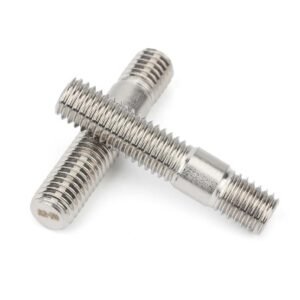
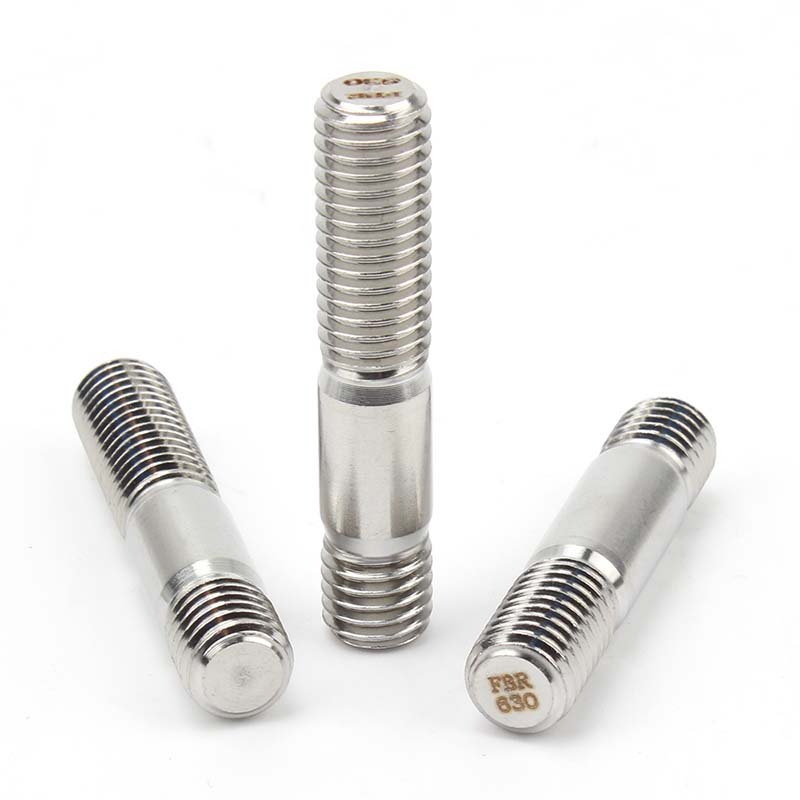
17-4PH H1150 studs combine precipitation-hardening stainless steel with a controlled aging condition for industrial connections requiring strength, toughness, and corrosion resistance. Manufactured from 05Cr17Ni4Cu4Nb, commonly cross-referenced to the Type 630 / 17-4PH alloy family, these double-end studs provide threaded connections at both ends for equipment assembly.
The key value lies in the combination of material and heat treatment. The alloy provides the foundation for mechanical and corrosion performance, while the H1150 condition develops a balance of properties suited to applications where strength must be considered alongside ductility and resistance to fracture.
Material and Heat-Treatment Highlights
- Precipitation-hardening stainless steel: A material family selected for its combination of mechanical strength and corrosion resistance.
- Specified H1150 condition: Controlled aging establishes the required material condition for consistent specification and inspection.
- Strength with toughness: H1150 generally provides greater ductility and toughness than peak-strength H900, with lower strength and hardness.
- Corrosion-resistant alloy: Suitable for consideration in atmospheric and industrial environments compatible with Type 630 stainless steel.
- Double-end connection: Threaded ends support attachment to mating components or an equipment body and retaining nut, depending on the design.
Why Choose 05Cr17Ni4Cu4Nb Stainless Steel?
A Material Designed for Precipitation Hardening
05Cr17Ni4Cu4Nb belongs to the martensitic precipitation-hardening stainless steel family. Its chromium, nickel, copper, and niobium alloying system allows mechanical properties to be developed through controlled heat treatment.
Copper-containing precipitates play an important role in the aging response. By controlling the treatment condition, the material can achieve different combinations of strength, hardness, ductility, and toughness. This makes the heat-treatment designation an essential part of the product specification.
Strength and Corrosion Resistance in One Material
For a loaded threaded connection, material selection involves more than corrosion resistance alone. The stud must also withstand the specified assembly and service loads without unacceptable deformation or failure.
This alloy family provides an option where both mechanical performance and environmental resistance matter. Its suitability should be assessed against the required properties of the finished stud and the actual operating conditions.
Clear Material Identification for Purchasing
05Cr17Ni4Cu4Nb is the Chinese grade designation. Type 630, 17-4PH, and UNS S17400 are commonly used references for the corresponding international alloy family.
These references help buyers identify the material, but cross-referencing does not automatically establish compliance with every national or product standard. The order should state the governing material specification, delivery condition, and documentation requirements.
What H1150 Heat Treatment Contributes
A Controlled Aging Condition
H1150 identifies an aging condition associated with approximately 1150°F, or 621°C. Published treatment schedules commonly describe aging appropriately solution-treated material at this temperature for four hours, followed by air cooling. The production cycle must follow the applicable specification and approved process.
The treatment changes the alloy’s microstructure and mechanical response. H1150 is therefore a metallurgical condition of the steel, rather than a coating or surface finish.
A Practical Balance of Mechanical Properties
H1150 is often considered where the design requires substantial strength together with useful toughness and ductility. Compared with H900, it places greater emphasis on these latter properties while accepting reduced strength and hardness.
For double-end studs, this balance is relevant because the threaded sections and transitions must carry the loads defined by the assembly design. The required condition should be selected together with stud diameter, thread engagement, mating-material strength, and loading.
Defined Properties for Inspection
Specifying H1150 gives material verification and mechanical testing a clear reference. Required tensile strength, yield strength, elongation, and hardness should be established from the governing product or material specification.
Typical alloy datasheet values should not be treated as guaranteed results for every finished stud. Acceptance depends on the agreed requirements and the inspection records for the supplied product.
H1150 also does not define a continuous operating temperature of 621°C. Service temperature must be evaluated separately.
Product Specification Overview
| Item | Description |
|---|---|
| Product | Stainless steel double-end stud |
| Specified Material | 05Cr17Ni4Cu4Nb precipitation-hardening stainless steel |
| Common Alloy References | Type 630 / 17-4PH / UNS S17400; compliance subject to the specified standard |
| Heat-Treatment Condition | H1150 |
| Connection Structure | Two threaded ends with dimensions defined by the product drawing |
| Diameter and Length | According to the selected specification or approved drawing |
| Thread Requirements | Diameter, pitch, tolerance, and engagement length specified for each end |
| Mechanical Acceptance | According to the governing specification and agreed inspection plan |
| Surface Condition | Cleaning and any passivation or additional finish specified in the order |
Material and Heat-Treatment Quality Control
The specified alloy and H1150 condition should remain traceable through manufacturing. A useful quality review covers the starting material, processing history, and finished-product condition.
- Material verification: Confirm the grade and chemical composition against the applicable material requirements.
- Heat-treatment records: Identify the required condition and document the relevant processing parameters.
- Mechanical verification: Check hardness and other specified properties using the agreed methods and sampling.
- Finished dimensions: Verify the overall length, threaded-end lengths, thread fit, and any critical shank dimensions.
- Surface inspection: Review cleanliness, visible defects, and specified finishing requirements.
Aging can produce small dimensional changes. The manufacturing and inspection sequence should account for these changes where thread fit or dimensional accuracy is important.
Flybear’s quality inspection capabilities include material analysis, hardness testing, tensile testing, dimensional inspection, and thread gauging. The required scope and reporting should be agreed for the order.
Applications for Material-Focused Stud Selection
These studs may be considered for machinery, pump and valve equipment, industrial fixtures, and other assemblies requiring a specified precipitation-hardening stainless steel.
The double-end configuration can allow one end to remain installed in an equipment body while a component is secured or removed using a nut at the other end. Installation method and engagement must suit the actual design.
For wet or chemically exposed equipment, review the medium, temperature, cleaning conditions, and potential crevices. For pressure-retaining connections, confirm the applicable bolting and equipment-code requirements separately.
Frequently Asked Questions
Is H1150 a Strength Grade?
H1150 identifies a heat-treatment condition. It should be specified together with the alloy and required mechanical properties, rather than used as a substitute for a finished-fastener performance specification.
Are These Studs Magnetic?
The 630 / 17-4PH alloy family is magnetic because of its martensitic structure. Magnetic response alone does not establish material identity or confirm the H1150 condition.
Does H1150 Make the Stud Suitable for Every Corrosive Environment?
No. Heat treatment influences material behavior, but suitability still depends on the environment and loading. Chlorides, aggressive chemicals, and sustained stress require application-specific assessment.
Request 17-4PH H1150 Studs from Flybear
Explore Flybear’s stainless steel studs and threaded rods or send your drawing for quotation. Include the material specification, H1150 condition, diameter, overall length, thread details for both ends, quantity, surface requirements, and inspection documents. Share the operating environment and mating-component materials to support a focused technical review.
Follow Me!