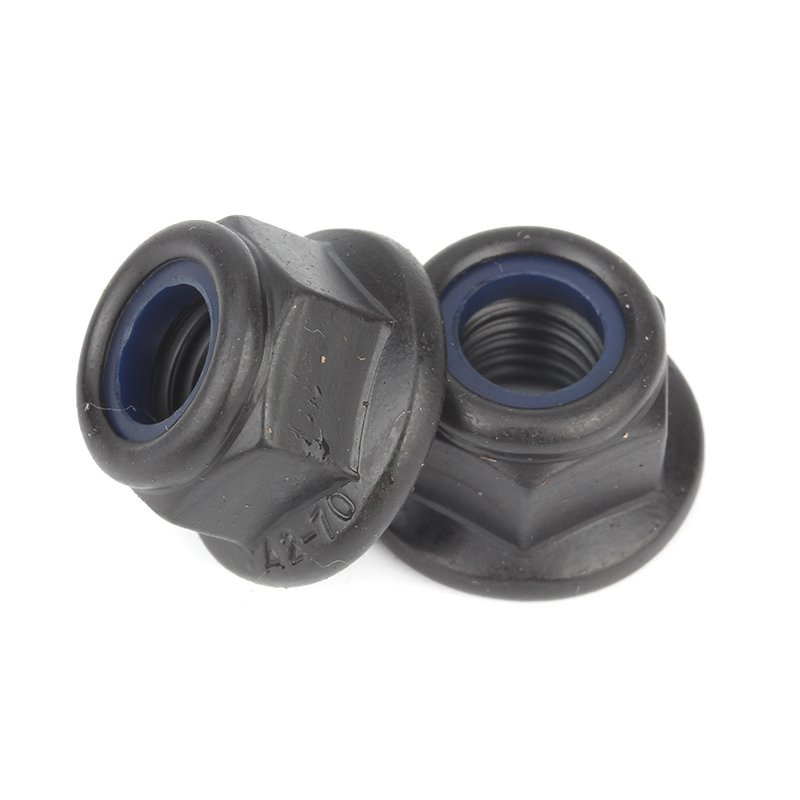
Flybear DIN 6926 black flange lock nuts combine a 304 stainless steel body, the specified A2-70 property class, an integrated flange, and a nylon locking insert. The design provides a broad bearing surface together with prevailing-torque resistance, making it useful for equipment brackets, machinery covers, mounting plates, and other metric threaded assemblies.
The black oxide finish complements dark frames, panels, and matching fasteners. A smooth, non-serrated flange supports the connected component, while the nylon insert provides the locking action through engagement with the mating thread.
Key Features of DIN 6926 Black Flange Lock Nuts
- 304 stainless steel body: Provides corrosion resistance for many indoor and mild outdoor environments.
- A2-70 property class: Specifies the stainless steel nut’s mechanical performance requirements.
- Nylon locking insert: Creates resistance to rotation as the mating bolt or stud engages the insert.
- Integrated smooth flange: Provides a wider bearing footprint and can simplify the assembly by reducing separate components.
- Black oxide finish: Coordinates exposed hardware with dark equipment surfaces.
Product Specifications
| Item | Description |
|---|---|
| Product Type | Prevailing-torque hex flange nut with nylon insert |
| Body Material | 304 stainless steel |
| Specified Grade and Property Class | A2-70 |
| Surface Treatment | Black oxide |
| Flange Configuration | Integral flange with a smooth, non-serrated bearing face |
| Locking Element | Nylon insert |
| Drive | External hexagon |
| Thread System | ISO metric thread; diameter and pitch according to order |
| Dimensional Reference | DIN 6926, according to the specified edition or approved drawing |
| Functional Requirements | Prevailing torque and installation performance according to the agreed acceptance specification |
304 Material and the A2-70 Designation
304 is an austenitic chromium-nickel stainless steel widely used for industrial fasteners. Its passive surface film supports corrosion resistance in ordinary atmospheric conditions. For applications involving chlorides, aggressive cleaning agents, or trapped moisture, material selection should reflect the actual exposure.
A2 identifies a stainless steel fastener grade within the austenitic family. For this product, 304 is the specified material. These descriptions address related aspects of material selection, while the finished fastener’s chemical composition should meet the applicable purchase requirements.
The “70” designation identifies the nut property class. Under ISO 3506-2, stainless steel nuts are assessed through requirements including proof load. This mechanical classification does not define the nylon insert’s locking torque, which must be evaluated separately.
Nylon Insert for Prevailing-Torque Locking
The nylon ring engages the bolt or stud thread during installation. This interference creates prevailing torque: resistance to turning that develops before the nut is seated against the joint.
The metal threads carry the connection load, while the insert adds rotational resistance. This can help resist vibration-related loosening in a properly designed assembly. The locking feature does not restore clamp load lost through joint settling or deformation.
Specify functional acceptance requirements where locking performance is important. Relevant checks can include installation resistance, removal resistance, and performance after an agreed installation and removal sequence.
Integrated Flange with a Smooth Bearing Face
The flange extends beyond the hex body and provides a larger support footprint beneath the nut. When properly seated, it helps distribute the clamping force across the connected component.
The smooth underside provides bearing contact without relying on teeth biting into the surface. This is useful where the assembly requires a flanged nut with locking action provided by the nylon insert.
In suitable joints, the integral flange can remove the need for a separate plain washer. Check the hole size, flange support, component thickness, and surface condition before doing so. Soft materials, thin panels, or slotted holes may require additional support.
Black Oxide Finish for Coordinated Hardware
The blackened surface helps the nut blend with dark equipment frames, housings, and mounting accessories. This is particularly useful where the flange and hex body remain visible after assembly.
Stainless steel blackening requires a suitable process and surface preparation. Shade, gloss, cleanliness, and handling characteristics depend on the finishing route and any protective post-treatment. An approved sample can establish the appearance required for repeat production.
Black oxide does not establish a higher mechanical class or a guaranteed corrosion-test result. Where finish durability, surface residue, or salt spray performance matters, define the relevant acceptance requirements in the order.
DIN 6926 Dimensional Reference
DIN 6926 is a withdrawn standard that remains a familiar purchasing reference for flange nuts with non-metallic locking inserts. ISO 7043 covers a related style 2 flange nut configuration.
For procurement or replacement, confirm the required thread, flange diameter, overall height, and width across flats against the approved drawing. Dimensional correspondence should be checked separately from the stainless steel mechanical requirements and the locking performance.
Typical Applications
- Automation equipment: Sensor brackets, guards, and mounting accessories requiring flanged locking hardware.
- Machinery assemblies: Covers, support plates, and auxiliary components subject to operational movement.
- Equipment enclosures: Panel and bracket connections where black hardware complements the housing.
- Instrument supports: Mounting points requiring a broad bearing surface and conventional hex tooling.
Selection should account for joint loads, vibration, temperature, and maintenance requirements. Explore Flybear’s stainless steel nuts and locking nuts for related configurations.
Installation and Quality Verification
Match the nut to the bolt’s exact metric diameter and pitch. Begin installation from the metal-threaded flange end, with the flange facing the connected component. Select sufficient bolt or stud length for complete engagement through the nylon insert.
Establish tightening settings for the actual assembly. Applied torque must overcome thread friction, bearing friction, and the insert’s rotational resistance. A torque setting intended for a plain nut may therefore produce a different clamp load.
For stainless steel mating threads, controlled installation speed and an approved lubrication strategy can help manage galling. Include the lubricant and finish condition when validating the tightening procedure.
Inspection can cover material identification, dimensions, thread fit, proof load, insert retention, locking performance, and finish appearance. Review Flybear’s fastener quality inspection capabilities and agree the product-specific test plan and documentation before production.
Frequently Asked Questions
Does the nylon insert limit service temperature?
Yes. The complete nut’s service range depends on the specified insert as well as the metal body. Confirm the insert’s temperature rating, exposure duration, and chemical compatibility for the application.
Can the nut be reused?
Repeated installation can reduce locking resistance. Reuse should follow the equipment manufacturer’s instructions and applicable acceptance criteria. Replace nuts with damaged inserts or inadequate prevailing torque.
Does A2-70 describe the locking strength?
A2-70 describes the stainless steel grade and mechanical property class. The nylon insert’s rotational resistance requires a separate functional specification and verification.
Request a Quote for DIN 6926 Flange Lock Nuts
Send Flybear the required metric diameter and pitch, quantity, drawing or dimensional reference, and black finish requirements. Include the mating bolt specification, operating temperature, service environment, and any locking-performance or inspection requirements.
Contact Flybear for a quotation on DIN 6926 304 A2-70 stainless steel black oxide hex flange nylon lock nuts.
Follow Me!