Is Magnetism in Stainless Steel Normal? How to Verify the Material Correctly
stainless steel is magnetic is one of the most searched and most misunderstood topics in fastener sourcing. Many buyers assume that if a stainless steel screw or bolt attracts a magnet, it must be “not real stainless.” In reality, magnetism can be completely normal depending on the stainless grade, how it was processed, and even how cold work changed its microstructure. This article explains why some stainless fasteners are magnetic, what magnet tests can and cannot prove, and the most reliable ways to verify stainless steel material in industrial supply chains.
Does Stainless Steel Have to Be Non-Magnetic?
No. Stainless steel is a family of alloys, not a single material. Some stainless types are naturally magnetic, while others are usually non-magnetic in the annealed condition. This is why popular Google searches like “is 304 stainless magnetic,” “is 316 stainless magnetic,” and “magnet test for stainless steel” often lead to confusing answers.
The core reason is metallurgy. Stainless steels are commonly grouped by crystal structure: austenitic, ferritic, martensitic, and duplex. Austenitic stainless (such as 304 and 316) is typically non-magnetic when fully annealed. Ferritic and martensitic stainless steels are magnetic by nature. Duplex stainless usually shows some magnetic response because it contains mixed phases.
Why 304/316 Stainless Screws Can Become Magnetic
Even if you specify 304 or 316 stainless, your screws may show magnetism after manufacturing. Many fasteners are produced through cold heading, thread rolling, and forming operations. These processes introduce cold work, which can transform some of the austenitic structure into martensite. That transformation increases magnetic attraction.
So if a customer asks, “my 304 stainless screws are magnetic, is that normal?” the honest answer is: it can be normal, especially for heavily cold-worked parts like threads. In fact, mild magnetism is common on the thread area even when the bulk chemistry is correct for 304 or 316.
Magnet Test vs. Real Verification: What a Magnet Can Prove
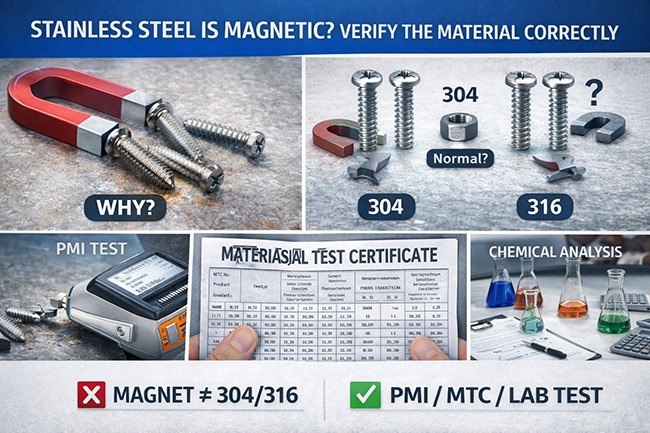
A magnet is a quick screening tool, but it is not a material certification method. It can help you identify obvious mismatches (for example, carbon steel parts incorrectly sold as stainless), but it cannot reliably distinguish between 304 and 316, and it cannot confirm alloy composition.
- Useful: Detecting if a “stainless” part is strongly magnetic like carbon steel.
- Not reliable: Confirming 304 vs 316, or confirming corrosion resistance level.
- Risky assumption: “Magnetic means fake stainless.” This is often wrong.
That is why buyers frequently search “how to tell if stainless steel is real” and “stainless steel identification test,” looking for more dependable methods than a magnet.
Stainless Steel Is Magnetic: Which Grades Are Typically Magnetic?
Magnetism varies by grade and processing. Here is a practical guide used in fastener purchasing:
- Austenitic stainless (304, 316): Usually low magnetism when annealed; may become partially magnetic after cold work.
- Ferritic stainless (430): Magnetic; used in some applications but not typical for high-corrosion fasteners.
- Martensitic stainless (410, 420): Magnetic and heat-treatable; used when higher hardness is needed, but corrosion resistance differs from 304/316.
- Duplex stainless (e.g., 2205): Often shows magnetic response due to mixed structure; strong corrosion resistance in many environments.
This also explains why a supplier might offer stainless fasteners that are magnetic but still legitimate stainless steel—just a different family than the buyer expected.
How to Verify Stainless Steel Material in Fasteners
If you need confidence for quality audits, high-risk industries, or long-life outdoor use, rely on verification methods that check composition and traceability. Common approaches include:
- MTC / Mill Test Certificate: Confirms heat number and chemical composition from the material source. This is essential for controlled procurement.
- XRF (X-ray fluorescence) testing: A fast, non-destructive method used on-site to check alloying elements. It helps confirm whether you are closer to 304 vs 316 by checking elements like nickel and molybdenum.
- PMI (Positive Material Identification): A broader term often used in industry for verifying alloy grade, commonly performed with portable analyzers.
- Lab chemical analysis: The most authoritative method for disputes, typically done by certified labs.
- Microstructure or hardness testing: Helpful when the issue is heat treatment (for martensitic grades) or when you suspect mixed lots.
Many procurement teams search “PMI testing stainless steel fasteners” and “XRF test for stainless steel” because these methods are widely accepted in industrial quality systems.
Common Sourcing Mistakes That Cause “Magnetic Stainless” Complaints
Most complaints come from specification gaps rather than intentional substitution. Typical issues include:
- Grade not clearly specified: Purchase orders say only “stainless,” allowing 410/430 equivalents that are magnetic.
- Mixed inventory: Different grades stored together in bulk bins, leading to mixed shipments.
- No documentation: Lack of MTC or traceable lot information makes verification difficult.
- Cold-work magnetism misunderstood: Customers reject valid 304/316 fasteners because threads attract a magnet.
Best Practice Checklist for Buyers
To avoid confusion and reduce returns, use this simple checklist:
- Specify grade clearly: 304 (A2) or 316 (A4), or the exact ASTM/ISO requirement.
- Request traceability and MTC for critical projects.
- Use XRF/PMI for incoming inspection when risk is high.
- Do not rely on magnet tests alone to judge authenticity.
- Match grade to environment: coastal, chemical, high-temperature, or general indoor.
Working With a Supplier Who Understands Verification
When you need stainless fasteners for demanding applications, verification should be part of the supply process, not an afterthought. At Flybear Fastener, we support customers with clear grade selection, lot traceability, and practical verification options so you can confirm stainless composition with confidence and avoid unnecessary disputes over magnetism.
Conclusion
Stainless steel is magnetic can be normal, especially for ferritic/martensitic grades or for 304/316 fasteners that have been cold worked during forming and thread rolling. A magnet is only a rough screening tool and cannot confirm the stainless grade. For reliable verification, use documentation and PMI methods such as XRF testing and mill certificates. With the right specification and inspection plan, you can ensure the material is correct and the fasteners perform as expected.
Follow Me!