Stainless Steel Screws Rusting Outdoors After 2 Years: Is It a Material Problem?
stainless steel screws rusting outdoors after 2 years can feel like clear evidence of “bad material,” but the real answer is usually more complex. Stainless steel is corrosion resistant, not corrosion proof. Outdoor conditions, chloride exposure, contamination from carbon steel tools, and the wrong grade selection can all trigger rust staining or pitting long before a product reaches its expected service life. In this guide, you will learn the most common causes, how to diagnose what happened, and how to choose the right stainless screws for long-term outdoor use.
Is Rust After 2 Years Always a Stainless Steel Material Issue?
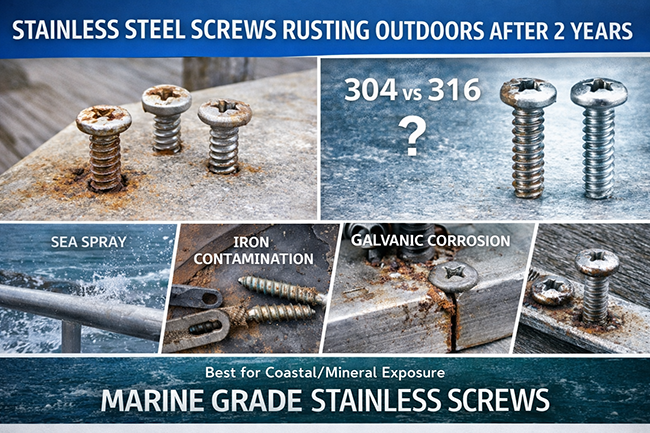
Not always. If the screws are genuine stainless and meet their stated grade, the rust may still be caused by environment or installation rather than the base material itself. Many people search for “why do stainless steel screws rust” or “are stainless screws rust proof” and discover that different stainless families behave very differently outdoors. The most common stainless fasteners in the market are 18-8 (often similar to 304) and 316. In mild outdoor conditions, 304/18-8 typically performs well, but in coastal air, de-icing salt, or chemical splash, 316 often lasts longer.
That said, material problems do occur: incorrect grade substitution, mixed batches, or low-quality stainless with poor corrosion resistance can lead to earlier rusting. The key is to identify whether you are seeing surface rust staining, embedded iron contamination, or deeper pitting corrosion.
Common Reasons Stainless Screws Rust Outdoors
Outdoor corrosion is rarely caused by “water” alone. The most damaging factor is often chloride. Chlorides come from sea spray, pool chemicals, coastal fog, road salt, and de-icing agents. These conditions can break down the passive layer that protects stainless steel and accelerate pitting.
- Wrong stainless grade: Using 304/18-8 in high-chloride areas can lead to staining and pitting sooner than expected.
- Iron contamination: Handling stainless screws with carbon steel tools, using the same wire brushes, or storing near carbon steel dust can embed free iron and create rust spots.
- Crevice corrosion: Tight gaps under washers, in joints, or under sealant can trap moisture and chlorides.
- Galvanic corrosion: Stainless screws in direct contact with aluminum or carbon steel in a wet environment can accelerate corrosion of the less noble metal and create visible rust around the joint.
- Surface finish and processing: Poor pickling/passivation, heat tint, or rough surfaces can reduce corrosion resistance.
These are exactly why many buyers also search “304 vs 316 stainless screws outdoor,” “stainless steel screws for coastal areas,” and “how to prevent stainless steel corrosion.”
How to Tell If It’s Surface Staining or True Corrosion
Before replacing everything, confirm what kind of “rust” you are seeing:
- Light orange/brown staining on the surface: Often caused by iron contamination or external rust deposits (for example, nearby carbon steel grinding dust). The screw may still be structurally fine.
- Small pinholes or rough pits: This indicates pitting corrosion, commonly linked to chlorides. Pitting is more serious because it can reduce cross-section and strength over time.
- Rust localized at joints: This may be crevice corrosion or galvanic effects depending on the mating material and moisture retention.
If the screw head and shank show deep pits, you should treat it as a performance risk and consider upgrading the grade and improving installation practices.
Stainless Steel Screws Rusting Outdoors After 2 Years: What Grade Should You Use?
Grade selection is the fastest way to improve outdoor performance. For general outdoor exposure (rain, humidity, non-coastal), 304/18-8 is often acceptable. For coastal environments, pool areas, or anywhere with road salt, 316 stainless is usually the safer choice because it has improved chloride resistance. For extreme chloride exposure, specialty alloys may be required, but 316 is the most common upgrade that balances cost and performance.
Popular Google searches like “best screws for outdoor deck,” “marine grade stainless screws,” and “316 stainless screws vs 304” typically point to the same conclusion: match the grade to the environment, not the label “stainless.”
Installation and Maintenance Factors That Accelerate Rust
Even the right grade can fail early if installation creates a corrosion trap.
- Use clean tools: Avoid using carbon steel wire brushes, worn drill bits, or contaminated sockets that can embed iron.
- Control crevices: Use appropriate washers, avoid moisture-trapping sealant pockets, and ensure drainage where possible.
- Use compatible materials: If fastening to aluminum, consider isolation washers or coatings to reduce galvanic interaction.
- Do not overheat stainless: Excessive heat from cutting or aggressive grinding can damage the protective layer.
For many outdoor builds, simple steps like rinsing salt deposits periodically and avoiding harsh chloride cleaners can noticeably extend service life.
What to Ask Your Supplier to Prevent Repeat Failures
To reduce the chance of receiving unsuitable screws, your purchasing specification should be clear. Include stainless grade (304/18-8 or 316), standard and property class if applicable, thread and size, and surface condition requirements. If the environment is coastal, state it explicitly. This helps suppliers recommend “marine grade stainless screws” solutions rather than defaulting to general-purpose stainless.
At Flybear Fastener, we help buyers select stainless fasteners based on real service conditions, including coastal exposure, de-icing salt, and mixed-metal assemblies—so outdoor screws maintain appearance and performance longer.
Conclusion
Stainless steel screws rusting outdoors after 2 years is not automatically a material defect. It may be the wrong grade for chloride exposure, iron contamination during installation, crevice conditions, or galvanic effects with the base metal. Start by identifying whether you have surface staining or pitting, then upgrade to 316 stainless when the environment is aggressive, and apply cleaner installation practices. With the right grade and handling, stainless fasteners can deliver reliable outdoor performance well beyond two years.
Follow Me!