UNC vs UNF vs UNEF Threads: Differences, Applications, and How to Choose
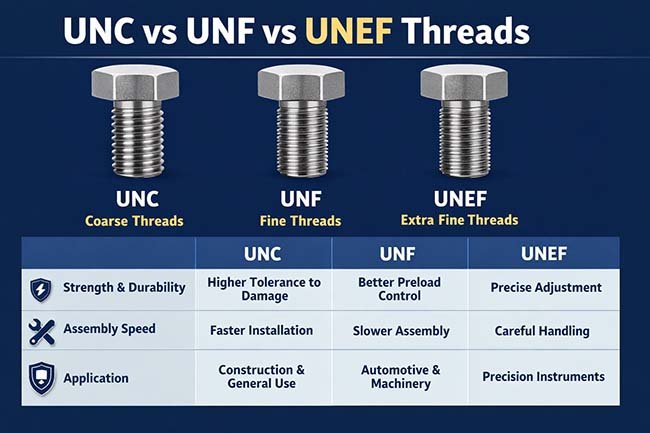
Quick answer: UNC, UNF, and UNEF are standard Unified inch thread series covered by ASME B1.1. At a given nominal diameter, UNC uses the coarsest standard pitch, UNF a finer pitch, and UNEF an extra-fine pitch. They are not interchangeable.
A complete purchase description should state the nominal diameter, threads per inch (TPI), thread series or full designation, class of fit, external or internal thread, thread direction, material or grade, finish, and the governing part standard or drawing. For example, 1/4-20 UNC-2A identifies an external Unified coarse thread; a mating internal thread is specified separately, such as 1/4-20 UNC-2B.
What Do UNC, UNF, and UNEF Mean?
- UNC (Unified National Coarse): the coarse standard series, with fewer threads per inch and a larger pitch for a given diameter.
- UNF (Unified National Fine): a finer standard series, with more threads per inch and a smaller pitch.
- UNEF (Unified National Extra Fine): an extra-fine standard series used where the approved design calls for a very small pitch.
Pitch affects geometry and assembly behavior, but it does not determine joint performance by itself. Material, fastener grade, engagement length, internal-thread material, achieved preload, friction, coating, fatigue loading, and joint design also matter.
UNC vs UNF vs UNEF: Practical Selection Guide
| Requirement or condition | Usual starting point | Checks before selection |
|---|---|---|
| Existing assembly or replacement part | Match the existing drawing and mating thread exactly. | Confirm diameter, TPI, class, thread direction, and final condition after coating. |
| General-purpose assembly, field installation, or a less-clean environment | UNC is often the first series considered. | Check engagement length, internal material, stripping risk, and required preload. |
| Larger tensile-stress area or finer axial adjustment at the same nominal diameter | UNF may be considered. | Overall capacity still depends on material, grade, engagement, fatigue, preload, and friction. |
| Thin threaded sections, hard mating materials, or very fine adjustment | UNEF may be considered. | Validate wall thickness, strip-out, manufacturing capability, gaging, and damage sensitivity. |
| Plated or coated thread | No series should be selected from coating alone. | Define whether limits and gaging apply before or after finish; coating changes thread clearance. |
| Vibration or dynamic loading | Do not select solely by UNC, UNF, or UNEF. | Joint stiffness, achieved preload, friction, locking method, and service loading control loosening. |
| Safety-critical assembly | Follow the approved drawing and sector specification. | Do not replace a specified series or class from a general comparison article. |
How to Read a Unified Inch Thread Callout
These examples explain the notation only; the current standard tables and the governing drawing control production requirements.
| Example | Meaning |
|---|---|
1/4-20 UNC-2A | 1/4-inch nominal diameter, 20 TPI, coarse series, Class 2 external thread. |
1/4-28 UNF-2B | 1/4-inch nominal diameter, 28 TPI, fine series, Class 2 internal thread. |
1/4-32 UNEF-2A | 1/4-inch nominal diameter, 32 TPI, extra-fine series, Class 2 external thread. |
In Unified inch designations, A identifies an external thread and B an internal thread. The class defines the applicable allowance and tolerance. A tighter class is not automatically a better choice: coating, contamination, gaging, interchangeability, and assembly conditions must be considered.
How to Identify an Unknown Unified Thread
- Check the drawing, part number, equipment manual, or markings before measuring.
- Measure the nominal diameter with suitable equipment.
- Use an inch thread-pitch gauge to identify TPI.
- Confirm the series and class against the specified standard or an approved inspection plan.
- Verify the mating component. A bolt that starts but binds may have a different pitch and should not be forced.
UNC, UNF, and UNEF FAQ
Are UNC and UNF interchangeable if the diameter is the same?
No. Diameter alone is insufficient. Mating components must have the same diameter and TPI and compatible thread-form and fit requirements. Forcing different pitches can damage both threads.
Is a UNF fastener always stronger than a UNC fastener?
No blanket conclusion is valid. At the same nominal diameter and material, a fine thread generally has a larger tensile-stress area, but the joint may instead be limited by internal-thread stripping, fatigue, engagement length, preload, or another component.
Is UNF inherently vibration-proof?
No. Thread series alone does not make a joint vibration-proof. Resistance to loosening depends on achieved preload, joint stiffness, friction, service loading, and any locking feature required by the design.
Can a metric fastener replace a similar-looking Unified inch fastener?
Not without engineering validation. Similar nominal diameter or pitch does not establish compatibility. Confirm the complete thread designation with a drawing, pitch gauge, or approved inspection method.
Which standard defines UNC, UNF, and UNEF?
ASME B1.1 defines the applicable Unified inch thread forms, series, classes, allowances, tolerances, and designations. Use the edition required by the drawing, contract, or governing specification.
Request a Unified Inch Thread Quotation
Send Flybear the part type and drawing; nominal diameter and TPI; full thread designation and class; external or internal and right- or left-hand thread; material and grade; finish; length; quantity; application; and required inspection or material documents. If the thread is unknown, include measurements and details of the mating component. Final production requirements should be confirmed by an approved drawing or specification, not inferred from a photograph alone.
Send your Unified inch fastener RFQ.
About This Guide
This guide is published by Flybear Fastener, the trade name used on this website by Nanjing Flybear Hardware Products Co., Ltd. Product conformity, inspection scope, and documentation are agreed for each order. This page does not imply that every thread option is stocked, certified, or suitable for every joint.
Official and Technical References
- ASME B1.1-2024 — Unified Inch Screw Threads
- NASA RP-1228 — Fastener Design Manual
- Flybear — American Fastener Standards Guide
Standards are revised over time. Confirm the edition required by the governing purchase and project documents.
Follow Me!