American Fastener Standards: A Practical Guide for Industrial Buyers
American fastener standards help buyers, engineers, and distributors identify the correct fastener dimensions, materials, mechanical properties, thread forms, coatings, and inspection requirements for industrial projects. For companies sourcing bolts, screws, nuts, washers, studs, and custom fasteners for the U.S. market, understanding these standards is essential for reducing selection errors, improving assembly reliability, and communicating clearly with suppliers.
Understanding American Fastener Standards for B2B Procurement
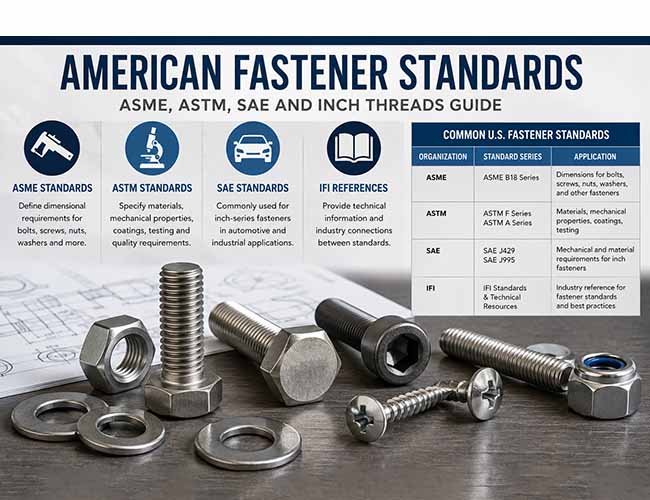
The U.S. fastener system is not controlled by one single standard. Instead, different organizations define different parts of fastener performance and product specification. ASME standards are often used for dimensions and product geometry, ASTM standards are widely used for materials, mechanical properties, coatings, and testing, while SAE standards are commonly applied to inch-series steel fasteners used in automotive and machinery-related applications. The Industrial Fasteners Institute also provides technical references that help connect multiple standards in practical fastener sourcing.
American Fastener Standards and Why They Matter
American fastener standards create a common technical language between buyers, manufacturers, engineers, and inspectors. A purchase order that only says “hex bolt” may be unclear, because it does not define the dimensional standard, material grade, thread series, coating, strength level, or inspection requirements. A complete specification, however, helps the supplier understand exactly what should be manufactured or delivered.
For example, a buyer may need an inch-series hex cap screw with a specified material grade, unified thread, zinc coating, and standard dimensional tolerance. Without standards, different factories may interpret the request differently. With standards, the buyer can compare quotations more accurately and avoid problems such as incorrect head size, unsuitable strength, mismatched threads, or coating performance issues.
ASME and ANSI Standards for Fastener Dimensions
ASME B18 standards are closely associated with many American dimensional requirements for bolts, screws, nuts, washers, rivets, and similar fasteners. In practical procurement, ASME dimensional standards help define product shape, head style, width across flats, thread length, bearing surface, washer dimensions, and other geometry-related details.
Many buyers still use the term ANSI fasteners because older American standards were historically connected with ANSI approval. In modern sourcing, it is common to see specifications written as ASME/ANSI B18, especially for inch fasteners. When a drawing or order references an ASME B18 standard, the supplier should verify the exact product type, size range, and revision required before production.
For standard industrial products, ASME dimensional references are especially important for hex bolts, hex cap screws, socket screws, machine screws, tapping screws, nuts, and washers. For custom production, ASME standards can also serve as a baseline when modifying head type, length, thread design, or special features according to the buyer’s drawing.
ASTM Standards for Materials, Grades, and Testing
ASTM standards are widely used when fastener performance depends on material, mechanical properties, coating, heat treatment, testing, and quality assurance. ASTM Committee F16 focuses on mechanical fasteners and covers areas such as threaded and non-threaded fasteners, manufacturing, coatings, inspection, classification, and mechanical properties.
For buyers, ASTM standards are useful because they help define what the fastener is made from and how it should perform. Common ASTM-related fastener categories may include carbon steel bolts, alloy steel fasteners, stainless steel bolts and nuts, structural bolting assemblies, washers, and coated fasteners. Depending on the application, ASTM standards may specify chemical composition, tensile properties, hardness, proof load, coating requirements, marking, and test methods.
In industrial sourcing, ASTM fastener standards are often used in construction, energy equipment, pressure systems, machinery, infrastructure, and heavy-duty assemblies. Buyers should confirm not only the ASTM grade but also the compatible nut, washer, coating, and thread requirements. A bolt specification alone may not be enough if the full assembly must meet a particular engineering requirement.
SAE Standards for Inch-Series Mechanical Fasteners
SAE fastener standards are frequently used for inch-series steel bolts, screws, studs, and related fasteners in automotive and machinery applications. SAE J429 is a well-known reference for mechanical and material requirements for externally threaded inch-series fasteners used in automotive and related industries.
In everyday sourcing, SAE grades help buyers distinguish different strength levels. For example, SAE Grade 2, Grade 5, and Grade 8 are commonly recognized in the market, but the correct choice depends on load, vibration, installation method, mating parts, and service conditions. Higher strength does not automatically mean better performance in every application. Engineers should also consider ductility, fatigue, corrosion protection, thread engagement, and torque control.
SAE fasteners are often requested for equipment repair, vehicle-related components, agricultural machinery, industrial machines, brackets, frames, and general mechanical assemblies. When sourcing SAE fasteners, buyers should specify diameter, thread pitch, length, grade, finish, head style, and packaging requirements to avoid confusion.
Unified Inch Threads: UNC, UNF, and Thread Fit
American fastener standards often use unified inch threads, especially UNC and UNF thread series. UNC threads are commonly selected for general assembly because they are easier to install and more tolerant of rougher working conditions. UNF threads have a finer pitch and may be used where tighter adjustment, better vibration resistance, or limited engagement length is needed.
Thread fit is also important. If the external thread and internal thread are not compatible, the fastener may loosen, seize, strip, or fail during installation. For export orders to the U.S. market, buyers should clearly state the thread series, diameter, pitch, class of fit, and whether the fastener requires full thread, partial thread, or special thread length.
Common U.S. Fastener Products and Standard References
American standard fasteners include a wide range of products used across industrial and commercial applications. Typical products include hex bolts, hex cap screws, carriage bolts, socket head cap screws, machine screws, self-tapping screws, thread forming screws, hex nuts, lock nuts, flat washers, spring washers, structural bolts, studs, and anchors.
Each product type may involve more than one standard. A hex bolt may need a dimensional standard, a material grade standard, a coating standard, and a testing requirement. A stainless steel nut may need both dimensional and material references. A structural bolting assembly may require compatible bolts, nuts, washers, and installation-related considerations. This is why professional fastener sourcing should focus on the complete specification, not only the product name.
Coating and Finish Requirements in American Fastener Sourcing
Finish selection is another important part of U.S. fastener procurement. Common options may include plain finish, zinc plating, hot-dip galvanizing, black oxide, phosphate, mechanical galvanizing, nickel plating, and passivation for stainless steel fasteners. The correct finish depends on corrosion exposure, appearance, friction, installation torque, electrical requirements, and compatibility with mating materials.
Buyers should avoid selecting a coating only by appearance. A bright zinc-plated fastener may look clean, but it may not be suitable for outdoor or high-corrosion service. Stainless steel may be more suitable for moisture exposure, while hot-dip galvanized fasteners may be considered for some outdoor steel structures. In custom fastener projects, coating thickness, thread tolerance, hydrogen embrittlement risk, and post-treatment inspection should be reviewed carefully.
How to Specify American Standard Fasteners Correctly
A clear fastener specification should include product type, standard, material or grade, size, thread series, length, finish, quantity, packaging, and inspection requirements. For engineered components, drawings should also include tolerance, special geometry, head marking, surface treatment, and application notes. If a part is custom-made, samples or 2D and 3D drawings can help the manufacturer evaluate production feasibility.
Flybear Fastener supports industrial customers with standard and custom fastener manufacturing, helping buyers match product design, material selection, production process, and quality control with project requirements. For buyers working with American fastener standards, early technical communication can reduce revision cycles and improve sourcing efficiency.
Conclusion
American fastener standards are essential for accurate product selection, consistent manufacturing, and reliable industrial assembly. ASME standards help define fastener dimensions, ASTM standards support material and performance requirements, SAE standards are widely used for inch-series mechanical fasteners, and IFI references help buyers understand practical standard relationships. By specifying the correct standard, grade, thread, finish, and inspection requirements, B2B buyers can reduce procurement risk and improve long-term fastening performance.
Follow Me!