35CrMo vs 42CrMo Alloy Steel Fasteners: What the Material Difference Means
35CrMo vs 42CrMo fasteners should be compared as two chromium-molybdenum alloy-steel material routes rather than as two fixed bolt-strength grades. Under GB/T 3077, both steels belong to the Cr-Mo alloy structural steel family, but 42CrMo has a higher specified carbon range and slightly different manganese and chromium ranges. Those chemistry differences can influence hardenability, achievable strength and hardness after heat treatment, toughness balance, and suitability for different fastener section sizes.
For industrial buyers, however, material grade alone does not determine the performance of the finished bolt. Heat-treatment condition, diameter, thread geometry, product standard, required property class, coating, and inspection requirements all matter. A 42CrMo fastener should not automatically be considered a stronger replacement for every 35CrMo bolt, and neither Chinese material grade should be converted directly into an ASTM, SAE, EN, or ISO fastener grade without checking the complete specification.
35CrMo vs 42CrMo Fasteners: Key Differences
| Selection Factor | 35CrMo | 42CrMo |
|---|---|---|
| Material family | Chromium-molybdenum alloy structural steel | Chromium-molybdenum alloy structural steel |
| GB/T material route | 35CrMo under GB/T 3077 | 42CrMo under GB/T 3077 |
| Carbon range | Lower than 42CrMo | Higher than 35CrMo |
| Manganese and chromium direction | Slightly lower specified ranges | Slightly higher specified ranges |
| Molybdenum | Both grades use a similar specified Mo range under GB/T 3077 | Both grades use a similar specified Mo range under GB/T 3077 |
| Strength potential after heat treatment | Suitable for many high-strength fastener applications when the required finished properties can be achieved | Can provide a higher strength/hardness potential under suitable heat-treatment and section conditions |
| Selection rule | Select from the finished fastener requirement, section size, heat treatment and governing standard—not from material name alone. | |
Chemical Composition: What Actually Changes?
GB/T 3077-2015 identifies both 35CrMo and 42CrMo as Cr-Mo alloy structural steels. Their chemistry overlaps substantially, but the ranges are not identical.
| Element | 35CrMo, Mass % | 42CrMo, Mass % | Practical Interpretation |
|---|---|---|---|
| Carbon | 0.32–0.40 | 0.38–0.45 | 42CrMo has a higher carbon range, contributing to its higher achievable strength and hardness potential after suitable processing |
| Silicon | 0.17–0.37 | 0.17–0.37 | Same specified range |
| Manganese | 0.40–0.70 | 0.50–0.80 | 42CrMo uses a slightly higher specified range |
| Chromium | 0.80–1.10 | 0.90–1.20 | 42CrMo uses a slightly higher specified range |
| Molybdenum | 0.15–0.25 | 0.15–0.25 | Same specified range in these grades |
These differences are meaningful, but they should not be interpreted as a direct finished-bolt performance table. Chemical composition establishes the steel grade and influences heat-treatment response. The final mechanical properties of a fastener still depend on section size, quenching response, tempering condition, manufacturing history, and the mechanical requirements imposed by the fastener standard.
Why 42CrMo Can Have Higher Strength Potential
The higher carbon level of 42CrMo is an important reason it can achieve a higher strength and hardness level after appropriate quenching and tempering. Chromium and molybdenum also support hardenability, helping the material develop the intended microstructure through a useful section depth.
This can make 42CrMo bolts attractive for highly loaded machinery, rail equipment, energy systems, shafts, heavy mechanical assemblies, and other applications where the design requires a demanding combination of strength and section size.
However, “higher strength potential” is not the same as “automatically stronger finished fastener.” A 42CrMo component supplied in one heat-treatment condition can have substantially different mechanical properties from another component of the same chemistry in a different condition.
Likewise, a 35CrMo fastener manufactured and heat treated to a defined property requirement can be more appropriate than an incorrectly processed 42CrMo part. Buyers should therefore specify the required finished properties rather than relying on material reputation.
35CrMo Bolts Remain a Strong Industrial Material Option
35CrMo bolts are used where chromium-molybdenum steel provides the required balance of strength, toughness, hardenability, and manufacturability. The somewhat lower carbon level compared with 42CrMo can be relevant when engineering balances strength against toughness and processing requirements.
35CrMo is also commonly encountered in high-strength metric fastener production. Flybear’s current carbon/alloy bolt category includes 35CrMo products in high-strength bolt configurations. That does not mean every 35CrMo fastener automatically belongs to one property class—the finished mechanical requirement must still be stated on the order.
Buyers can review Flybear’s carbon and alloy steel bolt range when sourcing standard or drawing-based high-strength bolts.
Section Size Can Change the Material Decision
Chromium molybdenum steel fasteners are often selected partly because hardenability matters in larger or higher-strength sections. A small-diameter fastener and a large-diameter forged bolt do not cool at the same rate during quenching.
The surface of a large bolt can cool substantially faster than its core. Material chemistry, austenitizing condition, quenching medium, geometry, and subsequent tempering therefore influence whether the required mechanical properties can be achieved appropriately through the fastener section.
This is why engineering should not approve 35CrMo or 42CrMo solely from a chemistry table. The manufacturer needs to know:
- Nominal bolt or stud diameter
- Head and shank geometry
- Required property class or mechanical properties
- Required heat-treatment condition
- Hardness limits where specified
- Sampling and mechanical-test requirements
For larger fasteners, section-size effects become especially important when comparing material certificates with actual finished-part mechanical results.
Alloy Steel Heat Treatment Controls the Finished Fastener
Alloy steel heat treatment is central to both 35CrMo and 42CrMo fastener performance. High-strength applications commonly use quenched-and-tempered conditions, but the exact thermal cycle should come from the material, fastener, drawing, and production requirements.
Buyers should avoid specifying a generic quenching temperature or tempering temperature copied from a material datasheet. Furnace conditions, product diameter, loading method, quenching system, desired properties, and applicable standard can all affect the manufacturing route.
Instead, the purchase requirement should define the acceptance criteria that matter to the finished fastener, such as:
- Required fastener grade or property class
- Tensile requirements
- Proof or yield-related requirements where applicable
- Hardness range or limits
- Impact requirements if specified by the project
- Microstructure or decarburization requirements where applicable
- Required test methods and sampling
The manufacturing and heat-treatment process can then be controlled to satisfy the specified acceptance criteria.
35CrMo and 42CrMo Are Not the Same as Fastener Strength Classes
This distinction is particularly important for international buyers. 35CrMo and 42CrMo are steel material grades. Designations such as ISO property class 8.8, 10.9, or 12.9 describe finished-fastener mechanical requirements under a different standards system.
A 35CrMo raw material certificate therefore does not automatically prove that the finished bolt conforms to class 10.9. Likewise, specifying 42CrMo does not automatically establish class 12.9 or any SAE grade.
The correct procurement logic is:
- Define the required finished-fastener standard and mechanical class.
- Determine whether 35CrMo, 42CrMo, or another approved material can satisfy that requirement for the product size.
- Control heat treatment and manufacturing accordingly.
- Verify the finished fastener through the required mechanical and dimensional testing.
Do Not Treat Cross-Standard Grades as Exact Equivalents
GB/T 3077 includes comparative references that can help engineers understand where Chinese alloy-steel grades sit relative to international material families. For example, 35CrMo is often discussed alongside steels such as EN 34CrMo4, SAE/AISI 4135-type material, or JIS SCM435, while 42CrMo is frequently compared with EN 42CrMo4, SAE/AISI 4140/4142-type material, or JIS SCM440.
These comparisons are useful for material discussions, but they should not be converted into automatic purchasing substitutions. Chemical limits, product forms, heat-treatment requirements, mechanical properties, dimensional ranges, testing rules, and standard editions can differ.
If an American drawing specifies SAE/AISI material, an EN drawing specifies 42CrMo4, or a Japanese drawing specifies SCM440, do not rewrite it as 42CrMo simply because the materials belong to a similar Cr-Mo family. Verify the governing standard and customer approval requirements first.
35CrMo vs 42CrMo for High-Strength Bolts
| Fastener Requirement | 35CrMo Selection Direction | 42CrMo Selection Direction |
|---|---|---|
| High-strength metric bolt | Can be considered when the specified finished properties can be achieved reliably | Can be considered where greater material strength/hardness potential is useful or specified |
| Larger high-strength section | Verify core response and finished properties carefully | May provide advantages depending on diameter, heat treatment, and required properties |
| Dynamic machinery component | Evaluate toughness, preload, thread geometry, surface condition, and fatigue requirements | Do not select from tensile strength alone; evaluate the same full joint requirements |
| Drawing specifies exact grade | Use 35CrMo unless an approved substitution is issued | Use 42CrMo unless an approved substitution is issued |
| Corrosive outdoor service | Neither grade should be selected for corrosion resistance alone; specify the required coating or surface treatment separately. | |
Toughness and Fatigue Cannot Be Ranked from Chemistry Alone
It is tempting to describe 42CrMo as “stronger” and 35CrMo as “tougher,” but that is too simplistic for a finished fastener. Toughness and fatigue performance are affected by heat treatment, hardness, section size, cleanliness, surface condition, thread geometry, residual stresses, preload, and the joint design.
A rolled thread can behave differently from a machined thread depending on the material condition and manufacturing sequence. Thread runout and under-head geometry can also create stress concentrations. Surface damage, decarburization, excessive hardness, or poor heat-treatment uniformity can reduce performance regardless of whether the starting material is 35CrMo or 42CrMo.
For fatigue-sensitive equipment, use the project-specific mechanical and validation requirements rather than assuming a fatigue ranking directly from steel grade.
Coating Is a Separate Engineering Requirement
35CrMo and 42CrMo are alloy steels selected primarily for mechanical behavior. They should not be treated as corrosion-resistant stainless steels.
Depending on the application, buyers may specify black oxide, phosphate, zinc-based coatings, zinc-flake systems, or another approved surface treatment. The coating should be selected according to the actual environment, property class, friction requirement, thread dimensions, and project standard.
High-strength heat-treated fasteners also require appropriate process control when surface preparation or coating processes could introduce hydrogen. The coating method should therefore be reviewed together with material hardness and fastener strength rather than added after the mechanical specification is finalized.
Manufacturing 35CrMo and 42CrMo Fasteners
Depending on size, geometry, quantity, and finished requirements, 35CrMo and 42CrMo fasteners may be manufactured using hot forging, cold heading, CNC machining, and thread rolling where applicable.
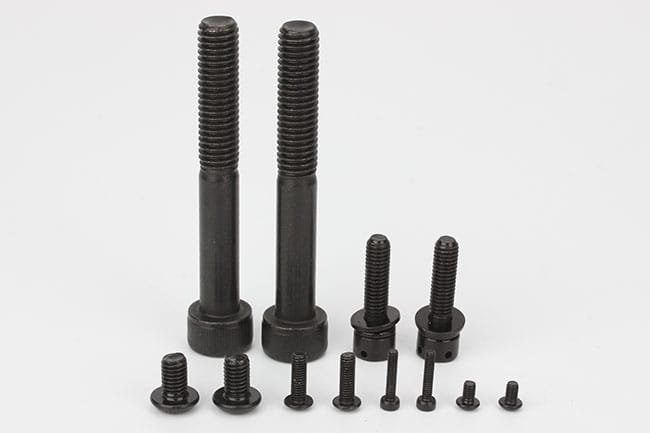
Flybear’s carbon and alloy steel fastener range includes bolts, screws, nuts, washers, studs, and threaded rods. For custom products, the selected manufacturing route should support the drawing and final property requirements rather than being chosen from the material grade alone.
A drawing-based RFQ should identify critical features such as head dimensions, shoulder geometry, grip length, thread runout, thread length, special holes, and dimensional tolerances. Heat-treatment and surface-treatment requirements should be provided at the same time.
Inspection Should Verify the Finished Fastener, Not Just the Steel
A material certificate confirms important information about the starting steel, but it does not replace finished-fastener testing. For high-strength Cr-Mo fasteners, the inspection plan may include:
- Material identification and chemical verification where required
- Heat or lot traceability
- Hardness testing
- Tensile or proof-related testing according to the product standard
- Impact testing when specified
- Metallographic examination where required
- Dimensional inspection
- GO/NO-GO thread gauging
- Coating thickness or surface-finish verification
Flybear’s fastener quality inspection capabilities can support order-defined material, mechanical, metallographic, dimensional, thread, and coating checks where applicable.
Common 35CrMo vs 42CrMo Purchasing Mistakes
- Assuming 42CrMo is always the better grade: the correct material depends on finished mechanical requirements, diameter, heat treatment, toughness, and project specification.
- Using material grade as property class: 35CrMo or 42CrMo chemistry does not automatically establish an ISO, SAE, or ASTM fastener grade.
- Treating 42CrMo as exactly equivalent to 4140 or 42CrMo4: cross-standard comparisons require verification of chemistry, condition, product form, and acceptance criteria.
- Ignoring section size: a material/heat-treatment combination that works for a smaller bolt may not give identical through-section response in a larger fastener.
- Specifying a heat-treatment cycle without context: finished properties and governing standards should control acceptance.
- Assuming higher hardness means better performance: strength, toughness, fatigue, environmental risk, and joint requirements must be balanced.
- Ignoring coating requirements: Cr-Mo alloy steel does not provide stainless-steel-like atmospheric corrosion resistance.
- Accepting the raw-material certificate as complete fastener approval: finished mechanical, dimensional, thread, and coating requirements still need inspection.
What to Include in a 35CrMo or 42CrMo Fastener RFQ
For accurate quotation and technical review, provide:
- Applicable material standard and exact grade: 35CrMo or 42CrMo
- Applicable fastener standard or controlled drawing
- Required property class or finished mechanical properties
- Required material or heat-treatment condition
- Product type: bolt, screw, stud, threaded rod, nut, washer, or custom component
- Nominal diameter, thread pitch, length, and thread length
- Critical dimensions and drawing revision
- Application loading and relevant operating conditions
- Coating, plating, black oxide, zinc-flake, or other surface treatment
- Nut and washer requirements
- Quantity
- Required hardness, tensile, impact, metallographic, dimensional, thread, coating, and material inspection
- Certificate and traceability requirements
FAQ: 35CrMo vs 42CrMo Fasteners
Is 42CrMo stronger than 35CrMo?
42CrMo has a higher specified carbon range and can provide a higher strength and hardness potential after appropriate heat treatment. However, finished fastener strength depends on heat-treatment condition, diameter, geometry, and the applicable fastener standard. The material name alone does not establish the delivered bolt strength.
Can 35CrMo be used for high-strength bolts?
Yes, 35CrMo can be used for high-strength fasteners when the material, section size, manufacturing process, and heat treatment can satisfy the required finished mechanical properties. The property class or project mechanical requirements should be verified by testing.
Is 42CrMo the same as AISI 4140?
No. 42CrMo and AISI/SAE 4140 are often compared because they belong to similar chromium-molybdenum steel families, but they are defined by different standards. Do not treat them as automatic substitutes without comparing chemical limits, product form, heat treatment, mechanical requirements, and project approval.
Should I select 35CrMo or 42CrMo for a large-diameter bolt?
The decision depends on diameter, required core and surface properties, fastener strength requirement, heat-treatment route, toughness, and the governing material specification. Larger sections make hardenability and heat-treatment response particularly important, so the final material should be selected from the complete engineering requirement.
Send the Material Standard and Finished Mechanical Requirements for Review
When requesting 35CrMo or 42CrMo fasteners, send Flybear the material standard, exact grade, product size and thread, required property class or mechanical properties, heat-treatment condition, coating, quantity, controlled drawing, and inspection requirements. Use the Flybear contact page to submit your RFQ. Defining the finished fastener requirements allows 35CrMo vs 42CrMo fasteners to be reviewed according to chemistry, section size, heat-treatment response, manufacturing route, and actual application rather than selecting material from a simple strength ranking.
Follow Me!