Robot Locking Round Nuts for Precision Motion Systems
Robot locking round nuts provide secure axial positioning for bearings, shafts, gears, sleeves, and other critical components in robotic motion systems. Unlike a conventional hex nut, a round locking nut is designed for compact cylindrical assemblies where installation space, rotational balance, positioning accuracy, and resistance to loosening are important. Depending on the product design, the nut may use radial locking screws, axial locking screws, clamping elements, slots, or spanner holes to maintain its position on a threaded shaft.
Industrial robots, collaborative robots, automated production equipment, and precision motion modules contain multiple rotating and articulated components. Any movement of a bearing or shaft-mounted part can influence alignment, repeatability, noise, vibration, and service life. Selecting the correct locking nut is therefore an important part of robotic joint and transmission design.
What Is a Robot Locking Round Nut?
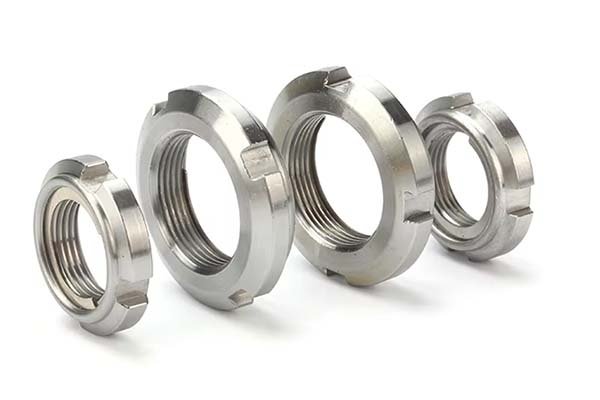
A robot locking round nut is an internally threaded circular fastener used to locate and retain components on a shaft. Its round external profile is suitable for assemblies where a conventional hexagonal nut would occupy too much radial space or interfere with nearby parts.
The nut is normally tightened against a bearing inner ring, spacer, gear, pulley, coupling, or another shaft-mounted component. After the required position or preload condition is reached, the integrated locking feature helps prevent unintended rotation of the nut.
Round lock nuts can be manufactured with different installation features. Some designs have external slots for a hook spanner, while others use face holes for a pin wrench. Precision versions may include several locking screws positioned around the nut body. The correct configuration depends on shaft size, assembly space, load direction, service requirements, and the available installation tools.
Why Robot Locking Round Nuts Matter
Robotic systems depend on controlled movement. Bearings and transmission components must remain in their intended axial positions while the robot accelerates, stops, reverses direction, and performs repeated cycles. A loose retaining component can introduce unwanted clearance or disturb the relationship between connected parts.
Robot locking round nuts help maintain the mechanical arrangement of the assembly. They can support bearing positioning in rotary joints, secure components in reduction mechanisms, retain gears on drive shafts, and hold spacers or sleeves in compact actuator modules.
The circular shape can also provide more uniform mass distribution than a large conventional hex nut. This characteristic may be useful in rotating assemblies, although the final balance of the complete component should always be evaluated according to the speed and precision requirements of the application.
Common Applications in Robotic Equipment
Precision locking nuts can be used in robot joints, servo drive assemblies, gearboxes, rotary tables, linear motion systems, end-of-arm tooling, automated positioning units, and compact transmission modules. They may also be used in machinery that supports robotic production lines, including indexing equipment, handling systems, inspection stations, and automated assembly machines.
In a robotic joint, the nut may position a bearing set or retain a rotating shaft component. In a gearbox, it may help secure a gear, sleeve, or bearing arrangement. In a linear actuator, it can be used to position components associated with the screw support assembly.
Each application has different requirements. A slowly moving adjustment mechanism may not need the same locking structure as a high-cycle robot joint. Buyers should therefore provide information about load, rotational speed, movement direction, vibration, operating temperature, lubrication, installation space, and maintenance frequency.
Locking Methods for Round Nuts
Several locking methods can be considered when designing a custom round nut for robotic equipment. A radial locking design uses screws installed from the outside diameter toward the threaded area. An axial locking design places the screws parallel to the shaft axis. Other products may use a separate locking washer, a clamping section, or an integrated flexible locking element.
The locking screws should not damage the shaft thread or create uncontrolled distortion in the nut. For this reason, some precision designs use an intermediate element between the screw and the mating thread. The locking force is distributed through this element instead of being applied directly by the screw tip.
The number and position of the locking screws can affect installation access and force distribution. A manufacturer should review the assembly drawing before recommending a design. The available wrench space, nearby housing features, screw orientation, and disassembly procedure all influence the final configuration.
Material Selection for Robot Locking Round Nuts
Material selection should reflect the mechanical load, operating environment, manufacturing method, and required surface condition. Alloy steel may be considered for applications requiring strength and wear resistance. Stainless steel can be useful where corrosion resistance, cleanliness, or exposure to moisture is important.
The nut material should also be compatible with the mating shaft and surrounding components. Differences in hardness, thermal expansion, and surface condition can affect thread behavior and long-term assembly performance. When stainless steel components are used together, the installation procedure should consider the possibility of thread galling.
Buyers should specify the required material grade rather than requesting only a general steel or stainless steel nut. When a material grade has not yet been selected, information about the application should be supplied so that available manufacturing options can be evaluated.
Thread and Dimensional Requirements
The thread is one of the most important features of a robot locking round nut. The inquiry should clearly identify the nominal diameter, pitch, thread direction, tolerance requirements, and mating shaft specification. Fine threads are often considered when controlled axial adjustment is required, but the appropriate pitch must be determined by the joint design.
Other important dimensions include the outside diameter, overall thickness, bearing face diameter, slot or hole position, locking screw size, and edge geometry. The bearing face should contact the intended component correctly without interfering with seals, cages, shoulders, or adjacent housing features.
For custom parts, a detailed technical drawing is preferable to a basic size description. The drawing should identify critical dimensions, tolerances, datum surfaces, thread requirements, material, heat treatment when applicable, surface finish, marking, and inspection expectations.
Manufacturing Precision Lock Nuts for Robots
Robot locking round nuts may require turning, threading, drilling, milling, grinding, heat treatment, surface finishing, and deburring. The exact manufacturing route depends on the design, material, quantity, tolerance, and functional requirements.
Thread accuracy and contact-face quality are especially important. The internal thread must engage correctly with the shaft, while the contact surface must support stable positioning of the retained component. Features for locking screws or installation tools must also be produced in the correct locations.
Machining burrs can interfere with assembly, damage nearby components, or contaminate a lubricated mechanism. Special attention should therefore be given to thread starts, drilled holes, wrench slots, and intersecting features. Cleaning requirements should be specified when the nut will be installed in a sensitive gearbox, bearing assembly, clean production area, or lubrication system.
Flybear Fastener can evaluate locking round nuts according to customer drawings, samples, materials, thread specifications, machining features, quantities, and inspection requirements. Providing complete application information supports a more accurate review of manufacturing feasibility.
Quality Control for Precision Round Lock Nuts
Inspection should focus on features that influence fit, positioning, and locking performance. Typical inspection items may include internal thread conformity, outside diameter, nut thickness, contact-face geometry, locking hole position, slot dimensions, concentricity requirements, surface condition, and burr control.
The inspection plan should be based on the approved drawing and purchase specification. Not every robotic application requires the same level of dimensional control, so critical characteristics should be identified before production begins.
First-article samples can be assembled with the actual shaft, bearings, tools, and surrounding components. This allows the customer to check thread engagement, installation access, axial positioning, locking operation, and disassembly before approving a larger production order.
For repeated orders, stable documentation is important. The approved drawing, material requirement, revision level, inspection criteria, packaging method, and labeling instructions should remain consistent unless an engineering change is formally introduced.
Surface Treatment and Cleanliness
Carbon and alloy steel nuts may require a surface treatment selected according to corrosion exposure, dimensional tolerance, appearance, and compatibility with lubricants. Stainless steel parts may be supplied with a machined or cleaned surface depending on the application.
Coating thickness must be considered when threads and close-fitting features have limited tolerance. A surface treatment should not prevent smooth engagement with the mating shaft or interfere with locking screws and installation tools.
Cleanliness is particularly important for robot gearboxes, bearing systems, and enclosed actuators. Metal chips, abrasive residue, heavy oil, and loose coating material should not enter the assembly. Customers with specific cleanliness requirements should state the required cleaning, preservation, and packaging conditions in the inquiry.
How to Order Custom Robot Locking Round Nuts
A complete request for quotation should include a drawing or sample, thread size and pitch, material grade, heat-treatment requirement, surface treatment, order quantity, annual demand, application description, and inspection requirements. Buyers should also identify whether the part is a new design or a replacement for an existing component.
For a new robotic system, supplying the shaft drawing and surrounding assembly dimensions can help identify potential interference or installation concerns. For a replacement part, the customer should confirm whether the original component was manufactured to a published standard or an equipment-specific design.
Packaging should protect precision threads and contact surfaces during transportation and storage. Individual separation, trays, protective caps, or other packaging methods may be considered according to the part geometry and handling process.
Choosing a Robot Locking Nut Manufacturer
A suitable robot locking nut manufacturer should be able to review more than the basic thread size. Buyers should consider machining capability, thread control, custom feature production, material management, inspection methods, drawing review, packaging, and communication.
The lowest unit price may not provide the lowest overall procurement cost if parts require additional sorting, rework, cleaning, or assembly adjustment. A technically complete quotation and an approved sample can help purchasing teams compare suppliers based on manufacturing suitability rather than price alone.
Robot locking round nuts are small components with an important role in precision motion systems. Correct material selection, accurate threads, controlled contact surfaces, dependable locking features, and appropriate inspection help ensure that the nut fits the robotic assembly and performs its intended retaining function.
Follow Me!


Need Fasteners for Your Application?
Share your application, standard or drawing, material or grade, dimensions, finish and quantity. Our team will review your requirements and recommend a suitable solution.