Double Slotted Nuts for Reliable Mechanical Locking
Double slotted nuts are widely used in mechanical assemblies where a standard hex nut is not enough to prevent loosening under vibration, rotation, or repeated load changes. Designed with slots that allow a cotter pin, split pin, or safety wire to pass through the nut and mating bolt, this fastener provides a practical locking solution for machinery, vehicles, construction equipment, agricultural systems, and other demanding industrial applications.
For buyers, engineers, and sourcing managers, selecting the right double slotted nut is not only about matching thread size. Material, grade, slot design, surface finish, dimensional standard, and application environment all influence performance. A well-specified slotted nut can help improve assembly reliability, simplify maintenance, and reduce the risk of fastener loosening in critical joints.
What Are Double Slotted Nuts?
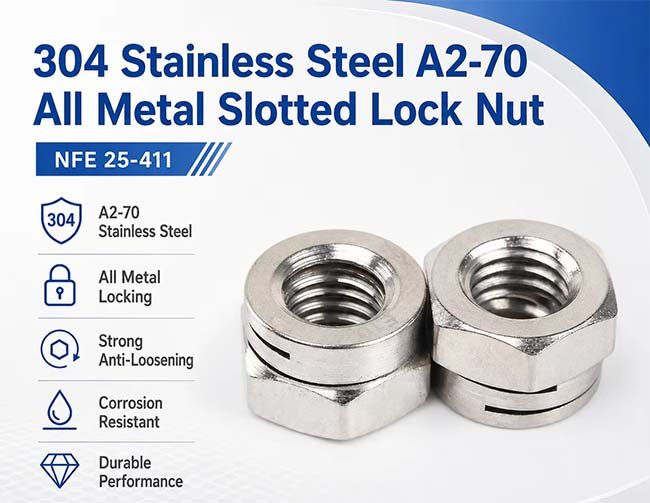
Double slotted nuts are hex nuts manufactured with slots on the top section, or in some designs on both usable sides, to support positive mechanical locking. After the nut is tightened onto a bolt, stud, or threaded shaft, a hole in the mating fastener aligns with one of the slots. A cotter pin or similar locking component is then inserted to secure the assembly and prevent the nut from backing off.
This design is often compared with castellated nuts and slotted lock nuts. While the exact geometry may vary depending on the drawing or standard, the core function remains the same: to provide a visible and mechanical locking method that does not rely only on friction. This makes double slotted hex nuts especially useful in equipment exposed to vibration, impact, or frequent movement.
Key Benefits of Double Slotted Nuts
One of the main advantages of double slotted nuts is their dependable locking performance. Unlike prevailing torque nuts or chemical thread lockers, a slotted nut with a cotter pin creates a physical barrier against rotation. This is valuable in assemblies where inspection, servicing, and safety are important.
Another benefit is reusability in many maintenance situations. When the cotter pin is removed, the nut can be disassembled for repair or replacement, provided the threads and bearing surface remain in acceptable condition. This makes double slotted nuts suitable for heavy-duty equipment, trailer parts, suspension systems, linkages, and shaft assemblies.
They also provide good installation visibility. Maintenance teams can quickly check whether the cotter pin is properly installed, which supports routine inspection and quality control. For industrial distributors and OEM buyers, this simple feature can be a strong advantage when supplying fasteners for safety-sensitive mechanical systems.
Double Slotted Nuts Materials and Grades
Double slotted nuts can be produced in a range of materials according to strength requirements, corrosion exposure, and cost targets. Carbon steel is commonly selected for general machinery and equipment. Alloy steel may be used when higher strength or improved mechanical performance is required. Stainless steel double slotted nuts are often preferred for outdoor, marine, food equipment, or chemical processing environments where corrosion resistance matters.
Common strength classifications may include metric property classes or inch-series grades depending on the market and application. Buyers should confirm the required thread type, proof load, mating bolt grade, and assembly conditions before placing an order. Choosing a nut that is weaker than the bolt or unsuitable for the service environment can reduce joint reliability.
Surface finishes are also important. Zinc plating is a popular choice for general corrosion protection and a clean appearance. Hot dip galvanizing can be considered for outdoor steel structures and larger fasteners. Black oxide, phosphate, nickel plating, and other coatings may be specified for functional or visual requirements. The finish should be selected with attention to thread fit, coating thickness, and the environment in which the fastener will be used.
Standards, Sizes, and Custom Manufacturing Options
Many buyers search for double slotted nuts using related terms such as DIN slotted nuts, castellated hex nuts, slotted lock nuts, and custom slotted nuts. Depending on the application, the product may be requested according to recognized dimensional standards or made according to a customer drawing. Important specification points include thread diameter, thread pitch, nut height, width across flats, slot width, slot depth, material, coating, and tolerance requirements.
For projects that require non-standard dimensions, custom manufacturing can be a practical solution. A supplier may produce double slotted nuts with special heights, fine threads, left-hand threads, special coatings, or modified slot structures. This is especially useful for OEM machinery, automotive components, power transmission parts, and replacement fasteners for existing equipment.
Flybear Fastener supports industrial buyers who need practical fastener solutions for standard and custom applications. When ordering double slotted nuts, providing drawings, samples, application details, or target standards can help reduce communication errors and improve production accuracy.
Applications in Industrial Assemblies
Double slotted nuts are used in many assemblies where a secure but serviceable locking method is required. In automotive and trailer systems, they may be found in wheel, suspension, steering, and axle-related connections. In agricultural machinery, they are useful for moving parts exposed to vibration, dust, and outdoor working conditions. In construction equipment and lifting mechanisms, they help secure joints that must remain stable during operation.
They are also used in power transmission systems, industrial linkages, mining equipment, railway-related components, and general mechanical repair. Because the locking function depends on alignment between the nut slot and the drilled bolt or shaft, proper installation is essential. Assemblers should tighten the nut according to the required torque or adjustment position, then align the slot with the hole without damaging the thread or overloading the joint.
How to Choose the Right Double Slotted Nut Supplier
When sourcing double slotted nuts, buyers should evaluate more than unit price. A reliable supplier should understand material selection, thread accuracy, slot machining, heat treatment requirements, coating control, packaging, and export documentation. For B2B purchasing, stable quality and clear technical communication are often more valuable than a very low quotation.
It is also important to confirm whether the supplier can support both standard fasteners and custom parts. Many industrial projects require mixed purchasing, including hex bolts, washers, lock nuts, slotted nuts, castle nuts, threaded rods, and special turned parts. Working with a supplier that understands multiple product categories can simplify procurement and improve delivery coordination.
Before mass production, buyers may request samples, drawings, material confirmation, or surface finish details. For critical applications, testing requirements should be agreed in advance. This helps ensure that the finished double slotted nuts meet the functional needs of the assembly and the expectations of the end user.
Conclusion
Double slotted nuts offer a strong, visible, and serviceable locking solution for mechanical assemblies exposed to vibration and movement. By combining a slotted nut with a cotter pin or safety locking component, engineers can improve fastening security without making future maintenance difficult. For successful sourcing, buyers should clearly define material, grade, finish, size, thread, standard, and application requirements. With the right specifications and a capable manufacturer, double slotted nuts can deliver dependable performance across a wide range of industrial fastening applications.
Follow Me!