Common Nickel-Based Alloy Fastener Materials and How to Select Them
Nickel-based alloy fasteners are widely used in industrial assemblies that must resist high temperatures, heavy mechanical loads, seawater, chlorides, acids, oxidation, creep, or stress relaxation. Unlike standard carbon steel or common stainless steel fasteners, nickel alloy bolts, nuts, studs, screws, washers, and locking components are designed for demanding environments where both corrosion resistance and mechanical reliability are critical.
The most frequently specified material families include Inconel, Hastelloy, Monel, Incoloy, and Nimonic alloys. Each family has a different balance of nickel, chromium, iron, molybdenum, copper, niobium, and other alloying elements. As a result, selecting the correct grade requires a clear understanding of service temperature, corrosion medium, mechanical load, fastening function, heat treatment, and applicable material standard.
Inconel Nickel-Based Alloy Fasteners
Inconel alloys are nickel-chromium-based materials known for resistance to high temperatures, oxidation, corrosion, and mechanical degradation. They are among the most common materials used for high-performance fasteners in aerospace, marine engineering, chemical processing, power generation, oil and gas, and industrial furnace equipment.
Inconel 600, UNS N06600, provides good resistance to high-temperature oxidation and a wide range of corrosive media. It is commonly considered for industrial furnaces, heat-treatment equipment, chemical processing machinery, and thermal systems. In fastener applications, it may be used for bolts, studs, nuts, washers, and special threaded parts exposed to heat and oxidation.
Inconel 601, UNS N06601, offers stronger high-temperature oxidation resistance than Alloy 600. It is frequently selected for furnace components, combustion systems, heat-treatment fixtures, and equipment exposed to repeated thermal cycling. Inconel 601 fasteners are useful where oxidation resistance is more important than maximum mechanical strength.
Inconel 625, UNS N06625, is one of the most widely used corrosion-resistant nickel alloys. It performs well in seawater, chloride-containing environments, and many acidic media. The alloy also offers good weldability and useful mechanical strength. Typical applications include offshore platforms, shipbuilding equipment, pumps, valves, chemical processing systems, flue gas desulfurization equipment, and oil and gas machinery.
Inconel 625 fasteners are commonly selected where the main concern is corrosion rather than extreme bolting strength. Bolts, studs, nuts, washers, U-bolts, and custom components made from Alloy 625 are particularly suitable for marine and chloride-bearing environments. ASTM B446 is commonly referenced for Alloy 625 rod and bar used as raw material for machined fasteners.
Inconel 718, UNS N07718, is a precipitation-hardened nickel-based superalloy designed for high strength, fatigue resistance, creep resistance, and elevated-temperature performance. It is one of the most important materials for high-load nickel alloy fasteners. Typical products include high-strength bolts, nuts, studs, lock nuts, threaded rods, and special aerospace fastening components.
Inconel 718 is commonly used in aerospace engines, gas turbines, nuclear power equipment, oil and gas systems, and high-pressure assemblies. Its final properties depend strongly on the specified heat-treatment condition. Therefore, procurement documents should identify the required material specification, solution treatment, aging condition, mechanical properties, and inspection requirements. ASTM B637 is frequently associated with precipitation-hardened nickel alloy bar and forging products.
Inconel 725, UNS N07725, combines much of the corrosion resistance associated with Alloy 625 with higher mechanical strength developed through precipitation hardening. It is particularly relevant for deep-sea equipment, downhole tools, oilfield components, and oil and gas fasteners that must operate under both high stress and corrosive exposure.
Inconel X-750, UNS N07750, is an age-hardenable nickel-chromium alloy known for high-temperature strength and resistance to stress relaxation. It is commonly used for high-temperature bolts, spring washers, retaining components, springs, and gas turbine fasteners. The required heat-treatment condition should be clearly stated because it has a major influence on mechanical performance and relaxation resistance.
Inconel 718 Versus Inconel 625
Inconel 718 and Inconel 625 are the two most frequently discussed nickel alloy fastener materials, but they serve different priorities.
Inconel 718 is usually the better choice when the assembly requires high tensile strength, fatigue resistance, creep resistance, and load retention at elevated temperatures. It is commonly used for high-strength bolts, studs, lock nuts, and critical fastening systems.
Inconel 625 is usually preferred when seawater, chlorides, acidic media, or general chemical corrosion are the primary concerns. It is widely used in offshore, marine, chemical, pump, valve, and pollution-control equipment.
In practical terms, buyers may prioritize Inconel 718 for high strength and high-temperature loading, while Inconel 625 is often selected for marine corrosion and chemical resistance. The two grades should not be treated as direct substitutes without reviewing the operating environment and required mechanical properties.
Hastelloy Fastener Materials
Hastelloy alloys are generally selected for severe chemical corrosion rather than simply for maximum mechanical strength. They are common in chemical processing, pharmaceutical production, flue gas systems, wastewater treatment, acid-handling equipment, and other aggressive environments.
Hastelloy C-276, UNS N10276, is the most common Hastelloy grade used for industrial fasteners. It offers strong resistance to acids, chlorides, pitting, crevice corrosion, and mixed oxidizing and reducing media. Hastelloy C-276 bolts and studs are often specified when ordinary stainless steel, duplex stainless steel, or some lower-alloyed nickel materials cannot provide sufficient service life.
Typical applications include chemical reactors, scrubbers, pharmaceutical equipment, flue gas desulfurization systems, waste-treatment equipment, and process piping assemblies. ASTM B574 is commonly referenced for C-276 rod and bar used for machining fasteners.
Hastelloy C-22, UNS N06022, provides excellent resistance to pitting, crevice corrosion, and stress corrosion cracking. It is often selected for fine chemical processing, pharmaceutical equipment, and assemblies exposed to complex corrosive media.
Hastelloy B-2, UNS N10665, is primarily associated with hydrochloric acid and strongly reducing environments. It may be used in acid-processing equipment and chemical reaction systems where oxidizing contaminants are carefully controlled.
Hastelloy B-3, UNS N10675, is an improved B-series alloy with better thermal stability and processing characteristics. It is designed for highly reducing acid environments and can be considered for custom bolts, studs, nuts, and machined fastening components used in specialized chemical equipment.
Monel Fastener Materials
Monel alloys are nickel-copper materials known for resistance to seawater, brine, alkalis, and certain chemical media. They are commonly used in marine systems, shipbuilding, pumps, valves, chemical equipment, and specialized processing machinery.
Monel 400, UNS N04400, offers good resistance to seawater, salts, alkalis, and hydrofluoric acid under appropriate conditions. Monel 400 fasteners are frequently used for marine bolts, screws, studs, nuts, washers, and pump or valve hardware where corrosion resistance is more important than very high strength.
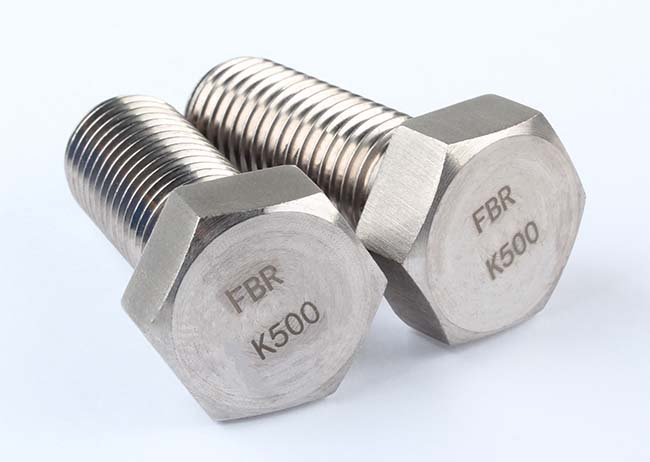
Monel K-500, UNS N05500, is a precipitation-hardened version of the nickel-copper alloy family. It retains much of the corrosion resistance of Monel 400 while offering higher strength and hardness. This makes Monel K-500 more suitable for load-bearing marine fasteners, pump shafts, valve parts, offshore equipment, and other mechanically demanding applications.
A simple selection rule is to consider Monel 400 when seawater resistance is required but the mechanical load is moderate. Monel K-500 is generally more suitable when both seawater resistance and higher strength are required.
Incoloy Nickel-Iron-Chromium Fasteners
Incoloy alloys are technically nickel-iron-chromium materials, but they are often grouped with nickel alloy fasteners in industrial purchasing. They are widely used in high-temperature equipment, heat exchangers, petrochemical systems, and acid-processing installations.
Incoloy 800, UNS N08800, provides resistance to oxidation, carburization, and elevated-temperature exposure. Typical applications include industrial furnaces, heat exchangers, and thermal processing equipment.
Incoloy 800H, UNS N08810, is designed for improved long-term strength at elevated temperatures. It may be selected for high-temperature pressure equipment, furnace assemblies, and petrochemical installations where creep strength is important.
Incoloy 800HT, UNS N08811, offers enhanced high-temperature creep and rupture performance. It is commonly considered for petrochemical equipment, industrial furnaces, and other systems exposed to sustained high-temperature loading.
Incoloy 825, UNS N08825, is a corrosion-resistant nickel-iron-chromium alloy used in sulfuric acid, phosphoric acid, and chloride-bearing environments. Incoloy 825 fasteners may be used in chemical processing, acid pickling systems, marine equipment, and oil and gas facilities.
Nimonic High-Temperature Fastener Materials
Nimonic alloys are nickel-based superalloys developed for elevated-temperature strength, oxidation resistance, and creep resistance. Common grades include Nimonic 80A, UNS N07080, Nimonic 90, UNS N07090, Nimonic 105, and Nimonic 115.
These alloys are used in gas turbines, aircraft engines, exhaust systems, high-temperature machinery, and other thermal assemblies. Typical fastener products include bolts, studs, nuts, locking parts, spring components, and special threaded hardware.
Nimonic 80A is especially relevant for high-temperature engine and turbine fasteners where resistance to creep, oxidation, and stress relaxation is required. As with other precipitation-hardened alloys, the heat-treatment condition must be defined during procurement.
Most Common Nickel Alloy Grades for Fasteners
In practical industrial sourcing, the most frequently requested nickel alloy fastener grades can be grouped according to their main performance advantage.
Inconel 718 is widely used for high-strength, high-temperature fasteners. Inconel 625 is common in corrosion-resistant marine and offshore fastening systems. Hastelloy C-276 is frequently specified for severe chemical environments. Monel K-500 is used for higher-strength marine fasteners, while Monel 400 is selected for seawater and special chemical resistance where extreme strength is not required.
Inconel X-750 is common for high-temperature bolts, springs, and elastic locking components. Incoloy 825 is relevant to acidic and chloride-containing environments. Nimonic 80A is often considered for engine, turbine, and other high-temperature fastener applications.
Nickel-Based Alloy Fastener Selection Guide
For high-temperature and high-load assemblies, Inconel 718 is often the first material to evaluate. For seawater, chloride exposure, and offshore platforms, Inconel 625 or Monel K-500 may be more suitable. For aggressive acids and complex chemical media, Hastelloy C-276 or C-22 should be considered.
Monel 400 and K-500 are relevant where seawater, alkaline solutions, or hydrofluoric acid resistance is required. Inconel 600, Inconel 601, and Incoloy 800H are commonly evaluated for industrial furnaces and high-temperature oxidation. Inconel X-750 and Nimonic 80A are suitable candidates where stress relaxation and spring performance at elevated temperatures are important.
For oil and gas downhole environments requiring both high strength and corrosion resistance, Inconel 718, Inconel 725, and Monel K-500 may be considered depending on the exact service conditions.
Final material selection should consider operating temperature, chemical composition, chloride concentration, pressure, load, joint design, galvanic compatibility, maintenance interval, expected service life, and applicable engineering codes. The alloy name alone is not sufficient. Buyers should also specify the UNS number, material condition, heat treatment, raw material standard, fastener dimensions, thread form, mechanical properties, inspection scope, and documentation requirements.
Manufacturing Nickel Alloy Bolts and Custom Fasteners
Nickel alloys are generally more difficult to machine and form than standard carbon steel and many stainless steels. Work hardening, low thermal conductivity, high cutting forces, and heat-treatment sensitivity can affect tool life, dimensional control, thread quality, and production efficiency.
The manufacturing route may include hot forging, cold forming, CNC machining, thread rolling, thread cutting, heat treatment, surface finishing, and final inspection. Thread rolling may be suitable for selected grades and conditions, while cut or machined threads may be required for high-strength materials, special diameters, low-volume production, or non-standard thread forms.
For custom nickel alloy fasteners, Flybear can review drawings, material grades, thread requirements, heat-treatment conditions, tolerances, inspection items, and application needs before production. This manufacturing review helps determine whether the selected alloy and process route are suitable for the required bolt, stud, nut, screw, washer, or special fastening component.
Quality control requirements may include raw material certificate review, dimensional inspection, thread gauging, hardness testing, mechanical testing, visual examination, positive material identification when specified, and lot traceability. The inspection plan should be based on the application risk, customer specification, and contractual requirements.
Conclusion
Nickel-based alloy fasteners cover a broad range of materials designed for different combinations of corrosion resistance, high-temperature strength, oxidation resistance, creep performance, and load-carrying capability. Inconel 718 and Inconel 625 are the two most common choices, but Hastelloy C-276, Monel K-500, Inconel X-750, Incoloy 825, and Nimonic 80A also play important roles in specialized industrial assemblies.
The correct grade should be selected according to the actual service environment rather than by alloy reputation alone. A complete fastener inquiry should define the material designation, standard, heat treatment, dimensions, threads, mechanical properties, inspection requirements, and application conditions. This approach supports more reliable manufacturing, more accurate quotations, and better long-term fastener performance.
Follow Me!