Monel K-500 Fasteners: When Strength and Marine Corrosion Resistance Matter
Monel K500 fasteners are commonly evaluated when an assembly needs higher mechanical strength than conventional nickel-copper Alloy 400 while retaining useful corrosion resistance in marine, chemical-processing, pump, valve, and other demanding environments. K-500, designated UNS N05500, is a precipitation-hardenable nickel-copper alloy whose strength is developed through controlled additions of aluminum and titanium followed by appropriate thermal treatment.
For industrial buyers, however, “Monel K-500 bolt” is not a complete purchasing specification. The final requirement should identify the exact material specification and condition, fastener standard or drawing, diameter, thread, length, mating material, operating environment, temperature, inspection, and documentation. K-500 has valuable marine-service characteristics, but it should not be described as immune to seawater corrosion or suitable for every chemical environment.
What Are Monel K-500 Fasteners?
Monel K-500, also known as Alloy K-500 or UNS N05500, belongs to the nickel-copper alloy family. It is related to Alloy 400 but contains controlled aluminum and titanium additions that enable precipitation hardening. After the appropriate solution and aging treatment, finely distributed precipitates develop within the alloy and increase its strength and hardness.
This combination makes K-500 attractive for components that need both corrosion resistance and greater mechanical capability than a solution-strengthened nickel-copper material can provide. Typical applications include marine fasteners, pump and valve components, shafts, springs, oil and gas equipment, and chemical-processing machinery.
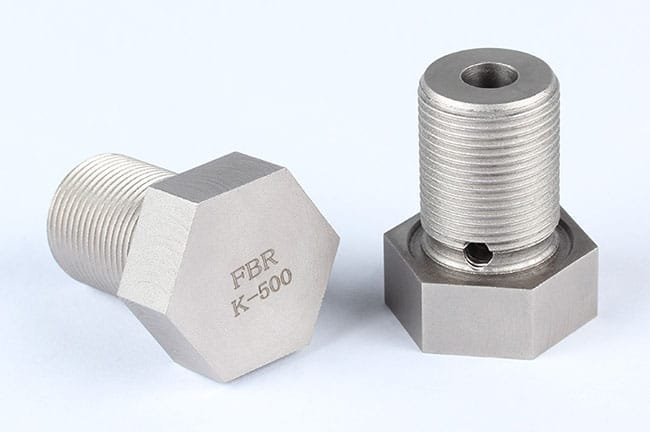
Flybear currently lists K-500 hex bolts within its nickel-based alloy fastener range. Buyers should still define the exact UNS designation, condition, dimensions, and governing product requirements for each order.
Why K-500 Is Stronger Than Monel 400
The primary reason engineers move from Monel 400 to K-500 is mechanical performance. Alloy 400 is a solid-solution-strengthened nickel-copper material, while K-500 can be precipitation hardened. The aluminum and titanium additions in K-500 allow a strengthening phase to form during controlled aging.
This means the mechanical performance of K-500 depends strongly on material condition and heat-treatment history. Two components identified simply as “K-500” should not automatically be assumed to have the same finished properties if they have been supplied or processed in different conditions.
| Selection Factor | Monel 400 | Monel K-500 |
|---|---|---|
| Material family | Nickel-copper alloy | Precipitation-hardenable nickel-copper alloy |
| Common UNS designation | UNS N04400 | UNS N05500 |
| Strengthening approach | Primarily solid-solution strengthening and processing condition | Aluminum/titanium additions plus controlled precipitation hardening |
| Mechanical selection direction | Used where Alloy 400 properties satisfy the design | Often considered where additional strength and hardness are required |
| Marine corrosion behavior | Established nickel-copper corrosion resistance | Broadly similar corrosion-selection family, but age-hardened condition requires additional environmental review |
| Automatic substitution? | No. The material condition, mechanical requirements, corrosion environment, and governing specification must be checked. | |
The purchasing implication is important: do not replace an Alloy 400 fastener with K-500 solely because K-500 can provide higher strength. Higher strength can change joint preload, mating-component loading, installation procedures, and qualification requirements.
Marine Pump Fasteners: Why K-500 Is Considered
Marine pump fasteners can encounter a difficult combination of seawater, mechanical loading, vibration, crevices, and maintenance cycles. K-500 has a long history in marine equipment such as pump shafts, impellers, fasteners, chains, cables, and springs because its nickel-copper base provides useful seawater resistance while precipitation hardening provides increased strength.
This combination can make the alloy attractive for pump and valve assemblies where the fastener must maintain load while exposed to marine water or salt-contaminated environments.
However, seawater exposure is not one condition. Engineers should distinguish between:
- High-velocity flowing seawater
- Stagnant or slowly moving seawater
- Intermittent splash and spray
- Coastal atmospheric exposure
- Continuous immersion
- Crevices beneath nuts and washers
- Deposits and biological fouling
- Shutdown periods with stagnant residual water
Material guidance for K-500 notes that stagnant or slow-moving seawater can present different pitting and fouling behavior from high-velocity water. Therefore, a successful pump-shaft application should not automatically be used as proof that every submerged K-500 threaded connection will perform identically.
For broader saltwater selection considerations, review Flybear’s marine and offshore fastener solutions.
K-500 Is Corrosion Resistant, Not Corrosion Proof
One of the most important sourcing cautions is to avoid treating K-500 as universally immune to corrosion. Its corrosion resistance is generally associated with the established performance of the nickel-copper alloy family, but the age-hardened condition can introduce additional stress-corrosion considerations in some environments.
Fasteners can be particularly sensitive because threads create local stress concentrations and crevice geometries. A loaded bolt may experience conditions that are different from an unstressed corrosion coupon made from the same alloy.
When evaluating nickel copper alloy fasteners, provide information about:
- Fluid composition and contaminants
- Chloride or salt exposure
- Temperature
- pH where relevant
- Flow or stagnant conditions
- Immersion, splash, condensation, or atmospheric exposure
- Crevices and deposits
- Applied or residual stress
- Mating materials
- Cathodic protection, if present
These details are more useful than a general request for a “seawater-resistant bolt.”
Where Monel K500 Bolts May Be Considered
Monel K500 bolts may be evaluated for applications where the combination of nickel-copper corrosion resistance and precipitation-hardened strength provides a practical advantage.
Marine Pumps and Valves
Pump casings, valve assemblies, shafts, impellers, and associated hardware may expose fasteners to seawater while also imposing substantial mechanical load. K-500 can be a candidate when the project material specification supports its use.
Chemical-Processing Equipment
K-500 may be considered in selected chemical environments compatible with nickel-copper alloys. Chemical suitability should be checked against the exact fluid, concentration, temperature, contaminants, and process conditions rather than assuming broad resistance to all acids or chemicals.
Oil and Gas Equipment
The alloy is used in various oil and gas components where strength, corrosion resistance, and low magnetic permeability can be useful. If sour-service requirements apply, buyers should specify the governing project requirements and applicable NACE MR0175/ISO 15156 criteria rather than assuming generic K-500 material automatically satisfies every H2S application.
High-Load Custom Components
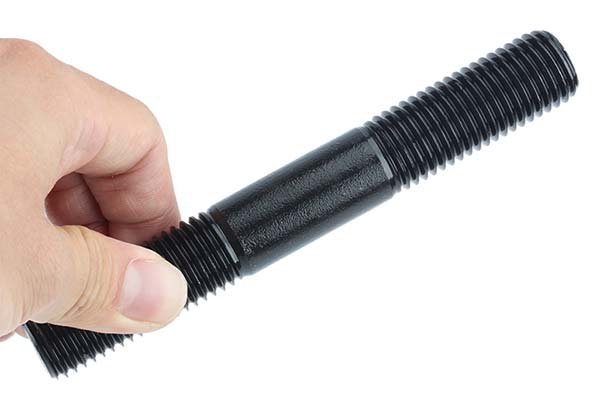
Drawing-based studs, bolts, threaded shafts, special screws, and machined components may use K-500 where a designer requires a high-strength corrosion-resistant nickel-copper material. The final mechanical properties should be specified through the relevant material and fastener requirements.
ASTM B865 vs ASTM F468: Buyers Need to Know the Difference
ASTM B865 is an important material specification for precipitation-hardening nickel-copper-aluminum Alloy UNS N05500. Its scope includes applicable bar, rod, wire, forgings, and forging stock. It can therefore define the starting material used for machined or forged K-500 fasteners.
But ASTM B865 is not, by itself, a complete dimensional specification for a finished hex bolt.
ASTM F468 is a finished-fastener specification for specified nonferrous bolts, hex cap screws, socket-head cap screws, and studs intended for general-use applications within its defined scope. K-500 appears in this system as Alloy 500 / UNS N05500. ASTM F467 is the corresponding specification buyers may encounter for nonferrous nuts.
A procurement package should therefore distinguish between:
- Raw material specification: establishes the required nickel alloy and material condition
- Finished fastener specification: establishes applicable mechanical and product requirements
- Dimensional standard: defines head, body, length, and related geometry
- Thread standard: defines diameter, pitch, tolerance, and thread form
- Project specification: may add inspection, documentation, environmental, or approval requirements
Do not write only “ASTM B865 bolt” when the project requires a controlled finished-fastener specification.
Heat Treatment Must Be Part of the Purchase Specification
K-500 obtains its key mechanical advantage through precipitation hardening. Consequently, heat-treatment condition is much more important than it would be for a generic material description that does not rely on aging for strength.
The applicable ASTM, AMS, customer, or drawing requirement should define the required condition. Buyers should avoid transferring mechanical values from a generic K-500 datasheet directly to a finished fastener without checking product size, starting condition, heat treatment, and the governing fastener standard.
This is also relevant for manufacturing sequence. Depending on the part, machining, forging, threading, solution treatment, aging, and final inspection must be coordinated so the delivered product satisfies both dimensional and mechanical requirements.
For custom and standard nickel-alloy fasteners supported by the product range, Flybear may use CNC machining, hot forging, and thread-production processes where applicable to the product and order. The exact route should be selected against the drawing, material condition, size, and specification rather than assumed from the alloy name.
Thread and Mating-Material Compatibility
A high-strength Monel fastener is only one component of the joint. Buyers must also define the nut, tapped component, washer, and connected materials.
A K-500 bolt installed into Monel, stainless steel, bronze, aluminum, carbon steel, or another nickel alloy creates different mechanical and corrosion conditions. In seawater or another conductive electrolyte, dissimilar-metal contact may introduce galvanic effects. Thread strength and nut proof requirements also need to be compatible with the bolt’s mechanical condition.
Specify:
- Bolt and nut alloy
- Diameter and thread pitch
- Thread class or tolerance
- Required engagement length
- Washer material
- Connected equipment material
- Surface finish or lubricant
- Installation preload or tightening procedure where controlled
If anti-seize or another lubricant is used, remember that thread friction changes can alter the preload generated from a given tightening torque.
Inspection and Traceability for K-500 Fasteners
Special-alloy fasteners should not be identified visually. K-500 can look similar to other nickel alloys after machining and finishing, making material traceability an important purchasing requirement.
Depending on the project, inspection may include:
- Material certificates and heat or lot traceability
- Chemical composition or positive material identification where specified
- Heat-treatment documentation
- Tensile, yield, elongation, or hardness testing required by the governing specification
- Dimensional inspection
- Thread gauging
- Surface-condition inspection
- Special project or third-party inspection requirements
Buyers can review Flybear’s fastener quality inspection information when preparing the inspection and documentation package. Required tests should be stated in the RFQ and purchase order rather than assumed to be included automatically.
Common Monel K-500 Procurement Mistakes
- Ordering only “Monel bolts”: this does not distinguish Alloy 400 from K-500 or other nickel-copper requirements.
- Omitting the material condition: K-500 mechanical performance depends strongly on precipitation-hardening condition.
- Assuming K-500 is immune to seawater: flow, stagnation, fouling, crevices, stress, and temperature can change corrosion behavior.
- Using ASTM B865 as the complete bolt standard: starting material and finished-fastener requirements are different parts of the specification.
- Copying generic mechanical properties: verify the actual product specification, condition, and size.
- Ignoring the nut: the mating component must provide compatible thread, material, and mechanical performance.
- Assuming automatic sour-service compliance: verify the applicable project and NACE/ISO requirements for the actual condition.
- Substituting K-500 for Alloy 400 without engineering approval: increased strength and different material condition can affect the joint design.
What to Include in a Monel K-500 Fastener RFQ
For an accurate quotation and technical review, provide:
- Exact material designation: Alloy K-500 / UNS N05500
- Required ASTM, AMS, customer, or other material specification
- Required material or heat-treatment condition
- Finished fastener standard or controlled drawing
- Product type: bolt, screw, stud, threaded shaft, nut, washer, or custom component
- Diameter, thread system, pitch, tolerance, length, and thread length
- Marine, chemical, oil and gas, or other operating environment
- Fluid chemistry and temperature where relevant
- Mating component and connected-material details
- Surface finish, lubricant, or cleaning requirement
- Quantity and packaging requirements
- Required material certificates, mechanical tests, PMI, inspection, and traceability documents
FAQ: Monel K-500 Fasteners
What is the main advantage of Monel K-500 over Monel 400?
K-500 can achieve greater strength and hardness through precipitation hardening while retaining the general corrosion-resistant characteristics of the nickel-copper alloy family. The exact benefit depends on the required material condition and application.
Are Monel K500 fasteners suitable for seawater?
K-500 is widely used in marine equipment and can provide useful seawater corrosion resistance, but it should not be treated as universally immune. Flow rate, stagnant water, deposits, pitting, crevices, stress, temperature, and mating materials should all be evaluated.
Is ASTM B865 a Monel K-500 bolt standard?
ASTM B865 covers UNS N05500 bar, rod, wire, forgings, and forging stock within its scope. It can define starting material for fastener production, but finished bolts still require appropriate fastener, dimensional, thread, mechanical, and inspection requirements.
Does Monel K-500 always require age hardening?
K-500 is precipitation hardenable, and the specified condition determines important mechanical properties. Whether and how aging is required depends on the applicable material or fastener specification and the ordered product condition. The RFQ should state the required specification rather than leave heat treatment undefined.
Send the Material Condition and Marine Environment for Review
When requesting Monel K-500 fasteners, send Flybear the UNS N05500 material specification and condition, product type, diameter, thread and length, drawing or fastener standard, marine or chemical environment, mating material, quantity, and required inspection documentation. Use the Flybear contact page to submit your RFQ. Defining both the precipitation-hardened mechanical requirement and the actual corrosion environment helps ensure the requested fastener is reviewed as a complete engineered component rather than simply as a “high-strength Monel bolt.”
Follow Me!