American Hex Nuts Guide: Standards, Grades, Materials and Applications
American hex nuts are among the most essential fastening components used across industries such as construction, machinery, oil & gas, and automotive engineering. Although they appear simple, selecting the correct hex nut involves understanding standards, grades, materials, and applications. This guide provides a comprehensive overview to help engineers, buyers, and sourcing professionals make informed decisions.
What Are American Hex Nuts?
American hex nuts are six-sided internally threaded fasteners designed to be used with bolts, screws, or threaded rods. Their primary function is to secure components by applying clamping force. These nuts are standardized to ensure compatibility with corresponding fasteners, especially those produced under unified thread systems.
At Flybear Fastener, we often help customers choose the right hex nuts based on specific applications, whether for high-pressure pipelines or general machinery assembly.
Key Standards for American Hex Nuts
The most important dimensional standard for inch-series hex nuts is ASME B18.2.2. This standard defines dimensions, tolerances, and thread compatibility. Additionally, material and performance standards play a critical role:
- ASTM A563 – Carbon steel hex nuts
- ASTM A194 – High-pressure and high-temperature applications
- ASTM F594 – Stainless steel nuts
- SAE J995 – Mechanical properties for carbon and alloy steel nuts
These standards ensure that hex nuts meet the required strength and performance for specific applications.
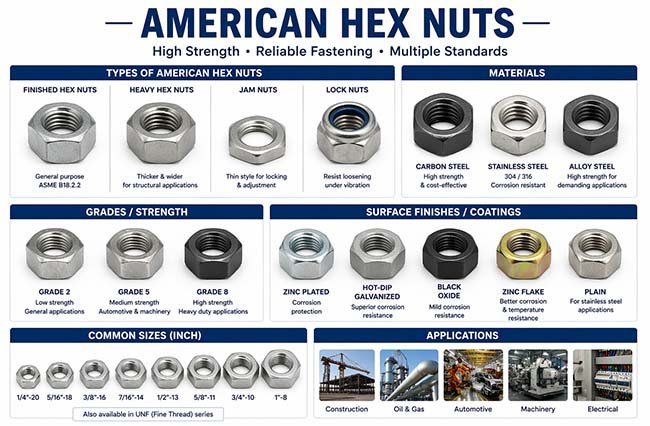
Types of American Hex Nuts
There are several common types of hex nuts, each designed for different uses:
- Finished Hex Nuts – Standard thickness, general purpose
- Heavy Hex Nuts – Thicker and wider, used in structural and high-strength applications
- Jam Nuts – Thin nuts used for locking and adjustment
- Lock Nuts – Designed to resist loosening under vibration
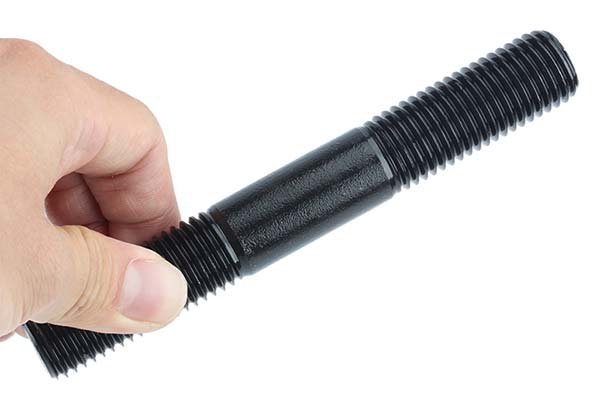
Heavy hex nuts are particularly common in flange connections and are often paired with ASTM A193 B7 stud bolts.
American Hex Nuts Grades and Strength
The strength of hex nuts is defined by material standards and grades. Understanding these grades is critical for ensuring compatibility with bolts.
- Grade 2 – Low strength, general applications
- Grade 5 – Medium strength, automotive and machinery
- Grade 8 – High strength, heavy-duty applications
For industrial projects, ASTM A194 Grade 2H nuts are widely used due to their high strength and resistance to pressure and temperature.
Materials Used in American Hex Nuts
Material selection directly impacts corrosion resistance, strength, and durability.
- Carbon Steel – Most common, cost-effective
- Alloy Steel – High strength for demanding applications
- Stainless Steel (304 / 316) – Excellent corrosion resistance
Stainless steel hex nuts, especially 316 grade, are widely used in marine and chemical environments where corrosion resistance is critical.
Surface Finishes and Coatings
Surface treatment improves corrosion resistance and extends service life. Common finishes include:
- Zinc Plated (Blue White Zinc)
- Hot-Dip Galvanized (HDG)
- Black Oxide
- Zinc Flake Coating
Zinc plating is the most widely used due to its balance of cost and performance.
American Hex Nuts Sizes and Thread Types
Hex nuts are typically sized according to the bolt they are paired with. Common sizes include:
- 1/4″-20
- 3/8″-16
- 1/2″-13
- 5/8″-11
- 3/4″-10
- 1″-8
Thread types include UNC (coarse thread) and UNF (fine thread), with UNC being the most widely used in general applications.
Applications of American Hex Nuts
American hex nuts are used across various industries:
- Construction and structural steel
- Oil and gas pipelines
- Automotive manufacturing
- Machinery and equipment assembly
- Electrical installations
In high-pressure systems, heavy hex nuts are often combined with stud bolts to create secure flange connections.
American Hex Nuts Selection Guide
Choosing the correct hex nut requires careful consideration of several factors:
- Bolt grade and compatibility
- Load requirements
- Environmental conditions
- Corrosion resistance
- Surface treatment
For example, ASTM A194 2H nuts are recommended for high-temperature and high-pressure applications, while stainless steel nuts are ideal for corrosive environments.
Why American Hex Nuts Are Essential
American hex nuts provide reliable fastening performance when properly selected and installed. Their standardized design ensures compatibility, while different grades and materials allow them to be used in a wide range of applications.
By understanding the differences between standards, materials, and finishes, buyers can optimize both performance and cost.
Conclusion
American hex nuts are fundamental components in fastening systems. From general-purpose finished nuts to heavy-duty industrial nuts, each type serves a specific role. Selecting the right hex nut ensures safety, durability, and long-term performance in any application.
Whether you are sourcing for industrial projects or everyday applications, mastering these fundamentals will help you make better procurement decisions.
Follow Me!