American Flat Washers: Standards, Types, Materials, and Applications Explained
American flat washers are one of the most widely used components in fastening systems across industrial, construction, and mechanical applications. Despite their simple appearance, these washers play a critical role in load distribution, surface protection, and joint stability. Understanding their standards, types, materials, and applications is essential for engineers, buyers, and procurement specialists.
What Are American Flat Washers?
American flat washers, commonly referred to as flat washers or plain washers, are thin circular discs with a central hole. They are placed between a fastener (such as a bolt or screw) and the surface being fastened. Their primary function is to distribute load and prevent damage to the surface.
At Flybear Fastener, we often see customers underestimate the importance of selecting the correct washer type. However, using the wrong washer can lead to premature loosening or even structural failure.
Key Standards for American Flat Washers
The most important standard governing inch-series flat washers is ASME B18.22.1. This standard defines dimensions, tolerances, and general specifications for washers used in the United States.
Other related standards include:
- ASTM F436 – Hardened washers for high-strength structural bolts
- SAE and USS dimensional series
These standards ensure compatibility with fasteners such as Grade 5 and Grade 8 bolts, as well as ASTM A193 B7 stud bolts.
Types of American Flat Washers
Flat washers are not all the same. They are categorized based on size, thickness, and application requirements.
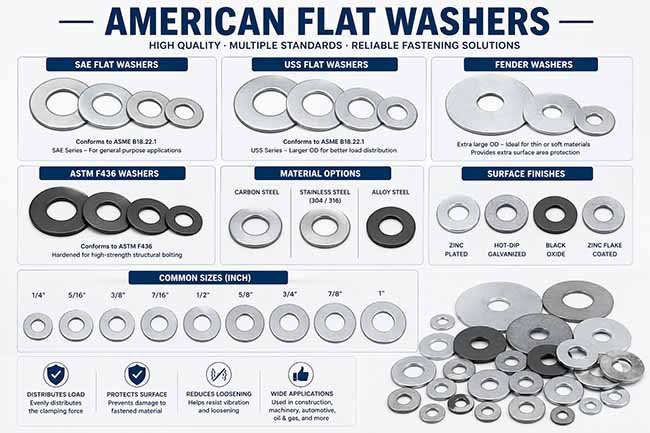
SAE Flat Washers
SAE washers have a smaller outer diameter and are commonly used in automotive and machinery applications. They are cost-effective and suitable for general fastening.
USS Flat Washers
USS washers have a larger outer diameter compared to SAE washers. This provides a greater load-bearing surface, making them ideal for construction and structural applications.
Fender Washers
Fender washers feature a very large outer diameter with a relatively small inner hole. They are designed for use with thin materials such as sheet metal, plastic, and wood.
ASTM F436 Washers
These are hardened washers specifically designed for high-strength bolting systems. They are commonly used with structural bolts such as A325, A490, and B7 stud bolts.
Materials Used in Flat Washers
The material selection directly affects the performance and durability of the washer.
- Carbon Steel: The most common option, offering good strength and cost efficiency
- Stainless Steel (304 / 316): Provides excellent corrosion resistance
- Alloy Steel: Used in high-strength applications
Stainless steel washers are particularly popular in marine, chemical, and outdoor environments due to their resistance to rust and corrosion.
Surface Finishes and Coatings
Surface treatment enhances corrosion resistance and improves product lifespan. Common finishes include:
- Zinc Plated (Blue White Zinc)
- Hot-Dip Galvanized (HDG)
- Black Oxide
- Zinc Flake Coating
Zinc plating is the most widely used finish due to its balance between cost and corrosion protection.
American Flat Washer Sizes and Dimensions
Flat washers are sized according to the bolt diameter they are designed to fit. Common inch sizes include:
- 1/4″
- 3/8″
- 1/2″
- 5/8″
- 3/4″
- 1″
Each size has defined inner diameter (ID), outer diameter (OD), and thickness. Choosing the correct size ensures proper load distribution and secure fastening.
Applications of American Flat Washers
Flat washers are used across a wide range of industries:
- Construction and structural engineering
- Automotive assembly
- Machinery and equipment manufacturing
- Oil and gas pipelines
- Electrical installations
They are especially important in applications where vibration, load distribution, or surface protection is required.
Why Flat Washers Are Essential in Fastening Systems
Flat washers serve multiple critical functions:
- Distribute load evenly
- Prevent surface damage
- Reduce loosening under vibration
- Improve joint stability
Without proper washers, even high-quality bolts and nuts may fail to perform effectively.
Choosing the Right Flat Washer
When selecting flat washers, consider the following factors:
- Bolt size and thread type
- Load requirements
- Environmental conditions
- Material compatibility
- Surface treatment requirements
For high-strength applications, ASTM F436 washers are recommended. For general use, SAE or USS washers are sufficient.
Conclusion
American flat washers are simple yet essential components in any fastening system. From standard SAE washers to heavy-duty ASTM F436 washers, each type serves a specific purpose. By understanding standards, materials, and applications, you can make better procurement decisions and improve the reliability of your assemblies.
Whether you are sourcing for industrial projects or everyday applications, choosing the right flat washer ensures long-term performance and safety.
Follow Me!