Hex Flange Bolts vs Standard Hex Bolts for Industrial Assemblies
The hex flange bolt vs hex bolt decision affects bearing pressure, washer selection, installation clearance, and tightening control. A flange bolt incorporates an enlarged bearing surface beneath its hexagonal head. A standard hex bolt offers more flexibility to select a separate washer for the joint. Neither head style automatically provides greater tensile strength or reliable resistance to loosening.
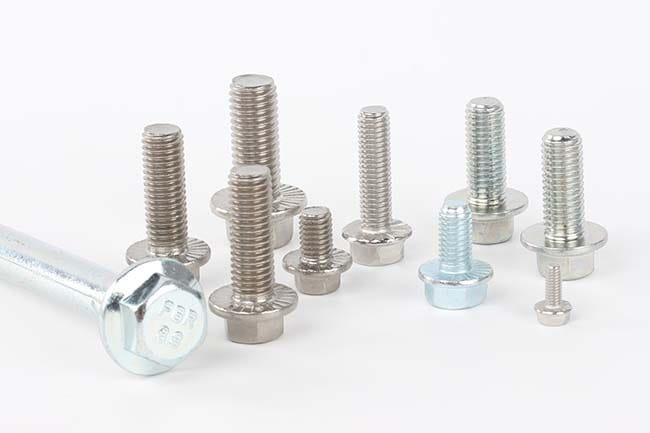
For machinery, automotive components, equipment frames, and industrial brackets, selection should begin with the mating surface and assembly requirements. The practical question is which combination of bolt, bearing surface, washer, and tightening method will maintain the required clamp load.
Hex Flange Bolt vs Hex Bolt: Quick Comparison
| Selection Factor | Hex Flange Bolt | Standard Hex Bolt |
|---|---|---|
| Head bearing surface | Integral flange provides an enlarged footprint beneath the head. | Bearing footprint depends on head geometry and any separate washer. |
| Washer requirements | May eliminate a separate plain washer when the joint design permits. | Can accommodate a washer selected for hardness, diameter, or another function. |
| Locking behavior | Smooth and serrated versions behave differently. A flange alone is not a guaranteed locking system. | Locking measures can be specified separately when required. |
| Installation clearance | Requires space for both the flange and the installation tool. | The bare head may fit a smaller seating area, depending on dimensions. |
| Assembly handling | Can reduce loose-component handling if a washer is removed from the approved assembly. | A separate washer adds a component but allows greater configuration flexibility. |
| Strength selection | Specify the applicable mechanical-property requirements independently of head style. | Specify the applicable mechanical-property requirements independently of head style. |
Both configurations are available within the broader family of carbon and alloy steel fasteners. The purchase description should identify the required head design explicitly.
Bearing Area: What the Flange Actually Changes
An enlarged bearing surface can distribute the clamping force over a greater supported area. At the same clamp load, increasing the effective contact area reduces average bearing pressure. This can help limit local indentation beneath the head.
However, flange outside diameter is not the same as effective bearing area. Hole diameter, chamfers, head fillets, surface flatness, and nearby edges affect how much material actually supports the flange. A flange that overlaps a slot or sits partly over an unsupported edge requires additional assessment.
A standard hex bolt with a properly selected washer may provide a larger supported footprint than a particular flange bolt. Compare the actual dimensions of the complete assemblies rather than assuming that every flange head distributes load better.
The larger head footprint also does not increase the bolt’s tensile capacity by itself. Bolt strength, internal-thread stripping resistance, and the strength of the clamped components remain separate design checks.
When Can a Flange Bolt Replace a Separate Washer?
A smooth flange bolt may replace a bolt-and-plain-washer arrangement when engineering confirms that the integral flange provides the required bearing function. Before approving the change, establish why the original washer was specified.
- Load distribution: compare effective bearing diameter and support around the hole.
- Surface hardness: determine whether the joint needs a separately specified hardened bearing surface.
- Special functions: retain any required sealing, electrical isolation, spacing, or locking function.
- Assembly geometry: recheck grip length, thread engagement, and clearance after removing the washer.
For example, removing a washer while retaining the same nominal bolt length can increase penetration into a tapped hole. In a blind hole, the revised assembly must still provide sufficient bottom clearance. With a partially threaded bolt and nut, the change may also move the nut closer to the thread runout.
Standard hex head bolts do not always require washers either. Direct seating may be acceptable when the component surface, bearing pressure, and governing assembly specification permit it.
Smooth Flange Bolts and Serrated Flange Bolts
Smooth Flanges
A smooth flange provides a continuous bearing face without locking teeth. It is a useful candidate where an integral bearing surface is wanted and deliberate tooth penetration would be undesirable. Nevertheless, a rotating smooth flange can still mark a coated or finished surface during tightening.
Serrated Flanges
Serrated flange bolts have teeth beneath the flange that engage the contacting surface. This engagement can increase resistance to reverse rotation, but its effectiveness depends on the tooth geometry, mating material, surface hardness, coating, and installation conditions.
The same contact mechanism can damage paint or other protective finishes. Specify whether such marking is acceptable, particularly where the joint is exposed to moisture or where appearance matters.
Washers and Repeated Assembly
A separate washer beneath a serrated flange changes the interface: the teeth engage the washer instead of the component. Do not assume that the original locking behavior remains unchanged, because the washer-to-component interface must also resist movement.
For serviceable joints, evaluate repeated installation separately. Inspect the bearing surface and establish replacement criteria appropriate to the chosen fastener. “Serrated” should not be treated as an unrestricted reuse instruction or a universal solution to vibration.
Tightening Torque Must Match the Complete Assembly
Changing from a standard hex bolt to a flange bolt can change the relationship between installation torque and achieved preload. Thread friction, friction beneath the rotating bearing face, bearing geometry, lubrication, and the tightening tool all influence the result.
The relevant rotating interface depends on the assembly method. If the bolt head turns during tightening, its bearing-face behavior is directly involved. If the bolt is held stationary while the nut turns, the nut-side interface becomes especially important.
Consequently, an existing torque setting should not be transferred automatically to a different head style, coating, or washer arrangement. Identify which component rotates and confirm the tightening procedure on representative production components.
For demanding joints, a useful validation plan includes the specified bolt finish, actual mating surface, approved lubricant condition, and production tool. Define acceptance around the required joint behavior and clamp load, rather than treating a torque reading alone as proof of adequate preload.
Installation Access and Assembly Efficiency
Flange head bolts can simplify assembly when they eliminate a separately handled washer. This can reduce washer omission opportunities and make manual positioning easier in awkward locations.
Those benefits depend on the installation layout. Before changing the bill of materials, check:
- Flange clearance from walls, ribs, welds, and adjacent fasteners.
- Seating-face diameter and flatness around the hole.
- Socket outside diameter and clearance for full engagement.
- Head height and access for powered tools.
- Feeder, gripping, and positioning requirements on automated equipment.
Neither configuration should be selected on assumed labor savings alone. A useful production trial compares complete assembly time, handling errors, tool access, and rework. Include washers, feeding equipment, and inspection effort when comparing installed cost.
Specify the Standard and Strength Requirements Separately
“Hex flange bolt” describes a product family, not one universal set of dimensions. For example, ISO 4162 covers a small-series hexagon flange bolt design, while ISO 4014 covers hexagon head bolts. These standards should not be treated as interchangeable simply because the nominal thread diameter matches.
Specify the product standard and applicable edition, thread, length, property class, finish, and any drawing-controlled features. Product grades such as A and B concern product tolerances; they are different from mechanical property classes such as 8.8 and 10.9.
When changing suppliers or standards, compare head dimensions, bearing geometry, thread length, and underhead clearance. For the separate question of threaded versus unthreaded body length, see the ISO 4014 vs ISO 4017 selection guide.
Practical Selection for Industrial Assemblies
The following situations illustrate how to structure the decision. They are starting points for engineering review, rather than blanket approvals.
- Repeated steel-bracket assembly: assess a flange bolt where a sufficiently large, flat seat is available and eliminating a loose washer would simplify installation.
- Painted equipment housing: review smooth bearing-face options and acceptable coating damage before considering serrations.
- Soft mating material: compare a flange with a separately selected washer, accounting for local bearing pressure and deformation.
- Restricted recess: check flange and socket envelopes against the recess before ordering samples.
- Frequently serviced connection: consider surface wear, replacement practices, and the repeatability of the approved tightening process.
- Vibration-sensitive assembly: evaluate preload retention and the complete locking arrangement under representative conditions.
For code-governed structural connections or other controlled assemblies, follow the specified fastener system and substitution approval process. Similar appearance and nominal size do not establish compliance.
Manufacturing and Inspection Points That Matter
For carbon and alloy steel bolts, the manufacturing route should suit the material, dimensions, head geometry, quantity, and required mechanical properties. Forming, machining, thread rolling, heat treatment, and surface treatment must be coordinated with the finished-part requirements.
Inspection should address the functional differences between the two head styles. A flange-bolt inspection plan may need particular attention to flange diameter, bearing-face condition, underhead geometry, and serration features where specified. Both styles require verification of thread acceptance, length, head dimensions, and the ordered property class.
Coating requirements should identify more than color. Where relevant, define thickness, friction characteristics, thread-fit acceptance, and corrosion-test requirements. Any process controls required for the selected strength level should be agreed before production.
Use the Flybear quality inspection information to discuss an order-specific inspection plan. State the required reports, sampling, lot identification, and traceability in the purchase specification.
What to Include in a Hex Bolt RFQ
A complete RFQ allows suppliers to compare the intended assemblies consistently. Include:
- Standard hex, smooth flange, or serrated flange head.
- Product standard, edition, and drawing revision.
- Diameter, pitch, nominal length, and required thread length.
- Material specification and mechanical property class or grade.
- Mating material, surface finish, hole geometry, and available seating area.
- Coating, lubrication, and friction requirements where controlled.
- Nut, washer, and locking-device requirements.
- Assembly method, rotating component, and approved tightening procedure.
- Quantity, inspection requirements, and documentation.
For a proposed replacement, include both the current assembly drawing and the intended change. A photograph alone rarely defines the required bearing geometry or installation constraints.
Frequently Asked Questions
Are hex flange bolts stronger than standard hex bolts?
Not inherently. An enlarged flange changes the bearing interface. Tensile strength depends on the specified mechanical properties and relevant dimensions, while joint capacity also depends on the connected components.
Can flange bolts be used without washers?
Yes, where the approved design permits direct seating and the flange satisfies the required bearing function. Retain a washer when its hardness, dimensions, or special function is necessary.
Do serrated flange bolts prevent all vibration loosening?
No. Serrations can resist reverse rotation through surface engagement, but performance depends on the actual joint. They cannot compensate for every cause of clamp-load loss.
Can I replace a hex bolt and washer with the same-length flange bolt?
Only after checking the revised assembly. Removing the washer changes the stack-up and may affect thread engagement, bottom clearance, thread-runout position, and tightening behavior.
Request a Review of Your Bolt Head and Assembly Requirements
Send Flybear your required head style, standard, size, property class, mating surface, locking requirement, coating, quantity, and assembly method. For replacement projects, include the current nut-and-washer arrangement and a section drawing of the joint.
Submit your fastener RFQ to Flybear for review of standard or drawing-based hex bolts and flange bolts, with manufacturing and inspection requirements defined for your order.
Follow Me!