Understanding Stainless Steel DIN 935 Hex Slotted Castle Nuts
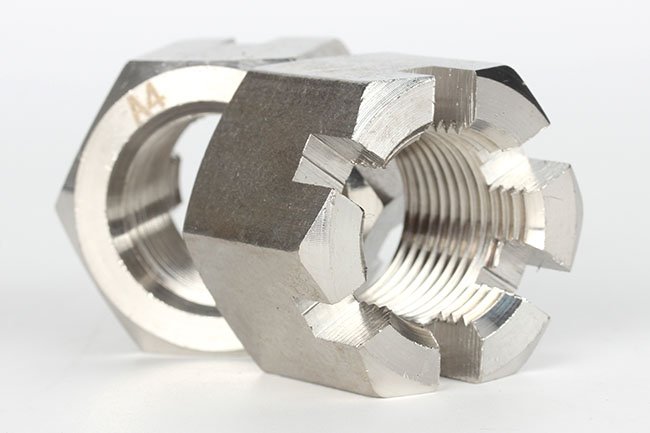
DIN 935 hex slotted castle nuts combine a conventional hexagonal driving section with a slotted upper section. The hex body allows the nut to be installed with standard tools, while the slots provide a practical positive-locking feature. Unlike locking methods that depend mainly on friction, the cotter pin creates a visible mechanical restraint after installation.
This design is widely considered for industrial equipment, mechanical linkages, transportation components, agricultural machinery, valve assemblies, material-handling systems, and other applications where accidental nut rotation could affect equipment reliability. The final fastener selection should always consider the load, mating bolt, thread specification, vibration level, operating temperature, corrosion exposure, and maintenance procedure.
How Stainless Steel Hex Slotted Castle Nuts DIN 935 Work
During installation, the castle nut is threaded onto a bolt, stud, or shaft with a cross-drilled hole. After the required assembly position or tightening condition is reached, one of the nut slots is aligned with the hole. A suitable cotter pin is inserted through the aligned opening and secured according to the assembly procedure.
Because the nut cannot rotate freely without interference from the cotter pin, the system offers a straightforward and inspectable locking method. Maintenance personnel can often verify the presence of the locking component visually. This makes castle nuts useful in assemblies where inspection access and maintenance control are important.
The nut, mating fastener, drilled-hole position, and cotter pin must be treated as one locking system. Buyers should therefore avoid selecting the nut only by thread diameter. Slot geometry, nut height, bolt-hole location, thread engagement, and installation requirements must also be reviewed.
Selecting the Appropriate Stainless Steel Material
Stainless steel castle nuts are frequently selected for their corrosion resistance, clean appearance, and suitability for outdoor or moisture-exposed equipment. Common purchasing specifications may reference A2 or A4 stainless steel categories, while some projects identify commercial stainless grades such as 304 or 316.
The correct material depends on the operating environment. General industrial equipment may require a different stainless steel grade from marine hardware, chemical-processing equipment, food-related machinery, or installations exposed to chlorides. Buyers should provide details about moisture, chemicals, temperature, cleaning agents, and contact with other metals before confirming the material.
Material compatibility with the mating bolt is also important. Stainless steel threaded components can experience galling when installed under unsuitable conditions. Correct thread fit, clean surfaces, controlled installation speed, appropriate lubrication when permitted, and a suitable tightening procedure can reduce assembly problems.
Important Dimensions and Procurement Details
A complete inquiry for hex slotted nuts should include the thread diameter, thread pitch, stainless steel grade, applicable standard, quantity, and any special inspection or packaging requirements. For fine-thread applications, the exact pitch should be stated instead of assuming a standard coarse thread.
Key dimensional characteristics include the width across flats, overall nut height, crown diameter, slot width, slot depth, and internal thread geometry. These features influence wrench engagement, cotter pin clearance, alignment, and compatibility with the mating component.
Purchasers should also clarify whether the requirement is for a standard DIN 935 configuration or a modified castle nut based on a drawing. A customized component may require a different slot arrangement, unusual thread, reduced height, special crown profile, controlled surface condition, or application-specific packaging.
Manufacturing Considerations for DIN 935 Castle Nuts
Consistent production requires control of both the threaded hex nut section and the slotted crown. The manufacturing route can vary according to the material, size, order quantity, dimensional requirements, and customization level. Thread formation, machining, slotting, deburring, cleaning, and final inspection all influence the usability of the finished fastener.
Slot quality deserves particular attention. Uneven slots, sharp burrs, or incorrect slot depth can interfere with cotter pin installation. Threads must also be protected from chips and deformation during secondary machining. After slotting, the nut should be cleaned and inspected so that machining residue does not remain inside the thread or crown area.
For custom stainless steel nuts, production planning should begin with a reviewed drawing or clearly defined specification. This allows the manufacturer and buyer to confirm critical dimensions, tolerances, material requirements, thread details, surface expectations, inspection methods, and acceptance criteria before mass production.
Quality Control for Stainless Steel Castle Nuts
Quality inspection should cover the characteristics that affect installation and locking performance. Typical checks may include thread verification, dimensional measurement, slot position, slot width, overall height, width across flats, burr control, and visual surface inspection. The exact inspection plan should match the drawing, purchase specification, and intended application.
Material identification and production traceability may also be requested for controlled industrial projects. However, documentation requirements vary between industries and customers. Buyers should state the required inspection records, material documents, sampling plan, labeling format, and lot traceability expectations when requesting a quotation.
Sample approval can be valuable for customized or application-sensitive parts. Testing the sample with the actual mating bolt, shaft, and cotter pin helps confirm thread engagement, slot alignment, wrench access, and assembly convenience before the full order is released.
Applications for Stainless Steel Hex Slotted Nuts
Stainless steel castle nuts can be used in pivot points, steering-related mechanisms, rotating assemblies, clevis connections, linkage systems, wheel-related equipment, agricultural machinery, lifting mechanisms, and industrial maintenance projects. They are particularly useful where a removable mechanical locking method is preferred.
The product should not be chosen solely because an assembly experiences vibration. Engineers must evaluate the complete joint, including load direction, preload, fatigue conditions, movement, maintenance frequency, and safety requirements. In some assemblies, another locking method may be more appropriate. Application review is therefore an essential part of responsible fastener selection.
Standard and Custom Supply for B2B Buyers
Distributors, equipment manufacturers, maintenance companies, and sourcing teams often need more than a basic unit price. Reliable procurement also depends on specification review, consistent batches, suitable packaging, clear labeling, and communication about production requirements.
When contacting Flybear Fastener, buyers can provide the DIN 935 designation, thread size and pitch, stainless steel requirement, order quantity, application details, drawings, and inspection expectations. Supplying complete information helps reduce technical misunderstandings and supports a more accurate manufacturing evaluation.
For recurring orders, buyers should establish an approved specification that defines the product consistently. This is especially important when different suppliers, historical drawings, or regional purchasing descriptions use slightly different terminology for castle nuts, castellated nuts, and hex slotted nuts.
Choosing a DIN 935 Castle Nut Manufacturer
A suitable DIN 935 castle nut manufacturer should be able to review the technical requirement rather than treating every inquiry as a standard catalog item. Buyers should assess material options, thread capability, dimensional control, slot machining quality, customization support, inspection procedures, packaging, and communication responsiveness.
Price remains important, but the lowest quotation may not represent the lowest total procurement cost. Incorrect threads, poor slot alignment, heavy burrs, inconsistent batches, or unclear threads, poor slot alignment, heavy burrs, inconsistent batches, or unclear packaging can create assembly delays and additional inspection work. A technically complete inquiry and a properly reviewed sample can help buyers compare suppliers more effectively.
Stainless Steel Hex Slotted Castle Nuts DIN 935 offer a practical combination of corrosion-resistant material, standard wrench installation, and positive mechanical locking. By confirming the material, thread, dimensions, mating components, manufacturing requirements, and inspection criteria, industrial buyers can source castle nuts that integrate smoothly into reliable assemblies.
Follow Me!