Nickel Alloy Fastener Material Selection: Hastelloy, Monel and Incoloy
Nickel alloy fastener material selection should begin with the failure mechanism the joint must resist, not with a simple ranking of Hastelloy, Monel, and Incoloy. These alloy families are engineered for different combinations of corrosion resistance, mechanical strength, temperature capability, and thermal behavior. A material that performs well in an acidic process stream may not be the best choice for a high-load seawater pump or a low-expansion thermal assembly.
For chemical-processing engineers, valve and pump manufacturers, EPC procurement teams, and special-alloy buyers, the correct specification should identify the exact alloy designation, material condition, fastener geometry, service fluid, temperature, load requirement, mating materials, governing project code, and required inspection documentation. Trade names alone are not sufficient for production or technical approval.
Nickel Alloy Fastener Material Selection Starts with Service Conditions
A practical selection process separates the application into several engineering questions. First determine the dominant corrosion mechanism. Then review temperature, mechanical load, thermal expansion, manufacturing condition, mating components, and the standards that govern the equipment.
| Application Requirement | Alloy Family Commonly Evaluated | Main Buyer Checks |
|---|---|---|
| Aggressive acids, chlorides, mixed chemical streams, localized corrosion | Hastelloy C-type alloys such as C-276 or C-22 | Exact chemical composition of the process fluid, concentration, temperature, oxidizing/reducing conditions, crevices, and required UNS grade |
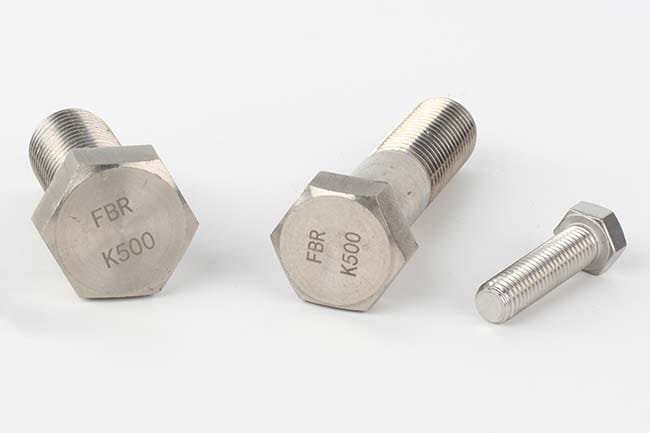
| Marine or seawater exposure combined with high mechanical strength | Monel K-500 where specified | Flow versus stagnant seawater, load, material condition, galvanic compatibility, temperature, and project requirements |
| High-strength assembly requiring controlled thermal expansion | Incoloy 909 where specified | Temperature cycle, clamped materials, expansion behavior, heat-treatment condition, preload, and oxidation environment |
| Generic “high-temperature nickel alloy” request | No family should be selected from the name alone | Determine whether strength, creep, oxidation, corrosion, or thermal expansion actually controls the design |
Flybear’s nickel-based alloy fastener range currently includes products in Hastelloy C-276, Hastelloy C-22, Monel K-500, and Incoloy 909. Buyers should confirm the exact listed alloy, product configuration, size, and specification before treating a material as available for a project.
When Hastelloy Fasteners Are the Starting Point
Hastelloy C-type alloys are nickel-chromium-molybdenum-based corrosion-resistant materials widely associated with demanding chemical-processing environments. Their value comes primarily from resistance to combinations of general corrosion, localized attack, and stress-corrosion mechanisms rather than from being universally “stronger” than other nickel-alloy families.
For fastener selection, C-276 and C-22 are useful examples of why the exact process chemistry matters. Both are highly alloyed nickel-chromium-molybdenum-tungsten materials, but their alloy balances are different. C-276 is a widely used material for many aggressive reducing and mixed chemical environments, while C-22’s higher chromium content can provide an advantage in a number of oxidizing and localized-corrosion conditions.
The buyer should not simplify this into “C-22 is better than C-276.” Instead, define:
- Process fluid and all significant constituents
- Acid or chloride concentration
- Operating and design temperature
- Oxidizing or reducing conditions
- Contaminants such as metallic ions or dissolved gases
- Continuous immersion, splash, condensation, or cleaning exposure
- Crevices beneath nuts, washers, bolt heads, and thread roots
A chemical plant may contain several corrosive environments within the same unit. The correct alloy for an open vessel connection may differ from the material required inside a stagnant threaded cavity. Corrosion data should therefore be matched to the actual fastener location rather than only to the name of the process.
When Monel K-500 Fasteners Make More Sense
Monel K-500 follows a different material strategy. It is a precipitation-hardenable nickel-copper alloy, commonly identified as UNS N05500. Its aluminum and titanium additions allow appropriate thermal treatment to develop substantially greater strength than a conventional solution-strengthened nickel-copper material.
This combination makes K-500 relevant to marine pumps, valves, shafts, highly loaded fittings, and other equipment where both mechanical strength and nickel-copper corrosion behavior are important.
For a buyer comparing Hastelloy vs Monel fasteners, the key question is therefore not which brand name represents a higher alloy. If aggressive mixed-acid or chemical-process corrosion controls the design, a C-type Hastelloy alloy may be the logical starting point. If the component needs a high-strength nickel-copper material for a compatible marine or pump environment, K-500 may be more appropriate.
Even in seawater, K-500 should not be treated as corrosion-proof. Flowing seawater, stagnant seawater, deposits, biological fouling, crevices, stress, and dissimilar-metal contact can produce different results. Buyers working on these applications can review Flybear’s marine and offshore fastener solutions when preparing the complete environmental specification.
Where Incoloy 909 Fits the Selection Framework
Incoloy fasteners cannot be grouped into one universal high-temperature category because different Incoloy grades were developed for different purposes. For the Incoloy 909 products currently represented in Flybear’s range, the defining selection characteristics are low thermal expansion and precipitation-hardened strength.
Incoloy 909, or UNS N19909, is a nickel-iron-cobalt alloy strengthened through additions including niobium and titanium. It is particularly relevant where changes in component dimensions during heating and cooling need to be controlled.
This can be important for turbine-related components, precision thermal assemblies, high-temperature machinery, flange systems, and equipment where differential expansion influences alignment or bolt load.
However, low thermal expansion does not mean zero thermal expansion, and it does not guarantee constant preload. The bolt and clamped components must be analyzed together. The designer should evaluate:
- Minimum and maximum operating temperature
- Thermal-cycle frequency
- Bolt and joint stiffness
- Effective grip length
- Thermal expansion of each clamped material
- Initial preload
- Temperature gradients
- Long-duration relaxation or creep where relevant
Incoloy 909 also illustrates why an alloy family name should not be used as a substitute for corrosion data. Its design emphasizes low expansion and strength rather than the high chromium content associated with many oxidation- and corrosion-resistant nickel alloys. If aggressive high-temperature oxidation or chemical corrosion controls the application, environmental suitability must be reviewed separately.
Corrosion Mechanism Should Come Before Alloy Brand
Corrosion resistant alloy fasteners should be selected against the expected damage mechanism. Different environments can produce uniform corrosion, pitting, crevice corrosion, stress corrosion cracking, galvanic attack, hydrogen-related damage, or high-temperature oxidation.
No single nickel alloy provides maximum resistance to all of these mechanisms. For example, increasing resistance to aggressive chemical corrosion does not automatically provide the lowest thermal expansion. A high-strength precipitation-hardened material is not necessarily the best alloy for mixed oxidizing acids. Likewise, a marine-resistant material may not be appropriate for every sour-gas or high-temperature process environment.
When the corrosion mechanism is uncertain, buyers should provide process data rather than asking the fastener manufacturer to select from a generic phrase such as “corrosion-resistant nickel alloy.”
Temperature Means More Than Oxidation Resistance
High-temperature fastener selection needs to consider strength retention, preload, thermal expansion, stress relaxation, creep where applicable, oxidation, and the behavior of coatings or lubricants. A material should not be approved solely because its base alloy can tolerate an elevated temperature in a general material datasheet.
The operating duration also matters. Short thermal excursions and continuous high-temperature exposure do not create the same design problem. Repeated startup and shutdown cycles can introduce additional preload variation and fatigue concerns.
For precipitation-hardened materials such as K-500 or Incoloy 909, the ordered heat-treatment condition needs particular attention because the mechanical properties depend on material processing. Do not apply one generic strength value to every size, product form, and condition.
Required Strength Can Change the Material Decision
Nickel alloy bolts are often selected only after a conventional stainless or alloy-steel fastener cannot satisfy the combined environmental and mechanical requirements. Even then, corrosion resistance should not replace proper joint design.
The engineering team should determine the tensile loading, preload requirement, thread engagement, fatigue loading, joint stiffness, and mating-component capacity. Higher fastener strength may transfer greater load into the nut, tapped component, flange, or surrounding equipment.
This is particularly important when changing from a solution-strengthened alloy to a precipitation-hardened material. An apparently stronger replacement is still an engineering substitution and should be approved against the complete joint.
Check the Exact Grade, Specification and Material Condition
A technically correct RFQ should specify more than “Hastelloy,” “Monel,” or “Incoloy.” Include the exact UNS, EN, ASTM, AMS, or project-defined designation required by engineering.
The material condition also matters. Depending on the alloy, the project may require solution treatment, annealing, aging, controlled cold work, or another specified condition. Heat treatment and cold work can affect mechanical properties, corrosion behavior, hardness, and environmental qualification.
Raw-material standards and finished-fastener requirements should also be separated. A standard covering nickel-alloy bar, rod, or forging stock does not necessarily define the complete dimensions, threads, finished mechanical properties, marking, or inspection of the final bolt or nut.
Do Not Ignore Galling, Nuts and Mating Materials
Nickel-alloy material selection should include the complete threaded pair. A corrosion-resistant bolt combined with an undefined nut does not create a controlled bolted joint.
Specify the nut alloy and condition, thread pitch and tolerance, required engagement, washer material, and connected equipment material. In wet conductive environments, dissimilar metals can introduce galvanic considerations. In highly loaded threads, galling and seizure may also require an approved lubrication or surface-treatment strategy.
If lubricant or anti-seize is used, the torque-preload procedure should reflect the actual friction condition. Changing lubricant can materially change the clamp load produced by the same installation torque.
Manufacturing Route Must Support the Final Specification
Special nickel-alloy fasteners may require CNC machining, hot forging, or appropriate thread-production methods depending on geometry, diameter, alloy condition, quantity, and project requirements. The manufacturing route should support the final material and mechanical specification rather than become a substitute for it.
For custom parts, provide a controlled drawing showing head geometry, grip length, shoulders, thread runout, special radii, cross holes, and critical tolerances. Where a particular process such as forging or thread rolling is mandatory, state it explicitly. Otherwise, the buyer should focus on the required finished properties and acceptance criteria.
Inspection and Traceability for Special Nickel Alloys
Special-alloy fasteners can look almost identical after machining, making controlled material traceability important. Depending on project requirements, inspection can include material certificates, heat or lot traceability, chemical verification or PMI, hardness and mechanical testing, dimensional inspection, thread gauging, heat-treatment records, and surface verification.
Flybear’s fastener quality inspection capabilities can support order-defined dimensional, thread, material, mechanical, and related inspection requirements. Buyers should define the required documentation before quotation because the inspection scope can affect both manufacturing planning and commercial comparison.
Nickel Alloy Selection Checklist for Buyers
| Decision | Information to Send |
|---|---|
| Corrosion | Service fluid, concentration, pH where relevant, chlorides, contaminants, flow, crevices, and exposure mode |
| Temperature | Operating/design temperature, duration, thermal cycles, and atmosphere |
| Mechanical | Load or required strength, preload, fatigue conditions, and mating-component requirements |
| Thermal behavior | Clamped materials, expansion requirements, gradients, and dimensional-stability concerns |
| Material | Exact alloy designation, specification, and required condition |
| Fastener | Product type, diameter, thread, length, dimensions, nut, washer, and drawing |
| Quality | Certificates, PMI, testing, inspection, traceability, and reporting requirements |
Common Nickel Alloy Material Selection Mistakes
- Ranking Hastelloy, Monel, and Incoloy universally: each family addresses different engineering requirements.
- Specifying only a trade name: the exact grade and material condition remain undefined.
- Choosing from corrosion resistance alone: strength, thermal behavior, joint design, and project code still matter.
- Using one maximum temperature from a datasheet: actual suitability depends on load, duration, condition, atmosphere, and the governing specification.
- Assuming marine resistance means seawater immunity: stagnant conditions, crevices, deposits, and galvanic effects still require review.
- Assuming a low-expansion alloy is automatically oxidation resistant: thermal-expansion behavior and environmental resistance are separate properties.
- Ignoring the exact nut specification: bolt and nut must be mechanically and environmentally compatible.
- Comparing supplier prices before normalizing specifications: alloy, condition, dimensions, inspection, and documentation must be equivalent before commercial comparison.
FAQ: Nickel Alloy Fastener Material Selection
Are Hastelloy fasteners better than Monel fasteners?
Not universally. Hastelloy C-type alloys are frequently evaluated for highly corrosive chemical-process environments, while Monel K-500 can be attractive where nickel-copper corrosion behavior and precipitation-hardened strength are needed. Select according to the actual service mechanism and project specification.
When should Incoloy 909 fasteners be considered?
Incoloy 909 is particularly relevant to high-strength assemblies where low thermal expansion and dimensional stability are important. Its corrosion and oxidation suitability should be reviewed separately for the actual environment.
Can a supplier select the nickel alloy from temperature alone?
No. Temperature is only one input. Process chemistry, required strength, thermal expansion, exposure duration, load, mating materials, product specification, and project code can all affect the correct material.
What information is most important for a nickel-alloy fastener RFQ?
Provide the service fluid, operating and design temperature, required load or strength, exact material specification if already defined, component type, diameter and thread, quantity, drawing, mating materials, and required inspection or certification package.
Send the Service Conditions Before Finalizing the Alloy
For nickel alloy fastener material selection or a quotation, send Flybear the service fluid and concentration, operating temperature, mechanical load or strength requirement, exact material specification where available, component type, size and thread, mating materials, quantity, drawing, and required documentation. Use the Flybear contact page to submit the technical package. Defining the real corrosion, mechanical, and thermal requirements allows Hastelloy, Monel, Incoloy, or another project-specified material to be evaluated without relying on an oversimplified alloy ranking.
Follow Me!