Stainless Steel Fasteners at Elevated Temperature: Material, Strength and Oxidation Considerations
Stainless steel fasteners high temperature applications require more than choosing a grade that resists visible oxidation. Elevated temperature can change bolt strength, stiffness, preload, creep behavior, stress relaxation, surface oxidation, thread friction, and the interaction between the fastener and clamped materials. A stainless bolt that meets its specified mechanical properties at room temperature should not automatically be assumed to retain those properties throughout high-temperature service.
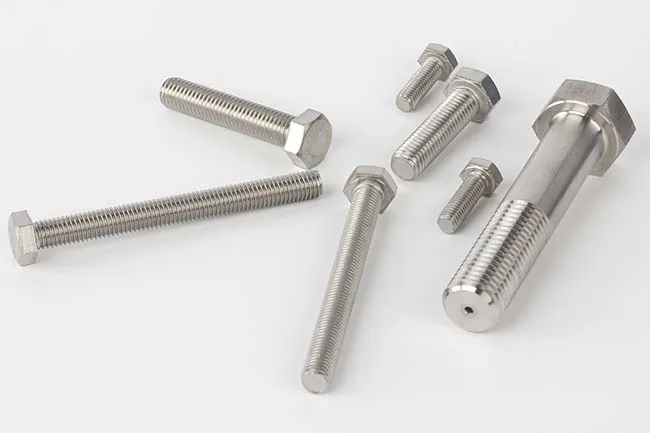
For furnaces, exhaust systems, valves, heat-processing equipment, industrial machinery, and other thermally loaded assemblies, buyers should provide the operating temperature, design temperature, exposure duration, thermal-cycle profile, fastener grade, joint materials, required load, and governing standard. These details are necessary because there is no universal maximum service temperature for “stainless steel bolts” as a category.
What Changes When Stainless Steel Fasteners Run Hot?
Elevated temperature affects several aspects of a bolted joint simultaneously. Focusing only on oxidation resistance can leave important mechanical risks unaddressed.
| Temperature-Related Factor | What Can Change | What the Buyer Should Verify |
|---|---|---|
| Mechanical strength | Tensile, yield-related, and other mechanical properties can decrease as temperature increases | Properties permitted by the governing fastener or material specification at the actual service temperature |
| Preload | Differential thermal expansion between the bolt and clamped components can increase or decrease bolt load | Fastener material, joint materials, temperature distribution, joint stiffness, and assembly preload |
| Stress relaxation and creep | Time-dependent deformation can reduce retained clamp load during prolonged high-temperature exposure | Temperature, duration, material condition, stress level, and maintenance requirements |
| Oxidation | Oxide scale can develop and change with temperature, atmosphere, and exposure time | Gas composition, temperature cycle, material grade, and required oxidation resistance |
| Threads and tightening | Surface scale, lubricant degradation, and temperature can change friction and disassembly behavior | Lubricant, coating, installation procedure, and hot-service maintenance strategy |
| Thermal cycling | Repeated expansion and contraction can repeatedly change joint load | Cycle range, frequency, gradients, fatigue concerns, and preload retention |
Room-Temperature Property Classes Cannot Simply Be Applied at High Temperature
One of the most important sourcing issues is the difference between room-temperature qualification and elevated-temperature performance. Common stainless fastener standards establish mechanical properties under defined test conditions. Those specified room-temperature properties should not automatically be extrapolated to a bolt operating continuously at a substantially higher temperature.
As temperature rises, the strength and stiffness of metallic materials can change. At sufficiently demanding combinations of temperature, stress, and time, creep and stress relaxation can also become design considerations. The result is that a fastener may remain intact while gradually losing part of the clamp load needed to keep the joint functional.
This is particularly important for gasketed joints, valves, exhaust connections, heat exchangers, furnace equipment, and assemblies where leakage or joint separation is unacceptable.
ISO 3506 distinguishes general corrosion-resistant stainless fasteners from special fasteners intended for higher-temperature applications. Likewise, ASTM pressure-bolting specifications use grade- and condition-specific requirements rather than treating all stainless materials as interchangeable. Buyers should therefore start with the governing product standard instead of selecting a material solely from a generic stainless-steel datasheet.
Austenitic Stainless Steel at Elevated Temperature
Austenitic stainless steels are widely used because they combine corrosion resistance, ductility, manufacturing flexibility, and useful performance across a broad range of industrial environments. Grades from the 304 and 316 families are common in bolts, screws, studs, nuts, and washers.
At elevated temperature, however, the room-temperature advantages of a particular property class or cold-worked condition may not remain unchanged. Long-duration thermal exposure can alter the mechanical performance that was achieved during fastener manufacturing. The relevant service data and governing standard must therefore be checked rather than assuming that an A2, A4, 304, or 316 designation establishes a high-temperature allowable load.
Buyers can review Flybear’s stainless steel fastener range when specifying austenitic bolts, screws, studs, nuts, washers, or drawing-based parts.
304 and 316 Are Not Automatically Heat-Resistant Fastener Grades
304 and 316 stainless steels can withstand elevated-temperature exposure in many applications, but their general corrosion resistance should not be confused with optimized high-temperature strength or oxidation performance. A grade selected for resistance to an aqueous chemical environment is not necessarily the best material for prolonged hot-gas service.
For example, molybdenum is important to the wet-corrosion behavior of the 316 family in many environments, but that does not mean a 316 fastener is automatically superior for every oxidation-controlled high-temperature application. Specialized heat-resistant stainless compositions may be evaluated when oxidation, creep, or long-duration hot strength becomes the controlling requirement.
Stabilized and Heat-Resistant Grades May Be Considered
Depending on the standard and service conditions, engineers may evaluate stabilized austenitic grades or stainless steels developed specifically for elevated-temperature performance. The final choice depends on the required mechanical properties, atmosphere, exposure duration, fabrication route, corrosion conditions, and availability of an appropriate fastener specification.
A plate or tube grade suitable for furnace service should not automatically be converted into a bolt specification. The finished fastener still needs defined mechanical, dimensional, thread, marking, and inspection requirements.
Precipitation-Hardening Stainless Fasteners Need Condition-Specific Review
Precipitation-hardening stainless steels such as 17-4PH can provide much higher strength than many conventional austenitic stainless fasteners. Their performance, however, depends strongly on heat-treatment condition.
Conditions such as H900, H1025, H1100, and H1150 represent different aging treatments and can provide different combinations of strength, hardness, ductility, toughness, and environmental behavior. Exposure to elevated temperature during service can interact with the existing precipitation-hardened condition, so the specified heat treatment and long-term operating cycle must both be considered.
A purchasing description such as “17-4PH high-temperature bolt” is therefore incomplete. The RFQ should state the required condition or mechanical properties and identify the operating temperature and exposure time. Maximum room-temperature strength should not automatically be treated as the optimum condition for prolonged hot service.
ASTM A193 Stainless Bolting for High-Temperature or High-Pressure Service
For pressure vessels, valves, flanges, and fittings, ASTM A193 is an important specification covering alloy-steel and stainless-steel bolting for high-temperature, high-pressure, and other special-purpose applications. Austenitic stainless grades such as B8 and B8M use their own grade and class requirements.
This distinction matters because an ASTM A193 B8 or B8M callout communicates more than “304 bolt” or “316 bolt.” The ordered class, size, material condition, mechanical requirements, mating nut, and project requirements all need to remain aligned.
Buyers working with stainless pressure bolting can review ASTM A193 B8 vs B8M before defining the complete bolting package.
Other high-temperature bolting specifications may be more appropriate for particular equipment or material systems. Do not substitute between ASTM A193, ASTM A453, ISO 3506, or another standard simply because the candidate alloys appear chemically similar.
Thermal Expansion Can Increase or Decrease Bolt Preload
Thermal cycling bolts must be evaluated together with the materials they clamp. A preloaded bolt and the surrounding joint do not necessarily expand by the same amount when their temperature changes.
If the clamped components expand more than the fastener over the effective grip length, the resulting constraint can increase tensile load in the bolt. Under another combination of materials, geometry, and temperature distribution, preload can decrease instead. Cooling can produce another shift in the joint-load condition.
This means a stainless bolt installed into aluminum, carbon steel, cast iron, nickel alloy, or another stainless grade can behave differently even when the initial room-temperature torque is identical.
Engineering review should consider:
- Coefficient of thermal expansion of the fastener
- Coefficient of thermal expansion of each clamped material
- Effective grip length
- Bolt and joint stiffness
- Initial preload
- Temperature gradient through the assembly
- Heating and cooling rates
- Minimum and maximum cycle temperatures
For joints that also experience marine or corrosive exposure, thermal and corrosion requirements should be evaluated together. Flybear’s marine and offshore fastener solutions provide additional context for material selection where salt, moisture, and temperature interact.
Stress Relaxation and Creep Can Reduce Clamp Load
High-temperature bolted joints can lose preload even without the nut rotating loose. At elevated temperature, sustained stress can produce time-dependent deformation in the bolt, nut, gasket, flange, or other clamped components.
Stress relaxation refers to the reduction in stress that can occur under constrained deformation, while creep describes time-dependent deformation under sustained load. Both mechanisms can become important in prolonged hot service, depending on material and temperature.
This is why short room-temperature tensile tests do not completely describe a fastener intended for long-duration elevated-temperature operation. The designer may need temperature-dependent material data, creep information, relaxation behavior, or project-specific qualification.
Repeated retightening should also not be prescribed generically. The correct maintenance procedure depends on the equipment, fastener specification, gasket system, operating condition, and governing code.
Need Help Selecting High-Temperature Stainless Fasteners?
Send the operating temperature, material grade, dimensions, quantity and inspection requirements. Flybear Technical Team will review the joint conditions and recommend suitable fastener options.
Oxidation Resistance Is Different from Wet Corrosion Resistance
Oxidation resistant fasteners operate under a different corrosion mechanism from stainless bolts immersed in water or exposed to chloride-containing moisture. At elevated temperature, the alloy reacts with the surrounding atmosphere and develops surface oxide layers. Their protectiveness depends on alloy composition, temperature, atmosphere, exposure duration, and thermal cycling.
Chromium is particularly important to the formation of protective oxide scales in stainless steel, while higher-alloy heat-resistant grades can be selected when scaling or high-temperature corrosion becomes severe.
However, hot-gas composition matters. Air, combustion products, sulfur-containing gases, carburizing atmospheres, reducing conditions, and other process environments can affect materials differently. A grade with good oxidation behavior in air should not automatically be approved for every furnace or exhaust atmosphere.
Thermal cycling can create another challenge because repeated expansion and contraction of the base metal and oxide layer may promote scale cracking or spalling. Continuous and intermittent exposure should therefore not be treated as identical service conditions.
Threads, Lubricants and Coatings Also Change at Temperature
A fastener material may remain technically suitable while the chosen lubricant or coating does not. Anti-seize compounds, oils, solid lubricants, plating systems, and other surface treatments have their own temperature and environmental limitations.
If the lubricant degrades, thread friction during maintenance can differ significantly from the original installation condition. Oxide scale or surface changes can also affect disassembly. For stainless assemblies, galling risk should remain part of the installation and maintenance review.
Do not apply a room-temperature torque table blindly to a different lubricant, coating, or hot-service joint. Torque-preload relationships depend strongly on thread and bearing friction as well as joint design.
Manufacturing and Inspection Requirements for High-Temperature Stainless Bolts
Depending on product size, geometry, material, and specification, high-temperature stainless bolts and studs may be produced using cold heading, hot forging, CNC machining, thread rolling, or suitable combinations of these processes. For precipitation-hardening or specification-controlled materials, heat-treatment sequence and final material condition can be especially important.
Inspection should confirm the characteristics required by the purchase specification. Depending on the order, this may include material verification, mechanical testing, hardness testing, dimensional inspection, thread gauging, surface-condition inspection, heat-treatment records, and traceability documentation.
Room-temperature acceptance testing does not by itself prove long-term elevated-temperature joint performance, but it confirms that the supplied fastener meets the defined product requirements before service. Buyers can review Flybear’s fastener quality inspection information when defining an order-specific inspection plan.
Common High-Temperature Stainless Fastener Procurement Mistakes
- Using a universal maximum temperature: suitability depends on grade, condition, stress, duration, atmosphere, joint material, and governing standard.
- Applying room-temperature strength directly to hot service: mechanical properties can change as temperature increases.
- Selecting only for oxidation resistance: preload retention, creep, relaxation, and joint strength may control the design.
- Assuming 316 is always better than 304 at high temperature: wet corrosion resistance and high-temperature oxidation are different selection problems.
- Ignoring thermal expansion: dissimilar fastener and joint materials can increase or decrease bolt load during heating and cooling.
- Ordering 17-4PH without a condition: precipitation-hardening condition is a critical mechanical variable.
- Changing lubricant without reviewing torque: friction changes can alter the preload generated by the same tightening torque.
- Using a raw-material datasheet as a fastener specification: finished bolts still require product, mechanical, dimensional, thread, and inspection requirements.
What to Include in a High-Temperature Stainless Fastener RFQ
For an accurate technical review and quotation, provide:
- Operating temperature and design temperature
- Continuous or intermittent exposure
- Heating and cooling cycle, including frequency where relevant
- Fastener material grade and condition
- Applicable ASTM, ISO, EN, ASME, or project specification
- Bolt, screw, stud, nut, or washer type
- Diameter, thread, length, and required dimensions
- Clamped-component materials
- Required preload, load, or mechanical performance where specified
- Hot-gas, exhaust, chemical, marine, or other environmental exposure
- Coating, lubricant, anti-seize, or surface-finish requirement
- Quantity and controlled drawing revision
- Required material certificates, heat-treatment records, testing, inspection, and traceability
FAQ: Stainless Steel Fasteners at High Temperature
Can standard stainless steel bolts be used at elevated temperature?
They may be suitable in some applications, but room-temperature fastener properties should not automatically be assumed to remain unchanged at elevated temperature. Verify the grade, property class or condition, duration of exposure, joint loading, environment, and governing standard.
Is 316 stainless better than 304 for high-temperature bolts?
Not automatically. 316 provides advantages over 304 in many wet or chloride-containing corrosion environments, but this does not make it universally superior for oxidation, creep, or hot-strength-controlled service. The actual high-temperature requirement should determine the grade.
Why can bolt preload change during thermal cycling?
The bolt and clamped parts can have different thermal-expansion rates and stiffness. As the assembly heats or cools, those differences can change bolt tension and joint compression. Thermal gradients and repeated cycles can make the response more complex.
Does an oxidation-resistant stainless bolt keep its room-temperature strength?
Oxidation resistance and mechanical strength are separate properties. A grade may resist surface scaling while its allowable mechanical performance changes with temperature and exposure time. Both requirements must be verified.
Send the Temperature Cycle and Joint Requirements for Review
When requesting high-temperature stainless fasteners, send Flybear the operating and design temperature, thermal-cycle profile, stainless grade and condition, fastener size and thread, clamped materials, load or preload requirement, atmosphere or corrosion exposure, surface treatment, applicable standard, quantity, and required inspection documentation. Use the Flybear contact page to submit your RFQ. Providing the complete thermal and mechanical conditions allows the fastener requirement to be reviewed without relying on a generic stainless-steel temperature limit.
Follow Me!