410 vs 304 Stainless Steel Self-Tapping Screws: Hardness vs Corrosion Tradeoffs
410 vs 304 self tapping screws present a fundamental tradeoff between tapping hardness and corrosion resistance. Type 410 is a martensitic stainless steel that can be hardened by heat treatment, making it useful when the screw must form or cut mating threads in sheet metal. Type 304 is an austenitic stainless steel with generally stronger corrosion resistance, but it is not hardened by conventional heat treatment in the same way as 410. For industrial buyers, the correct material depends on the substrate material and hardness, sheet thickness, pilot-hole condition, screw geometry, installation torque, corrosion environment, and governing fastener specification.
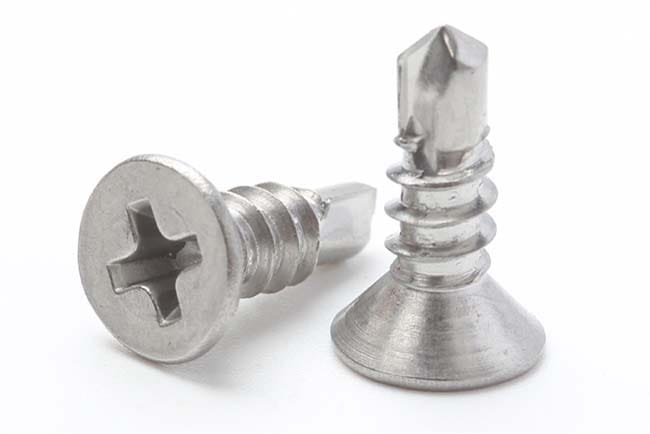
This distinction is particularly important in HVAC equipment, sheet-metal enclosures, appliances, machinery, and automotive assemblies. A screw that survives outdoor exposure but cannot tap the substrate is unsuitable. A screw that taps efficiently but corrodes prematurely is also unsuitable. Material selection must address both installation and service performance.
410 vs 304 Self Tapping Screws: Quick Comparison
| Selection Factor | 410 Stainless Self-Tapping Screws | 304 Stainless Self-Tapping Screws |
|---|---|---|
| Stainless family | Martensitic | Austenitic |
| Hardening route | Can be hardened through suitable heat treatment | Not hardened by conventional heat treatment; strength can increase through cold working |
| Tapping capability | Higher hardness can provide an advantage when the screw must form or cut threads in suitable sheet-metal substrates | Depends more strongly on substrate hardness, pilot-hole size, screw geometry, and cold-worked condition |
| Corrosion resistance | Useful stainless corrosion resistance, but generally below 304 in many wet or atmospheric environments | Generally preferred where corrosion resistance has greater priority |
| Typical selection direction | Sheet-metal assembly where tapping performance and point/thread hardness are critical | Softer substrates, suitable pilot-hole applications, or assemblies where corrosion resistance has higher priority |
| Key risk | Choosing hardness without evaluating corrosion exposure | Choosing corrosion resistance without verifying that the screw can create the mating thread |
| Automatic substitution? | No. A change between 410 and 304 can affect tapping torque, failure mode, corrosion performance, installation method, and qualification. | |
Why 410 Stainless Steel Is Common for Self-Tapping Screws
Type 410 belongs to the martensitic stainless steel family. Unlike austenitic 304, martensitic stainless steel can respond to hardening heat treatment. This characteristic is highly relevant to a tapping screw because the screw point and thread must withstand considerable localized loading while creating a mating thread.
A self-tapping screw normally has to displace or remove material from the substrate. If the screw threads or point are not sufficiently hard relative to the workpiece, the screw may deform before the required mating thread is established. Possible installation failures include damaged points, flattened threads, excessive drive torque, incomplete seating, or torsional fracture.
This is why 410 stainless self tapping screws are frequently considered for HVAC sheet metal, metal enclosures, appliance housings, machinery panels, brackets, and similar assemblies. However, the phrase “410 stainless” is not enough to confirm performance. Required hardness, heat-treatment condition, screw design, point geometry, substrate properties, and testing must also be defined.
Why 304 Stainless Screws Are Selected for Corrosion Resistance
Type 304 is an austenitic chromium-nickel stainless steel widely used where a combination of corrosion resistance, formability, and general industrial durability is required. Unlike 410, it is not hardened through a conventional quench-and-temper route. Austenitic stainless steel can, however, develop higher strength and hardness through cold working.
For self-tapping applications, this means 304 should not automatically be rejected as “too soft,” but it also should not be assumed to tap every sheet-metal substrate successfully. Performance depends on the manufacturing condition of the screw, thread profile, point design, pilot-hole diameter, substrate hardness, substrate thickness, and installation process.
304 can be particularly attractive when the receiving material is relatively soft or when a correctly sized pilot hole reduces the amount of work the screw must perform. It may also be preferred where atmospheric moisture, cleaning exposure, outdoor service, or other corrosion conditions make the lower corrosion margin of 410 undesirable.
Buyers can review Flybear’s stainless steel fastener range when sourcing standard or drawing-based stainless screws.
Hardness Is Critical, but the Substrate Controls the Requirement
The most important question when selecting a self-tapping screw is not simply “How hard is the screw?” It is “What material must this screw tap?”
A screw intended for thin aluminum sheet faces a very different installation condition from one used in carbon-steel sheet. Stainless steel sheet, multilayer stack-ups, coated sheet, engineering plastics, cast materials, and formed sections can all require different thread and point designs.
Buyers should define at least:
- Substrate material and grade
- Substrate hardness where relevant
- Individual sheet thickness
- Total material stack-up
- Whether a pilot hole is provided
- Pilot-hole diameter and tolerance
- Whether the screw must form or cut the mating thread
- Required engagement length
- Installation tool and speed
- Required seating and tightening condition
Without these details, comparing 410 and 304 by material name alone can lead to the wrong screw.
Thread-Forming vs Thread-Cutting Self-Tapping Screws
Thread-Forming Screws
A thread-forming screw creates a mating thread mainly by displacing the substrate material rather than cutting it away. This approach can work well in suitable ductile materials, but the pilot-hole diameter is critical. A hole that is too small can produce excessive installation torque, while a hole that is too large can reduce thread engagement and stripping resistance.
The required screw hardness must be considered together with substrate strength and ductility. A hardened 410 screw can provide an advantage in many metal applications, but excessive hardness is not an excuse to ignore the correct hole and thread design.
Thread-Cutting Screws
A thread-cutting design uses cutting features to remove some substrate material as the mating thread is generated. Cutting geometry can reduce forming forces in certain applications but may create chips. Whether this is acceptable depends on the assembly. Electrical enclosures, electronics, fluid systems, and clean equipment may have restrictions on loose chips or debris.
For either design, qualification on the actual production substrate is preferable to relying only on a generic material chart.
Self-Tapping and Self-Drilling Are Not the Same Requirement
Industrial sourcing frequently mixes the terms self-tapping and self-drilling. A self-tapping screw creates its mating thread. A self-drilling screw also incorporates a drill-point feature intended to create the initial hole in the specified substrate.
The distinction matters when comparing 304 and 410. Drilling through metal can require point hardness and cutting performance beyond those required when a correctly sized pilot hole already exists. A screw suitable for tapping a prepared hole should therefore not automatically be approved for a no-pilot-hole drilling application.
When corrosion resistance is important but a hard drilling or tapping feature is also necessary, engineers may evaluate alternative screw constructions, coatings, or other material strategies. Any such design should be qualified for the actual substrate rather than assumed to combine the best characteristics of different materials automatically.
Corrosion Tradeoffs Between 410 and 304
304 generally provides a higher level of corrosion resistance than 410 in many common atmospheric and wet environments. The difference becomes important for equipment exposed to condensation, outdoor weather, washdown, road moisture, or other corrosive conditions.
However, 304 should not be described as corrosion-proof. Chlorides, aggressive cleaning chemicals, crevices, deposits, high temperatures, and continuous wet exposure can all change stainless-steel corrosion behavior. More corrosion-resistant material systems may need to be considered when 304 does not provide sufficient service margin.
Likewise, 410 is still stainless steel, but its material selection is often driven more strongly by the need for hardness. Buyers should not assume that specifying 410 solves both installation and environmental requirements simultaneously.
Can a Coating Make 410 Equivalent to 304?
No surface finish should be described as converting 410 into 304. Passivation or a specified coating can modify the surface condition and may provide additional corrosion protection, but the underlying alloys remain different.
Coating selection for a self-tapping screw also requires special care because the point and threads experience contact and abrasion during installation. A coating that performs well on an undisturbed laboratory sample may behave differently after the screw cuts or forms its way through metal.
Buyers should specify the required finish separately from the material grade and determine whether installation testing, coating-thickness verification, or corrosion testing is required. Do not assign salt-spray hours or outdoor service life without a defined coating system, test method, substrate, installation condition, and acceptance requirement.
What Current Fastener Standards Mean for Buyers
ISO 3506-4:2025 addresses mechanical and physical properties of corrosion-resistant stainless steel tapping screws with specified grades and hardness classes. Its scope includes tapping screws made from austenitic, martensitic, ferritic, and duplex stainless steels. This reinforces an important procurement point: tapping screws need product-specific mechanical requirements, not just a generic stainless material callout.
For ISO tapping-screw threads, ISO 1478 remains a relevant thread reference where it applies. Inch-series buyers may encounter ASME B18.6.3 for machine screws, tapping screws, and metallic drive screws. The project drawing should identify the dimensional and performance standard actually required.
Do not convert “AISI 410” or “304 stainless” directly into an ISO grade or hardness class without checking the applicable standard. Material names, fastener-grade designations, hardness classes, and dimensional standards communicate different information.
410 vs 304 for Common Industrial Applications
| Application | Selection Direction | What Must Be Verified |
|---|---|---|
| HVAC sheet-metal panels | 410 is often evaluated where reliable tapping into metal is the main requirement | Sheet grade, thickness, pilot hole, corrosion exposure, screw hardness, and point type |
| Outdoor equipment enclosure | 304 may offer better environmental corrosion resistance, but tapping capability must still be proven | Substrate hardness, pilot hole, moisture exposure, finish, and installation torque |
| Appliance assembly | Either material may be possible depending on substrate and service environment | Sheet thickness, hole condition, appearance, corrosion requirement, and assembly speed |
| Automotive sheet or trim assembly | Material should follow substrate, corrosion, coating, and OEM requirements | Stack-up, vibration, installation torque, finish, and qualification requirements |
| Plastic or soft-metal component | 304 may be feasible where high cutting hardness is unnecessary | Thread-forming geometry, boss or hole dimensions, stripping resistance, and installation torque |
For vehicle-related sheet-metal and lightweight fastening applications, buyers can also review Flybear’s automotive fastener solutions when defining the complete assembly requirements.
Installation Testing Is More Useful Than Material Assumptions
A successful self-tapping screw must survive installation and produce a reliable joint. Material certificates alone cannot prove this. For OEM programs, testing should reproduce the actual substrate thickness, hole size, coatings, stack-up, installation tool, and assembly sequence as closely as practical.
Depending on the project, useful checks can include dimensional inspection, thread and point inspection, material verification, hardness testing, drive or installation torque testing, stripping behavior, and torsional performance. Corrosion testing may also be specified when the assembled environmental requirement justifies it.
Flybear provides order-defined dimensional, material, hardness, and torque-related inspection capabilities. Buyers can review the fastener quality inspection page when preparing the acceptance plan.
Common Procurement Mistakes with 410 and 304 Self-Tapping Screws
- Choosing 410 only because it is harder: corrosion requirements still need to be evaluated.
- Choosing 304 only because it resists corrosion better: the screw must still tap the actual substrate successfully.
- Ignoring the pilot-hole diameter: hole size can strongly influence tapping torque and thread engagement.
- Using “self-tapping” and “self-drilling” interchangeably: creating the mating thread and drilling the initial hole are different performance requirements.
- Specifying material without hardness: the finished tapping performance can depend on heat treatment or cold-worked condition.
- Assuming every steel sheet behaves the same: substrate grade, hardness, thickness, and coating can change installation behavior.
- Changing coatings without retesting: surface finish can affect friction, drive torque, corrosion behavior, and dimensional fit.
- Approving from a material datasheet alone: production-substrate testing is more representative of the completed screw application.
What to Include in a 410 or 304 Self-Tapping Screw RFQ
To receive a technically useful quotation, provide:
- Required screw material, such as 410 or 304 stainless steel
- Applicable ISO, ASME, DIN, customer, or other product standard
- Screw diameter, thread designation, and length
- Head style and drive type
- Point or tapping configuration
- Substrate material and grade
- Substrate hardness where available
- Individual sheet thickness and total stack-up
- Pilot-hole diameter and tolerance, or confirmation that no pilot hole will be used
- Required screw hardness or hardness class where applicable
- Corrosion environment and indoor/outdoor exposure
- Required coating, passivation, or other surface finish
- Installation tool, speed, and torque requirements where controlled
- Quantity and drawing revision
- Required material verification, hardness testing, dimensional inspection, torque testing, and documentation
Flybear supports standard and custom stainless-steel fasteners and drawing-based production. For applicable screw designs, manufacturing can include cold heading, thread rolling, machining, surface finishing, dimensional inspection, and material verification according to the order requirements.
FAQ: 410 vs 304 Self Tapping Screws
Are 410 stainless self-tapping screws harder than 304 screws?
410 can be hardened through suitable heat treatment and is commonly selected when high thread or point hardness is important. 304 follows a different metallurgical route and can gain strength through cold working rather than conventional martensitic hardening. Compare the finished screw requirements rather than raw alloy names alone.
Can a 304 stainless self-tapping screw tap into steel?
It depends on the steel grade and hardness, sheet thickness, pilot-hole diameter, screw geometry, and condition of the 304 screw. Do not assume that a 304 screw can reliably tap every steel substrate. Installation testing on the intended material is recommended for controlled OEM applications.
Will 410 stainless self-tapping screws rust?
410 is a corrosion-resistant stainless steel, but it does not provide the same corrosion behavior as 304 in many environments. Moisture, chlorides, chemicals, crevices, surface condition, and coatings can affect performance. It should not be described as rust-proof.
Which is better for outdoor equipment, 410 or 304?
304 generally offers a corrosion advantage for many outdoor environments, while hardened 410 may offer better tapping capability in suitable metal substrates. If an application needs both demanding tapping performance and strong environmental corrosion resistance, the complete screw design, surface treatment, substrate, and possible alternative construction should be reviewed rather than choosing by grade name alone.
Send the Substrate and Hole Details Before Selecting the Screw
For a quotation or technical review, send Flybear the substrate material and thickness, hardness if known, pilot-hole condition, screw diameter and length, thread and point design, head and drive type, required hardness, corrosion environment, finish, quantity, and inspection requirements. Use the Flybear contact page to submit drawings or samples. Defining the workpiece and installation conditions at the RFQ stage allows 410 vs 304 self tapping screws to be evaluated on both tapping performance and corrosion requirements rather than material reputation alone.
Follow Me!