Duplex 2205 vs Super Duplex 2507 Fasteners for Chloride Environments
2205 vs 2507 fasteners should be selected by comparing the actual chloride environment, corrosion mechanism, mechanical requirements, product standard, manufacturing condition, and mating materials—not by assuming that super duplex is automatically necessary whenever salt or seawater is present. Duplex 2205 and super duplex 2507 both combine austenitic and ferritic phases, but 2507 is more highly alloyed and is generally selected when additional resistance to chloride-induced pitting, crevice corrosion, and stress corrosion cracking is required.
For marine, desalination, offshore, chemical-processing, and industrial OEM applications, the difference can affect both technical performance and procurement cost. Buyers should therefore specify the exact UNS or EN grade, finished-fastener requirements, dimensions, surface condition, inspection scope, and service data rather than placing a generic order for “duplex bolts.”
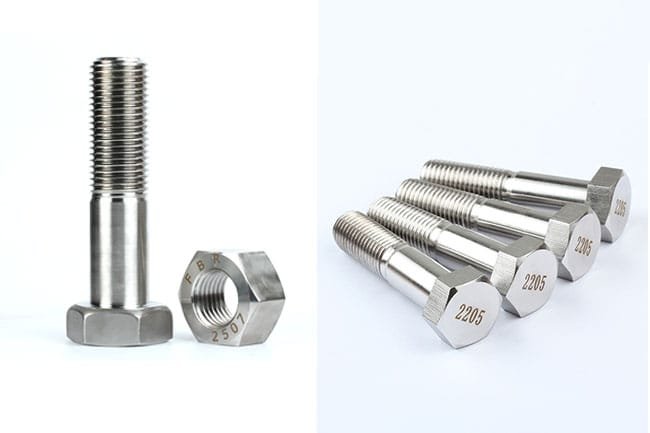
2205 vs 2507 Fasteners: Key Differences at a Glance
| Selection Factor | Duplex 2205 Fasteners | Super Duplex 2507 Fasteners |
|---|---|---|
| Material family | Duplex austenitic-ferritic stainless steel | More highly alloyed super-duplex austenitic-ferritic stainless steel |
| Common UNS designations | UNS S31803 or S32205, depending on the required specification | UNS S32750 |
| Common EN material reference | EN 1.4462 | EN 1.4410 |
| Alloying direction | High chromium with molybdenum and nitrogen | Higher chromium, molybdenum, and nitrogen alloying than 2205 |
| Chloride corrosion selection | Strong option for many chloride-bearing industrial environments when project conditions are within the approved material envelope | Often considered when chloride severity, temperature, crevices, process chemistry, or corrosion allowance requires additional margin |
| Mechanical strength | High strength compared with many conventional austenitic stainless grades | Generally provides a higher strength level in comparable material specifications |
| Typical procurement decision | Select where its corrosion and mechanical properties meet the project specification without unnecessary alloy cost | Select when engineering review requires the additional corrosion or mechanical capability of super duplex |
| Automatic substitution? | No. 2205 and 2507 are different material grades and should not be substituted without approval against the governing specification. | |
What Are Duplex Stainless Fasteners?
Duplex stainless steels are called “duplex” because their microstructure contains both ferritic and austenitic phases. This differs from conventional 300-series stainless steels, which are primarily austenitic. The duplex structure, combined with chromium, molybdenum, nitrogen, and other controlled alloying elements, provides a useful combination of corrosion resistance and mechanical strength.
For fasteners, however, the raw alloy name is only the starting point. Material processing, forming, machining, heat treatment, cold work, thread production, and final microstructure can affect performance. A correct UNS chemistry alone does not guarantee that a finished bolt, stud, or nut complies with the mechanical and metallurgical requirements of the purchase specification.
Buyers sourcing bolts, studs, nuts, washers, and drawing-based components can review Flybear’s stainless steel fastener range and then provide the exact duplex grade required by the project.
Duplex 2205: When It Is the Practical Choice
Duplex 2205 is widely used where conventional austenitic stainless steels do not provide sufficient resistance to chloride-related corrosion or where higher mechanical strength is useful. The 2205 family is commonly referenced through UNS S31803 or S32205, while EN 1.4462 is frequently encountered in European specifications.
In procurement documents, buyers should not casually replace S31803 with S32205 or describe both simply as “2205” when the project identifies an exact UNS number. Their chemistry requirements are not identical. If material is offered against more than one designation, verify the actual material certificate and purchaser acceptance requirements.
Typical areas where 2205 may be evaluated include:
- Process equipment handling chloride-bearing water
- Water-treatment and desalination equipment under suitable service conditions
- Marine and coastal equipment where the corrosion assessment supports 2205
- Chemical-processing machinery and pumps
- Heat-exchanger and cooling-water equipment
- High-load structures requiring corrosion resistance
- OEM assemblies where both strength and corrosion resistance influence material selection
The word “chloride” alone is not enough to approve 2205. Concentration, temperature, oxygen level, pH, deposits, crevices, flow conditions, contaminants, and cleaning procedures can all influence the corrosion mechanism.
Super Duplex 2507: Why Buyers Upgrade
Super duplex 2507, commonly identified as UNS S32750 and EN 1.4410, contains higher levels of key alloying elements associated with localized corrosion resistance than standard duplex 2205. This gives 2507 a stronger position where resistance to pitting and crevice corrosion in aggressive chloride-containing service is a major design requirement.
Common applications considered for super duplex fasteners include offshore equipment, seawater systems, desalination equipment, chemical processing, high-chloride process streams, and other assemblies where engineering specifications require additional corrosion margin.
That does not mean every coastal or seawater fastener should automatically be 2507. Material selection should account for the actual exposure and the design of the connection. An exposed bolt washed by rain behaves differently from a permanently wetted threaded joint, a gasketed crevice, a submerged assembly, or a component exposed to concentrated brine.
For broader application considerations, see Flybear’s marine and offshore fastener solutions.
Chloride Corrosion: Why 2507 Can Provide More Margin
Pitting Corrosion
Chloride ions can destabilize the passive film on stainless steel and initiate localized pits. Chromium, molybdenum, and nitrogen are important elements in resistance to this mechanism. Because super duplex 2507 contains a higher alloying level than 2205, it generally provides greater pitting resistance under comparable material and surface conditions.
Crevice Corrosion
Fastener assemblies naturally create possible crevice locations beneath bolt heads, nuts, washers, gaskets, deposits, and overlapping components. Local chemistry inside these restricted areas can become more aggressive than the bulk environment. Consequently, an alloy that performs acceptably on an open surface may require additional review when the same environment is trapped inside a threaded or shielded region.
Chloride Stress Corrosion Cracking
Duplex stainless steels are well known for improved resistance to chloride stress corrosion cracking compared with many conventional austenitic stainless steels. However, neither 2205 nor 2507 should be described as immune to every cracking mechanism. Stress level, temperature, chloride chemistry, hydrogen exposure, sour-service conditions, manufacturing condition, and cathodic protection can change the risk.
This is why Flybear does not recommend using a universal chloride concentration or temperature limit to choose between the two grades. The project’s corrosion engineer or governing material specification should define the acceptable operating envelope.
PREN Is Useful, but It Is Not a Complete Fastener Selection Rule
The Pitting Resistance Equivalent Number, commonly shortened to PREN, is frequently used to compare the relative pitting resistance of stainless steel compositions. It reflects the contribution of important alloying elements such as chromium, molybdenum, and nitrogen.
Super duplex 2507 generally has a higher PREN than duplex 2205, which helps explain its stronger resistance to localized chloride corrosion. However, buyers should not purchase fasteners by PREN alone.
Actual performance also depends on microstructure, heat treatment, phase balance, inclusions, surface condition, fabrication history, welding, cold work, and the service environment. A calculated alloy index cannot replace qualification to the material and finished-product requirements in the purchase order.
Strength Is Another Reason to Compare 2205 and 2507
Duplex stainless steels can provide substantially higher strength than many conventional austenitic stainless steels, which is one reason they are used for highly loaded corrosion-resistant components. Super duplex 2507 can also provide a higher mechanical property level than 2205 under common material specifications.
For fasteners, however, do not copy mechanical values from a plate, pipe, or forging datasheet and apply them automatically to a finished bolt. Mechanical requirements depend on the applicable fastener standard, product size, material condition, manufacturing process, thread geometry, and testing requirements.
A higher material strength also does not automatically justify a smaller bolt. Joint design must consider preload, fatigue, thread engagement, bearing stresses, flange or equipment design, mating components, installation procedure, and the governing design code.
UNS S31803, S32205 and S32750: Specify the Exact Grade
The phrase UNS S31803 S32750 sometimes appears in sourcing searches when buyers are comparing duplex and super duplex fasteners, but these are separate UNS designations.
- UNS S31803: a duplex stainless steel designation associated with the 2205 family.
- UNS S32205: another commonly specified 2205-family designation with its own chemistry requirements.
- UNS S32750: the common UNS designation for super duplex 2507.
Do not write only “duplex 2205 equivalent” or “2507-type material” on an application-critical RFQ. State the exact UNS, EN, or other governing grade and identify which standard establishes the material requirements.
ASTM, ISO and EN References Require Careful Interpretation
Duplex materials can appear in multiple product and material standards, but a material standard for bar, plate, pipe, or forgings is not automatically a finished-fastener standard. For example, ASTM and EN specifications may define duplex bar or forging materials used as manufacturing input, while the finished bolt or stud can require separate dimensional, mechanical, thread, marking, and testing requirements.
ISO 3506-1 includes duplex stainless steel grades within its scope for corrosion-resistant bolts, screws, and studs, but an ISO property-class designation should not be assumed merely because the raw material is called 2205 or 2507.
The same caution applies when comparing duplex fasteners with austenitic ASTM pressure bolting. ASTM A193 B8/B8M follows a different grade and class system. See ASTM A193 B8 vs B8M bolting when the project is evaluating ASTM austenitic stainless pressure bolting rather than duplex material.
Manufacturing Control Matters More with Duplex Materials
Duplex performance depends on maintaining an appropriate microstructure. Excessive or poorly controlled thermal exposure can create undesirable phases or change the ferrite-austenite balance, potentially affecting corrosion resistance and toughness. This makes manufacturing-route review important for hot-forged or thermally processed duplex fasteners.
Depending on product geometry and the applicable specification, manufacturing may involve cold heading, hot forging, CNC machining, and thread rolling. The appropriate process depends on material grade, diameter, geometry, quantity, required mechanical properties, and inspection requirements.
For custom fasteners, buyers should provide the final drawing rather than specifying only the raw bar grade. Head dimensions, under-head radii, shoulders, thread runout, thread length, tolerances, and machining details may affect both manufacturability and inspection.
Surface Finish, Coating and Mating Materials
A duplex or super duplex base material does not eliminate the need to define surface condition. Machining contamination, embedded iron, scale, inappropriate blasting media, or fabrication residue can affect stainless surfaces. Where required by the project, cleaning, pickling, passivation, or another specified finishing process should be stated on the order.
Coating should not be added automatically to an already corrosion-resistant duplex fastener. The finish must be compatible with the assembly, environment, installation procedure, electrical potential, and project specification.
Mating materials also matter. Duplex fasteners may contact carbon steel, stainless steel, aluminum, nickel alloys, or other structural materials. In wet conductive environments, galvanic effects should be considered. In offshore structures using cathodic protection, hydrogen-related cracking risks can also require project-specific review, particularly for highly stressed components.
Inspection and Documentation for Duplex Stainless Fasteners
For critical duplex and super-duplex orders, material verification should be defined before production. Depending on the project specification, the purchaser may request:
- Material certificates and heat or lot traceability
- Chemical composition verification
- Mechanical testing required by the applicable specification
- Hardness testing where specified
- Metallographic or microstructure evaluation where required
- Dimensional and thread inspection
- Surface-condition or finish verification
- Additional corrosion or qualification testing when specified by the project
Testing should follow an agreed acceptance standard rather than an informal comparison between alloys. Buyers can review Flybear’s fastener quality inspection capabilities when preparing order-specific dimensional, mechanical, material, metallographic, and documentation requirements.
Common Procurement Mistakes with 2205 and 2507 Fasteners
- Ordering only “duplex bolts”: the exact UNS or EN grade remains unclear.
- Assuming 2507 is always required near seawater: actual exposure and corrosion design should control the selection.
- Using a universal chloride threshold: chloride concentration alone cannot define material suitability.
- Applying pipe or plate properties directly to bolts: finished-fastener properties require their own specification review.
- Assuming S31803 and S32205 are identical: verify the exact requested chemistry and certification.
- Substituting 2507 for 2205 without approval: an upgrade still changes the specified material and may require customer authorization.
- Ignoring manufacturing heat exposure: duplex microstructure and corrosion performance depend on suitable processing.
- Ignoring mating materials and cathodic protection: the fastener must be evaluated as part of the complete assembly.
What to Include in a Duplex or Super Duplex Fastener RFQ
For accurate technical review and quotation, provide:
- Exact UNS, EN, ASTM, ISO, or project material designation
- Product type: bolt, screw, stud, threaded rod, nut, washer, or custom component
- Diameter, thread system, pitch, length, and thread length
- Dimensional standard or controlled drawing and revision
- Required mechanical properties or property class
- Chloride concentration or water chemistry where available
- Operating and design temperature
- pH, process chemicals, H2S, oxygen condition, or other relevant service information
- Whether the joint is submerged, splashed, atmospheric, or exposed to crevices and deposits
- Mating materials and any cathodic protection system
- Coating, surface finish, cleaning, or passivation requirement
- Quantity and manufacturing documentation
- Required material certificates, testing, inspection, and traceability
FAQ: 2205 vs 2507 Fasteners
Is super duplex 2507 always better than duplex 2205?
No. 2507 provides additional alloying, corrosion resistance, and generally higher mechanical capability, but that does not make it necessary for every application. If 2205 meets the corrosion, mechanical, and project requirements, specifying 2507 can add material and procurement complexity without providing a required engineering benefit.
Can duplex 2205 fasteners be used in seawater?
Do not approve 2205 for seawater from the alloy name alone. Temperature, chloride level, oxygen, flow, crevices, immersion conditions, deposits, mating materials, and project corrosion criteria must be reviewed. More aggressive conditions may lead engineers to specify super duplex 2507 or another material.
Are S31803 and S32205 the same material?
They are both associated with the 2205 duplex family, but their specified chemistry requirements are not identical. Use the exact UNS designation required by the project and verify certification before accepting a substitution or dual designation.
Can 2507 replace 2205 without engineering approval?
It should not be treated as an automatic substitution. Even when the more highly alloyed material appears to exceed certain performance requirements, changing the specified grade can affect qualification, documentation, mating-material strategy, manufacturing, cost, and project compliance.
Does a higher PREN guarantee that a fastener will not corrode?
No. PREN is a useful comparative indicator for pitting resistance, but actual performance depends on material condition, microstructure, surface quality, fabrication, temperature, chemistry, crevices, stress, and other service factors.
Send the Chloride Environment and Exact Grade for Review
When requesting duplex or super duplex fasteners, send Flybear the exact UNS or EN grade, product type, dimensions, thread, chloride and service conditions, operating temperature, mating material, surface finish, quantity, drawings, and required test documentation. Use the Flybear contact page to submit the RFQ. Flybear can review standard and drawing-based stainless fastener requirements, with cold heading, hot forging, CNC machining, thread rolling, surface finishing, dimensional inspection, and material verification considered where applicable to the specified product and order.
Follow Me!